












The Puerto Rican superstar, I discovered, could not disappoint a fan.
It is a parable for the decline of the mainstream media: About 25 years ago, I was the bureau chief of the Associated Press for the Caribbean, based in Puerto Rico, where we published an entire local news service in Spanish and employed some two dozen staffers. Today I am no longer with AP, and AP no longer has a significant bureau in Puerto Rico. Not all change is good.
Ah, but how we lived the vida loca! I initially resisted speaking Spanish, figuring that since the island was a US territory its residents should adjust to me. One night in the streets of Old San Juan, where the beer truly flowed like wine, I encountered one of our staffers en flagrant delicto of drunkeness. Emboldened, she told me something that changed my life: “¡Si quieres ser el jefe de los puertorriqueños, tienes que hablar español con ellos!” I vowed to do just this, and it improved my standing somewhat with the staff.
One among this multitude, whom we shall call Manuel, owned the arts and entertainment beat, and Puerto Rico had no shortage of either. Back then, it seemed hardly a day went by without some Boricua celebrity making a splash even in the “mainland.” The scandalously magnetic actress Jennifer Lopez. The singer Mark Anthony, whose succession of wives was destined to include her. For a few years perhaps the most impactful was Yankees slugger Bernie Williams, who hailed from my adopted home of San Juan. Even the non-local journo-icon Hunter Thomson got in on the act, revealing in a book around that time that he had spent years as a young pencil on the island.
There were countless others, but none compared to Ricky Martin, graduate of the boy band Menudo who became fantastically famous for singing “La Copa de la Vida,” the tournament anthem at the 1998 World Cup (which was also memorable, if less so, for France winning the whole thing on home soil).
I thought it a silly song for a silly sport, but soon I was sold on the singer: the guy had some seriously excellent tunes! I recommend “La Bomba,” but really you can’t go wrong: Electrifying rock-pop with smooth vocals layered over upbeat tempos exploding with horns and percussion is what you’ll find in what Rolling Stone referred to as his “Caribbean hothouse”
It is difficult to overstate the Martin mania that gripped Puerto Rico then, and also in the United States, where he was constantly on TV (a showstopping performance at the Grammys) with a near-native command of English that sadly is uncommon on the island.
And among his ardent fans was little Maya Perry, my daughter. Whenever she identified his songs (and sometimes others) she would commence jumping around with celebratory waving and shouts of “Mickey Martin!” I considered this too adorable to correct and let it be.
So you can imagine my approval when Manuel announced that he had scored an interview with the great man himself, to be conducted the next day. My approval was considerable indeed.
Now, AP bureau chiefs at the time came in two varieties. Some were journalists through and through, ink-stained wretches to the last. But others succumbed to the allure of being a business-person. They wore slightly fancier clothes, troubled themselves with “budget performance” and dutifully tended to the subscriber media operations, striving to “upsell” services, upgrade delivery mechanisms, and such. It may surprise some readers to learn that I was flirting with the latter model at the time, maintaining some distance from the “snappers” and the “scribblers.” Not for me their sweaty jostling for position! A garish, grasping, and indecorous display.
But there was nothing decorous about my excitement as I informed Manuel that I would accompany him to the interview along with our photographer.
And so it was that we drove the El Conquistador, a plush resort perched on a cliff in the island’s northeastern corner, in one of whose suites awaited Ricky Martin. He was now living in Miami and back for a visit, preparing for a massive concert and hawking his new English-language album (see below).
It is an odd sensation, meeting extremely famous people — never mind a sex symbol (rumored correctly to be gay). You never quite get used to it. Fawning over them is for morons strictly. But one mustn’t be rude either. On still the other hand, don’t be too familiar. Do you feel that their proximity makes you yourself important? Do you think they’re now your friend? These things are just sad, for no one is actually important and your actual friends are few.
I have trained myself to be interested but emotionally indifferent, and mostly I’m just struck by how ordinary they tend to be – because naturally they are. But there are always exceptions. And there was nothing natural-seeming about the exception called Ricky Martin.
At six-foot-one, then 28 years old, he seemed sculpted from a magical plasteline, then buffed and scrubbed and shined by tireless elves. Dressed in black slacks and tight shirt that could have been painted on, he greeted Manuel and me with a blindingly dazzling smile and a finger-crushing handshake — as his handlers kicked the photographer out of the room.
“No photos of Ricky except publicity shots,” one said. “You guys got 20 minutes.”
We sat down for our chat. Ricky – I think I can call him that by now – gamely touted his new album, but soon emerged to be a man on a bigger mission: to correct what he viewed as the often negative and inadmissibly distorted image of his people. He said he emphasizes his Puerto Rican origins to anyone who will listen: “It’s part of my flesh, and I need to share it. It’s about letting people know the beauty of my island.”
Why does he feel it necessary?
“Unfortunately, there are classics in the theater about Puerto Rican gangs,” he lamented – apparently referring to “West Side Story” and its depiction of Puerto Ricans in New York. “It’s very important for everyone to get rid of stereotypes.”
Why is that his business?
“It’s a mission. We have the opportunity to talk to masses of people … Let’s create some consciousness, and let’s talk about humanitarian issues … Yes, I’m a leader. A lot of people follow my career, follow my music, and I have to let them know (what) I’m concerned about.”
Well, if such a leader, does he want to be an auteur? I asked Ricky whether he would like to write his own songs — like Bob Dylan, or perhaps Paul Simon, or Billy Joel. Back then, in the Before Times, singer-songwriters mattered. But Ricky, a man of the future, swatted this aside.
“I’m not a writer, man,” he said. “I’m a storyteller.”
It is at this point in most interviews that I feel the itch to provoke a little. To get the subjects just a little off balance. So I asked him whether Puerto Rico – which is a US “territory” whose people cannot vote in presidential elections – should be the 51st state. Ricky said he voted in the 1998 referendum in which voters rejected U.S. statehood, but refused to reveal whether he supported statehood, independence or the in-between status quo. I pressed a little. “Let’s not go there,” was his reproach. The man knew media.
Does he view Puerto Rico as a separate country?
Pause. Then, with quiet determination: “Yes. I do. I do. I do.”
Does he feel American?
No pause. “I’m Puerto Rican. In America, I never felt American. I don’t know – it’s like going to China and trying to feel Chinese.”
Martin had recently joined the struggle to expel the US Navy from its bombing range in outlying Vieques Island – which a few years later would achieve its goal. Martin had pushed the issue during a visit at the White House. Standing up, he gazed at Vieques, clearly visible across seven miles of deep blue waters where the Atlantic Ocean meets the Caribbean Sea. “What comes to mind when I look at Vieques? Just a beautiful island with amazing people who deserve a little bit of serenity and tranquility.”
A thought occurred to me as I saw him there, by the window.
“Listen, Ricky, I gotta tell you something,” I said.
He seemed to forget all about Vieques, genuinely concerned. If necessary, I felt sure, he would write a song for me.
“The thing is that I have a four-year-old girl who is, well, just a massive fan of yours. Now, I know that pictures are forbidden. I do. But she would be so excited if, uh, if…”
I produced the little camera that I had with me always in my pocket in those chino-wearing, pre-smartphone days. Martin’s handlers froze, as if they’d seen a gun. For a second I thought that anything might happen. Manuel seemed terrified for his life.
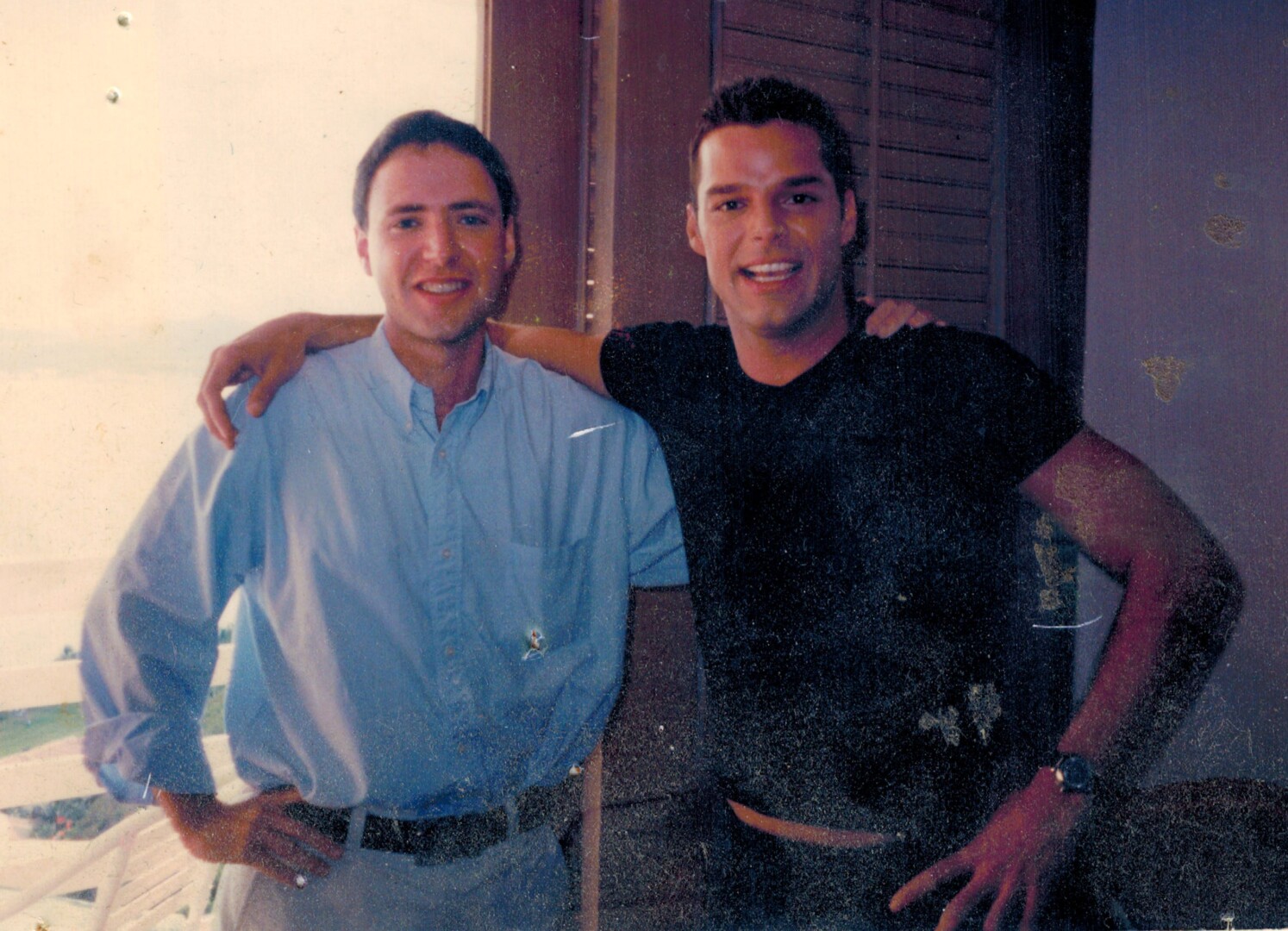
Ricky Martin grabbed the camera out of my hand before I knew what was going on. He tossed it gently to the most capable of his handlers, seized me by the arm and positioned us by the window. “Let’s do it!” he barked.
The handler did as he was told.
I had the film developed on the way home, and that evening presented Maya with the photo. Her little face lit up.
“Mickey Martin!” she cried, looking at the image. Then, confused, “Daddy,” pointing at me. She went back and forth, perplexed. “Mickey Martin … Daddy… Mickey Martin …”
She looked up at me and asked: “But why is he real?”
he looked up at me and asked: “But why is he real?”

