







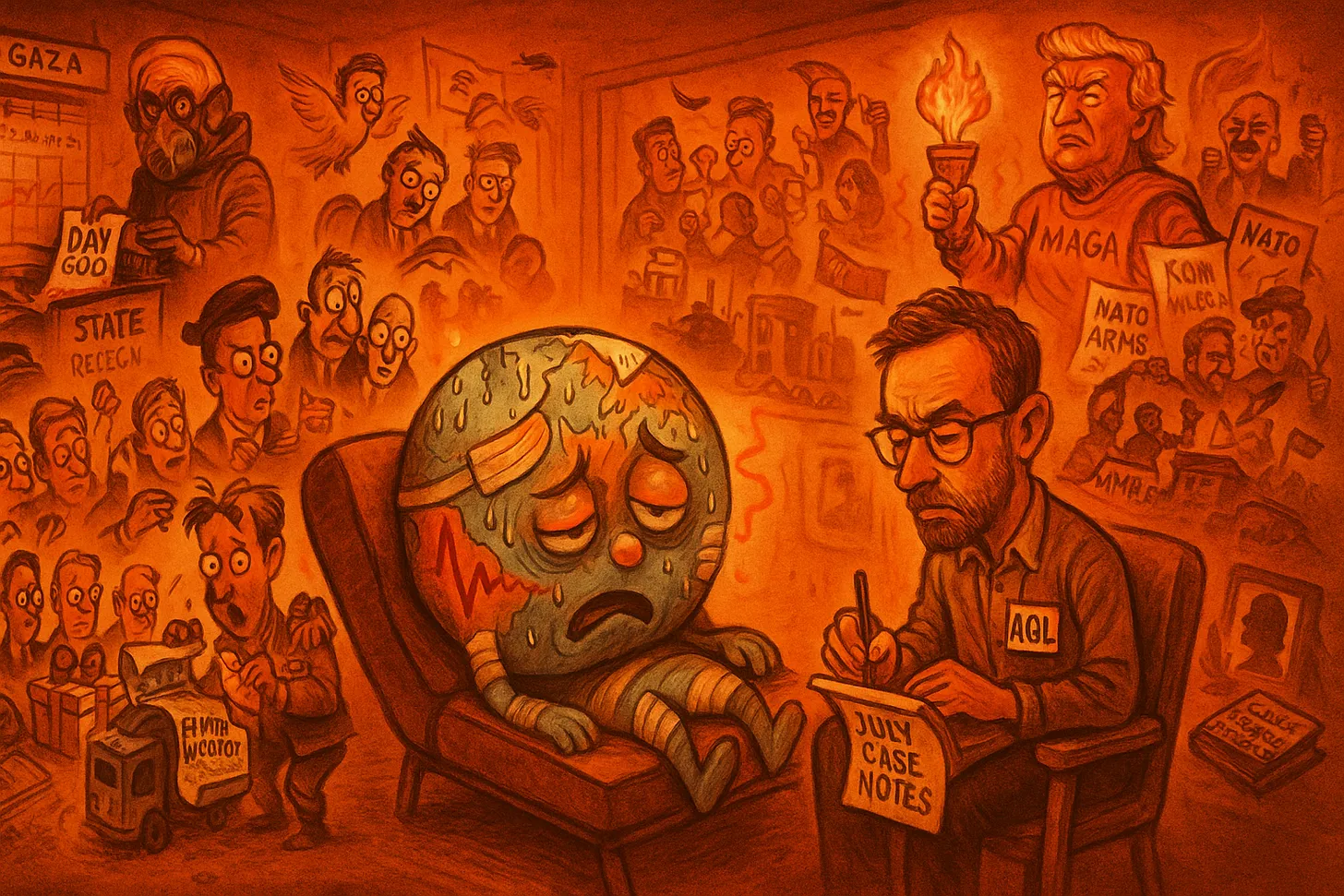
It has been a particularly scorching summer in the news. We offer a July retrospective.
uly was a month of global turbulence with overlapping crises, rising autocracy in many places, and flickers of uneasy change. Ask Questions Later was all over it, offering geopolitical commentary by Dan Perry and contributions from Afghanistan’s General Haibatullah Alizai, globetrotting journo Larry Luxner, tech titan Ronni Zehavi, and the intrepid Gen Zer Luca Wolfe Murray.
We explained why the Gaza war must end — and what a real roadmap to peace would look like — but also warned that Western recognition now of Palestinian statehood would backfire by empowering Hamas just as the Arab nations are finally deserting it. We dissected Trump’s unraveling of American governance, the problems and made the capitalist case against inequality. We highlighted the importance of the new NATO plan to arm Ukraine, argued for isolating Myanmar’s junta, covered the Taliban’s rise and Syria’s dangerous decline, and even traced an Armenian photographer’s legacy in the Holy Land.
The coming month, far from a time of les vacances, may actually prove pivotal on many of the issues that affect all of us in this interconnected and turbulent world. We plan to be there to help connect the dots. Join our growing community!
Meanwhile, for anyone who may have missed, here’s a collection of Ask Questions Later offerings from the hottest of Julys.
Time to end the Gaza War
The Gaza war has gone on too long, with no clear endgame and devastating consequences for both Palestinians and Israelis. Israel has eliminated much of Hamas’s leadership and infrastructure, yet the group remains ruling over the ruins of Gaza. A strategic roadmap is urgently needed—one that offers Gazans a binary choice: continue under Hamas and remain sealed off and impoverished, or disarm and welcome international reconstruction and governance by a reformed Palestinian Authority backed by Arab states. This would unlock massive Gulf funding and global support, creating a path to prosperity. That said, we also argued that unilateral recognition of a Palestinian state by France and the UK would backfire, since it would reward Hamas just months after the Oct. 7 massacre, hardening Israeli opposition to territorial compromise — precisely as the Arab nations are finally calling on the jihadists to disarm. And lastly, our comprehensive The Trouble with Bibi explained why under him Israel faces existential peril: Netanyahu prolongs war, rejects peace, erodes democracy, empowers extremists, alienates allies, and sacrifices hostages. His legacy is corruption, moral collapse, and national decline, and if he stays in power Israel may actually not survive (sounds exaggerated? read it and see).
The Trouble With Trump

Ask Questions Later asked (and answered) the question of the moment: what on earth is going on with Trump? In a blistering two-week series, we dissected the systemic wreckage of American governance under Trump’s second term. They chronicle an unraveling: presidential immunity that flirts with monarchy, tariffs that punish Americans, the gutting of FEMA during natural disasters, a resurgent measles outbreak due to anti-vax misinformation, and a tax bill enriching the wealthy at the poor’s expense. Trump is undermining institutions, meddling in foreign judicial systems, and pressuring the Fed. The verdict: a democratic backslide veiled in chaos and populism. But we also offered a rare partial defense of Trump’s controversial executive order on federal elections: The core ideas in the order — national voter ID, proof of citizenship, and firm ballot deadlines — are reasonable and common in other democracies. And the current U.S. election system is chaotic, inconsistent, and vulnerable to mistrust.
The AI paradox: Master it – but don’t use it?

RONNI ZEHAVI, a serial tech entrepreneur, explained how despite AI’s growing presence across industries and education, its use remains stigmatized. Institutions demand proficiency in AI while punishing open reliance on it, creating a paradox: we must master tools we can’t admit using. This tension stems from outdated standards clashing with modern tools and our need to measure genuine effort. Transparent, thoughtful AI use should be treated as a skill, not a shortcut. But boundaries matter: education still requires testing unassisted ability. The challenge is to embrace AI without hollowing out human competence. Institutions that balance integrity with innovation will thrive; those that don’t risk promoting mediocrity.
The capitalist case against extreme inequality

The “Big Beautiful Bill,” passed by Republicans on July 4, slashes taxes for the ultra-rich while cutting healthcare and food aid for millions, deepening America’s already extreme inequality. The richest 0.1% gain massively, while most Americans struggle with stagnating wages and soaring costs. With CEOs now earning 340 times the average worker and 60% of Americans unable to cover a $1,000 emergency, the US is courting social instability. So we argued for focused reforms — wealth taxes, capital gains equality, executive pay caps — to curb oligarchy. If not, a real anti-capitalist backlash may emerge, threatening the legitimacy of free markets themselves.
Isolate Myanmar
Myanmar’s brutal military junta, lacking both strategic value and economic clout, presents a rare opportunity for meaningful global action. We argued that this tyranny — responsible for war crimes, ethnic cleansing, and the imprisonment of Aung San Suu Kyi — can and should be isolated. Unlike oil-rich autocracies, Myanmar offers the world nothing it can’t live without. A coalition of democracies should lead efforts to sever the regime’s access to global markets, freeze assets, suspend diplomatic recognition, and redirect humanitarian aid to civil society. This is a crisis the world can actually do something about.
Trump and NATO changed the Ukraine War
Trump and NATO’s new weapons corridor to Ukraine — structured as arms sales— signals a surprising shift: US support is back, if indirectly, and Putin has reason to worry. While Trump maintains deniability for his MAGA base, the move reinforces NATO’s role and grants Ukraine time. If Putin presses on, Trump could impose crushing tariffs on Russia’s trade partners. In How the East was Lost, we reflected on how Richard Nixon, flawed but astute, warned that if freedom failed in post-Soviet Russia, a new, dangerous despotism would rise. The West’s naïve triumphalism paved the way for Putin’s empire, and today’s far less sophisticated leaders are reaping the consequences of that historic miscalculation.
Prominent Druze in US warns: ‘Don’t trust Syria’
LARRY LUXNER interviewed the surprising woman who is arguably the most prominent Druze in the United States, hearing her warning against trusting Syria’s new regime under President Ahmed al-Sharaa. The former jihadist leader has portrayed itself as reformed and pragmatic, gaining Western support and easing of sanctions. Sharaa has made overtures to Israel and distanced himself from extremist rhetoric. However, his image is unraveling amid a brutal military crackdown in the Druze-majority region of Suwayda, where massacres echo ISIS-style atrocities. Eyewitnesses report executions, rape, and terror by regime-linked forces. Sharaa’s past in jihadist militancy, his purging of Alawites, and the regime’s apparent complicity in sectarian violence are casting serious doubt on his legitimacy and the international community’s rush to rehabilitate him.
Afghanistan is on fire again — and the world is watching it burn
GENERAL HAIBATULLAH ALIZAI — the last chief of the Afghan army before the Taliban return — wrote that the world is ignoring a mounting global threat. In a searing essay, he warned that mass deportations of Afghan refugees from Iran are fueling extremist recruitment while the Taliban make inroads with Russia and hand Afghanistan’s resources to China. The regime, he argued, is irredeemable — a radical syndicate allowing ISIS-K and al-Qaida to regrouping, making Afghanistan again a haven for chaos.
Fear and Loathing in Driving School

LUCA WOLFE MURRAY provided a sidesplitting recollection of his attempt to get a Romanian driver’s license — a journey marked by fake medical exams, racist and abusive driving instructors, and a theory test full of obscure trivia. Drawn by cheaper prices and quicker scheduling than in England, Luca expected efficiency but found chaos. After five lessons he abandoned the effort, wiser but unlicensed.
An Armenian in the Holy Land

LARRY LUXNER weaved the take of Armenian Genocide survivor and photographer Elia Kahvedjian, who just had a square named for him near Jerusalem’s Damascus Gate in a rare act of solidarity with Armenians. While Israel still hasn’t formally recognized the 1915 genocide, the gesture, using the Hebrew term for genocide, was highly symbolic as the nations seek reconciliation.
