















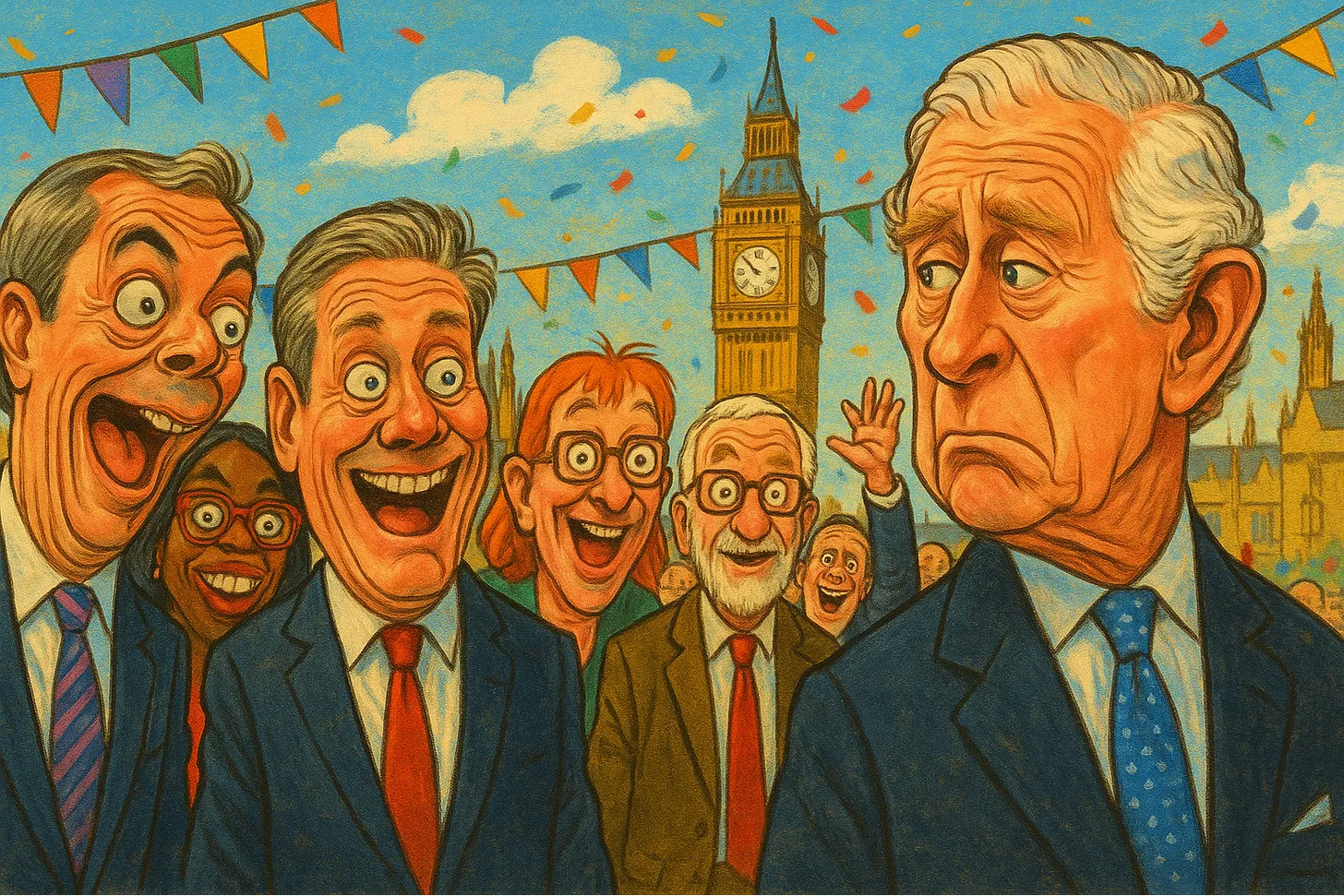
This article is the first in a series about political systems that may be no longer fit for purpose, distorting ideological reality or yielding unworkable outcomes
In the next British general election, voters will confront a political field more fractured than at any time in recent memory. In addition to Labour and the Conservatives you’ll have the far-right Reform UK, the centrist Liberal Democrats, Jeremy Corbyn’s new progressive party, the Scottish National Party, and smaller regional contenders.
To support the defense of democracy, decency and reason, consider unlocking full access to Ask Questions Later by upgrading to a Paid Subscription (unless you have one!)
Britain’s first-past-the-post (FPTP) system, in which each of the 650 parliamentary constituencies elects a single MP by simple plurality, was never designed to handle this degree of fragmentation. It was meant to create stability by inflating even small pluralities that are evenly distributed. Theoretically, a party could win every seat by a single vote — controlling the country completely with just 650 more votes than its rival. It’s a ludicrous but revealing scenario: the system prioritizes distribution over proportion. You could lose the popular vote by millions and still walk away with nearly all the power.
The system was built for a simpler world. For decades, one of the two major parties reliably won a clear, inflated majority. The idea of no outright winner was so alien it earned its own ominous label: the “hung parliament.” Wonder greeted the coalition of 2010 — a mundane European outcome treated in Britain as an exotic aberration. But the age of inflated majorities may be over. If FPTP remains unchanged, it will start generating bizarre results and unstable alliances stitched together by happenstance.
This chaos is one of Brexit’s many unintended consequences. The 2016 vote shattered the postwar consensus and scrambled political alignments. It birthed Reform UK, which channeled nationalist-populist energy into a durable anti-establishment force.
Last year’s election captured the new reality: Labour under Keir Starmer was declared the “landslide” victor, though its vote share rose only slightly from Jeremy Corbyn’s catastrophic 2019 loss. What changed was not Labour’s appeal but the Conservatives splitting their vote with Reform UK. Labour’s 34 percent looked like triumph only because the right fractured, which the system punishes. Taken together, the right actually won more votes. Reform now leads everyone, including Labour, in most polls — partly because the Tories look like losers.
The Conservative Party’s 2025 conference in Manchester had the tragicomic air of a family reunion where no one remembers why they’re related. Polling at a dismal 16 percent, the Tories are trapped in a political no-man’s-land: too right-wing for centrist voters, too cautious for the populist right now rallying behind Nigel Farage’s Reform UK. Kemi Badenoch, elevated as a symbol of renewal after a series of underwhelming leaders, commands little loyalty or authority within her own ranks. Cabinet ministers mutter about uniting with Reform, while moderates recoil at the idea of following Nigel Farage into full nationalist theater.
Policy-wise, the party flails for identity. It promises tax cuts, sweeping spending reductions, and a “Removals Force” to deport migrants — a mix of libertarian economics and authoritarian posture that pleases no one. The climate retreat and anti-immigrant rhetoric are meant to shore up the base, but they only underscore desperation. Even business leaders, once the party’s natural allies, grumble about instability and short-term populism.
The Conservatives’ real problem isn’t ideology but irrelevance. Britain’s old ruling party now exists in a system that no longer fits it — a two-party machine trying to operate in a five-party world.
Britain’s left has fractured again — despite the electoral system that punishes splits. Disillusioned with Keir Starmer’s moderation, Jeremy Corbyn and Zarah Sultana launched Your Party with several independents, promising to choose a name in November. A fundraising dispute quickly devolved into accusations, legal threats, and further splinter factions. Despite a rapprochement, divisions remain..
Reform UK is surging, with one Sunday Times poll suggesting it could win an outright parliamentary majority if elections were held today. The right is fractured too, but momentum is with Farage. Immigration has overtaken the economy as voters’ top concern, and Starmer struggles to shift the agenda. The recent terrorist attack in Manchester by a Syrian refugee, in which two Jews were murdered outside a synagogue, has deepened the national sense of crisis.
Starmer may take grim comfort watching his opponents tie themselves in knots — but the real danger comes from the right or even maybe from a genuine left that aims to speak to voters the way that Farage does.
One interesting recent development in the political quagmire is a surge in support for The Greens who now incredibly have more members than the Conservative Party. Since the likeable Zach Polanski became leader last month, membership has surged 80%.
The Greens are currently polling in 3rd place according to this POLITICO poll – not far behind those ahead of them — only Reform stand ahead
The thinking is for the Greens to be a Reform for the left: to make the message simple and easy to understand with their slogan ‘Tax wealth, not work,’ and ‘let’s make hope normal again.’
.
UNLOCK FULL ACCESS WITH PAID TIER
Starmer’s approval rating sits near 11 percent — the lowest of any post-war British prime minister. His managerial style, once sold as steadiness, now reads as dullness. He appears caught between a socially progressive urban base inflamed by identity politics and a working-class bloc increasingly drawn to nationalism and cultural conservatism. Reform UK is capturing the latter; Corbyn’s new movement appeals to the former. The political center may still hold numerically, but it is thinly spread, ideologically conflicted, and ill-served by a system built to ignore nuance.
Starmer’s contortions on Palestine capture this bind. Once praised for rooting out Corbyn-era radicalism and antisemitism, he now faces revolt within his own party. When he announced that the UK would recognize a Palestinian state unless Israel met a long list of conditions, the move pleased few. For many on the left it was too timid; for others it rewarded Hamas amid a war of its own making. Israel reacted with fury, and ordinary Britons wondered why this issue, and why now. The answer: votes. Labour’s support has plunged in constituencies with large Muslim populations; Corbyn is harvesting the disillusioned there.
A System in Need of Repair
The FPTP system turns all this fragmentation into chaos. Compare Britain to continental Europe, where proportional systems at least attempt to reflect popular will. Germany, France, the Netherlands — all accommodate multiparty politics. Even Israel, for all its dysfunction, does not hand absolute power to a party with a third of the vote and majority opposition. Britain alone persists in pretending the 1950s never ended.
America suffers its own version of the problem. Its FPTP structure entrenches the two-party duopoly and punishes third-party efforts — discouraging reformers who might better represent the centrist majority that probably exists. But the US limps along with two dominant parties, however problematic they may be. Britain has leapt into post-duopoly politics without fixing the rules of the game.
Reform is theoretically possible in Britain but politically perilous. A shift to proportional representation would demand legislative overhaul and threaten incumbents in both major parties. Many MPs would lose their seats; both sides fear losing dominance. And British political culture, for all its irony, remains deeply wary of change.
Without (lower-case) reform, expect growing apathy, and resentment at a democracy that increasingly resembles a lottery. Britain once exported parliamentary democracy to the world. Unless it adapts its own version to the multiparty era it now inhabits, it risks becoming a parody of itself.
As things stand, there is only one way to shoehorn method into madness. Tactical voting. Constituency-level coordination — sometimes openly, sometimes tacitly — allows likeminded parties to divide the battlefield rather than the vote. In a handful of seats last year, Greens stood down for Labour; in others, the Liberal Democrats quietly encouraged tactical Labour abstention. Reform UK and hard-right splinters are now toying with similar arrangements.
These bargains, cynical or pragmatic depending on your taste, are the electorate’s improvised fix for a system that can’t reflect its own diversity. If party elites cannot modernize the voting rules, candidates and voters will attempt to bend them in practice — constituency by constituency, deal by deal. Given Britain’s realities today, it’s either that, or a coin flip.
Alison Mutler is a veteran British journalist who has worked with the Associated Press and is currently the director of Universul.net in Bucharest
UPGRADE TO DAN PERRY’S ASK QUESTION LATER HERE
Starmer may take grim comfort watching his opponents tie themselves in knots — but the real danger comes from the right or even maybe from a genuine left that aims to speak to voters the way that Farage does.
One interesting recent development in the political quagmire is a surge in support for The Greens who now incredibly have more members than the Conservative Party. Since the likeable Zach Polanski became leader last month, membership has surged 80%.
The Greens are currently polling in 3rd place according to this POLITICO poll – not far behind those ahead of them — only Reform stand ahead
The thinking is for the Greens to be a Reform for the left: to make the message simple and easy to understand with their slogan ‘Tax wealth, not work,’ and ‘let’s make hope normal again.’
