










My parents were born in Romania. I speak the language, lived in the country for four years, and have visited countless times. I feel deeply connected to the place, to its people, its culture and history. Yet I am not a Romanian citizen, and in essential ways I am not Romanian. That distance may mean I miss certain nuances. But it can also bring clarity.
In decades of leading the journalistic coverage of over 100 countries across Europe, Africa, and the Middle East for the Associated Press, I’ve seen what makes societies different – but also what is similar. And I can say this: in almost every society, 30 to 40 percent of the population feels alienated from the system and frustrated with their lives.
Some are frustrated with corruption or stagnation. Others feel alienated by modernity, multiculturalism, or just the erosion of traditional hierarchies. Many simply feel powerless in their own lives. They are angry — sometimes with convincing cause, sometimes without — and they seek refuge in ultranationalism, conspiracies, and tribal belonging. It’s a chaos of grievances and misanthropy, united not by a coherent ideology but by shared bitterness.
When a single political force manages to consolidate that vote — as George Simion did in Romania on Sunday — it can win a plurality in an open field. Simion maxed out the disaffected. But what matters now is not that he won the first round. That is noise. The only thing that matters is whether everyone else — the majority — can unite against him in the second round. Because if they do not, Romania will follow a path trodden by many countries in recent years — into illiberalism, isolation, and national shame.
That’s why the May 4 first round is not a mandate for Simion. It’s a test for Romanians.
There are three reasons why the remaining 60% might not come together—and all are dangerous.
- Fatalism. After a strong first-round performance, the media often anoints the frontrunner as inevitable. But this is psychological, not mathematical. People, even sophisticated ones, can fall into the trap of thinking “he’s going to win anyway” — and then, by withdrawing, they help him do just that. Some even jump on the bandwagon to support the “winner.” This is how democracy collapses: not in a bang, but in a sigh of resignation.
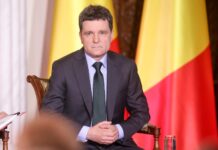
- Petty Politics. We’re already seeing this in the National Liberal Party’s Crin Antonescu’s refusal to endorse Simion’s second-round opponent, independent Nicușor Dan. That decision — driven perhaps by ego, perhaps by miscalculation — is not just petty. It is reckless. This is a moment that demands maturity, even sacrifice. We can only hope Antonescu recalculates, or that his supporters will ignore him and vote for the candidate best positioned to stop extremism.
- Personality. Simion is charismatic. He speaks with clarity. He offers easy answers to hard problems. None of them hold up under scrutiny, but in a media-saturated age, where social media can dominate the discourse, simplicity can be seductive. Even people outside his ideological tribe — educated people, urban professionals, fence-sitters — can be drawn in by his “alpha” demeanor. That could be enough to move another 5–10% of the vote.
This is critical, because Simion of part and parcel of the attack on democracy by the illiberal right – being carried out in the name of democracy.
How can this be? Because there are two versions of democracy floating around our metaphorical agora. One is liberal democracy, in which the government is constrained by a system that guaranteed individual and minority rights, an array of freedoms including of speech, assembly and protest, and by competing power centers in the legislature and judiciary. The other, which to humanity’s misfortune is represented by President Donald Trump in the United States, is a dictatorship of whoever wins the election.
Make no mistake: Whether or not he openly declares this now, Simion is part of that cabal. Its members – from Hungary’s Viktor Orban to France’s Marine Le Pen – tend to gain strength from disillusionment with globalization, from the weaponization of identity, and from the decline of trust in traditional democratic institutions.
This brand of politics insists that because it represents “the people,” it is entitled to do anything: to rewrite the rules, silence dissent, vilify minorities, and redefine reality itself. In the name of “national dignity,” leaders like Vladimir Putin (who was once also elected) and Turkey’s Recep Tayyip Erdogan have warped their societies, crushed civil institutions, and unleashed waves of division and hatred.
Simion speaks the same language. He speaks of purity. Of “Romanian values.” Of taking back control. But a Romania under Simion would find itself adrift — perhaps still tolerated by Washington, where Trump may well cheer his rise, but increasingly marginalized in Europe. The EU is not just a club. It is Romania’s main trading partner and financial lifeline.
Alienating it would yank Romania off the path of democracy and Western alignment — to a far darker place. Simion claims to support NATO but opposes military aid to Ukraine, downplays the Russian threat, and has been banned from entering Ukraine for anti-Ukrainian activities. He bashes the EU and its liberal values and would likely become tethered to global elected autocrats.
And there are domestic risks, too. Simion’s rise would pose a real threat to Romania’s ethnic minorities, especially the Hungarian and Roma communities. The Hungarian minority in Transylvania is sizable and politically active. Relations between Bucharest and Budapest have been tense at times, and a far-right government in either capital could easily inflame nationalist tensions. The Roma, meanwhile, are already among the most vulnerable and marginalized populations in Europe. A government obsessed with ethnic purity and “traditional values” would not likely offer them justice, inclusion, or opportunity. History shows us what happens when minority scapegoating becomes state policy.
Some may hope that Simion, if elected, would be constrained by Romania’s political system. But that is a dangerous bet.
Romania’s presidency is a hybrid role — not quite ceremonial like in Germany, not fully executive like in the U.S., and not a clean dual-executive like in France. It functions through nuance, coordination, and informal norms. That makes it especially vulnerable to someone who rejects norms and pushes boundaries.
A President Simion could easily paralyze governance by feuding with Parliament. He could attempt to dissolve it. He could appeal directly to the streets. He could push the envelope —as populists always do — until the system breaks. And if violence follows, as it so often does in such cases, the consequences could be disastrous while he will blame others and seek to centralize power in the presidency. That’s what Erdogan did, with success.
The good news is that there is precedent for defeating the far right through unity.
In France, every presidential election since 2002 has seen mainstream parties—left and right — come together to block the Le Pens. It worked. In 2020, Americans narrowly defeated Trump by forming a broad coalition. In 2024, that coalition faltered—and the result was a return to dysfunction and democratic decline. In Israel, even parties with deep ideological differences set aside their disputes to form a government that ousted Benjamin Netanyahu in 2021; it didn’t last, but it proved that it can be done.
In Romania, the logic is even clearer. There is no significant second far-right candidate to siphon votes from Simion. The remaining 60% need only to come together. Not forever — just for one election. And then they need to focus on making changes. That is because Romanians are not crazy for signaling they want change. Corruption lingers. Wealth has spread unevenly. Many politicians are mediocre or self-interested.
But none of that justifies burning the house down. Simion is not the solution. He is the lighter fluid.
I arrived in Romania for the first time just a few weeks after the 1989 revolution. The shelves were empty. I do not mean this metaphorically — but quite literally that stores had nothing. The spirit of the people had been broken by a regime built on lies, surveillance, and fear. Children were taught to betray their parents. The country had been cut off from the world, not for years but for decades.
And the result was not “national dignity.” It was despair, disconnection, and darkness.
Over the last 30 years, Romania has made extraordinary strides. Mistakes have been many and Balkan skullduggeries bred distrust — but it is freer, richer, more open, and more respected than at any point in its modern history.
To deny that is not “national dignity.” It is ignorance at best, and stupidity at worst.
Dan Perry, a global columnist and TV commentator, served as the Cairo-based Middle East editor and London-based Europe/Africa editor of the Associated Press and as chairman of the Foreign Press Association in Jerusalem, and is the author of two books. Follow him at danperry.substack.com.
Romania faces existential choice between West and abandoning its pro-Western path, Bucharest mayor
