











It’s just so strange that my pet peeves are not a global consensus. So I am launching my campaign for a global exorcism of the Top 10 abominations.
Yes yes, I know. Languages develop through what eggheads call mistakes. That sounds true — but there must surely be a limit! Things have gone too far. Obviously. So I will correct you. And I will own my linguistic snobbery. Using “own” here is as far as I shall go in throwing modernity a bone. Enough is enough.
If you are a fellow pedant, join us!
1. Ellipses
Once the province of great novelists who used it to trail off a thought with tragic dignity, the dot-dot-dot scourge has been hijacked by texters, emailers, and passive-aggressive colleagues. It is the equivalent of humor’s pun — the lowest form of punctuation. An ellipse implies something left unsaid, but why? If it’s worth saying, say it! If it’s not, don’t. This hovering cloud of implied meaning (“I’m not saying you’re wrong … nudge nudge, wink wink…”) is the refuge of the manipulative. It’s a swing and a miss in the pursuit of subtlety. It’s the writer’s way of saying, “I want credit for nuance, but I can’t be bothered to come up with it.” If the period is a full stop, the ellipse is stumble. It is a hint with a glint. Avoid!
2
Capitalization of Random Nouns
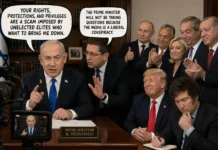
“A powerful new Book,” tweeteth Trump, in another echo of civilizational decline. The random capitalization of nouns — once a charming quirk of 18th-century English and still a legitimate feature of German — has, in his hands, become a symbol of pathological disregard for norms and expertise. It’s weirdly logical, since Trump’s ancestry is German, though there’s no evidence he knows any of that. He presumably means emphasis. But instead of elevating the word, it infantilizes it. A “Country” with a capital C is not nobler, but dumber. And the tragedy is that people imitate it, and extend the calamity to adjectives: “We have a Great Team.” “We must show True Patriotism.” What began as one man’s oddity becomes a contagion of misbegotten majuscules. Once the capital letters start marching, the lower case — democracy’s true voice — is trampled underfoot.

3. Pointless Mispronunciations
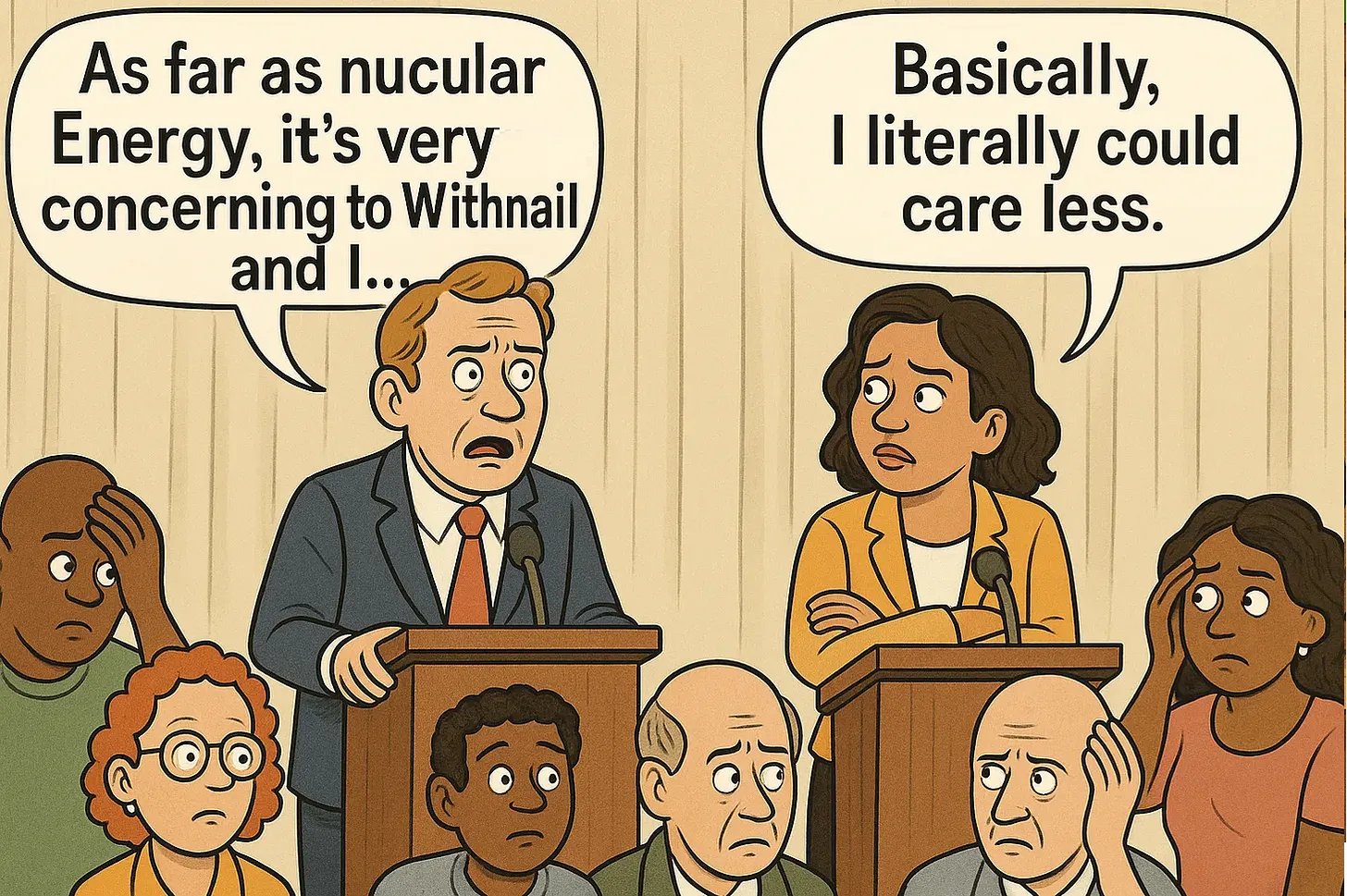
The world is already complicated enough. We have too many languages, too many words, too many letters that seem to have been assigned duties at random. The fact that laugh is spelled L-A-U-G-H rather than L-A-F is indignity enough. But if spelling is a maze, pronunciation is supposed to be the rope that leads us out. Yet we trip over it constantly. And nothing better captures the modern collapse of linguistic order than the rise — and merciful partial fall — of “nucular.” It became epidemic with George W. Bush, who single-handedly turned a perfectly simple word into a phonetic car crash. The most powerful man on earth, in command of the actual nuclear arsenal, could not pronounce it (though some suspect he was pretending). For a time, neither could much of America. It was as if the nation, in solidarity, decided pronunciation was elitist. The fact that this has receded since Bush’s presidency offers a rare glimmer of hope.
4. Apostrophes After Acronyms
You’ve seen them: “VIP’s only.” “Two NGO’s signed the deal.” “Mind your RSVP’s.” The plural is not possessive. The acronym already stands as a fortress of compression — every letter a monument to efficiency. To jam an apostrophe into it is to graffiti the Parthenon. It’s linguistic littering, committed by those who vaguely remember that an apostrophe signals something grammatical, but can’t recall quite what. Sometimes this madness extends to other words, not even acronyms, that the user must think are lonely. So et it be engraved in tablets of style: CDs, MPs, UFOs. No apostrophe’s need apply. They’re for contractions only.
5. “Literally”
“Literally” was once a noble word, meant to convey precision. Now, it has been hollowed out and refashioned as a universal intensifier, often meaning exactly the opposite of what it says. I literally died laughing, yet I am still speaking with you. It is the verbal equivalent of inflation: a currency whose value has collapsed from overuse. When everyone is “literally” something, nothing is. Much of the time we say something is literally happening when it was literally not happening, and we don’t seem to know it. This is an assault on reality for the post-truth society — all literally three syllables. “Basically” is a close cousin.
6. Misplaced “ofs” and “ands” (And the Needless Prefix)
I would “of” not mentioned it if it weren’t so awful. Try “and” understand! Enuff said, irregardless. This entry, roughly in the middle of the list, is an omnibus of ignorance. A place to rest for a moment, before things get literally explosive.
7. A couple abominations
People who say “a couple things” walk the earth with an air of linguistic lawlessness. If they can drop the “of” after “couple,” what’s next? “I have a bunch apples”? “Give me a slice pizza”? “I bought a herd cows”? The tragedy is that this can be found not only on the lips of the George W. Bushes but in the scribblings of otherwise literate people. Journalists even! Civilization collapses here.
8. “As Far As”
“As far as” has become pandemic, the “nucular” of the 2020s and a default hedge of lazy imprecision. As far as policy, I believe in isolationism. Really? No. That should be “as regards,” basically. Or at minimum: “as far as policy is concerned,” comma. The phrase “as far as” is now literally flung into sentences with utter disregard for syntax or precision. It should be banned at public meetings, on TV and certainly in song and story. I’ve been ridiculed about this a couple times, but you know I’m right!
9. Wrong Pronoun (Not What You’re Thinking!)
Among the saddest exemplars is of using “and I” as an object: Stephen was speaking to Ellen and I. This is not merely incorrect — it is pitiably transparent. It is a grasping attempt to sound elevated while committing the most basic of errors. This is much worse that using “me and” as the subject — “Me and Ellen walked to school” — because while that is the exact inverse mistake, no one commits it because they want to sound intelligent.
10. “I Could Care Less”
Finally, the one phrase that most shockingly embodies our era’s mulish illogic is “I could care less.” This is the ultimate logical crime, because it means the polar opposite — actually precisely literally the polar opposite! — of what is intended. By saying this, the speaker inadvertently implies that some care remains — that the level of concern is above zero. I couldn’t care less about whether you care — but think a little, people! Just for a couple seconds!
In the end, these are not just my grievances; they are a collective, global, societal SOS. Every instance of their deployment adds a tiny warning light on the dashboard of civilization. My advice is therefore this: Adopt my pet peeves and enforce them brutally, with zero regard for niceties and norms. Correct strangers in cafes. Fire off scoldy chidings to colleagues, replying-all if applicable. Stink-eye anyone who “could care less.” You will make no friends, ‘tis true, but there is a higher calling: The global linguistic exorcism. The time is nigh, and it is high!
