











A night walk in the Old Town and a lesson in modern slavery
Last week I attended a meeting of European Editors of independent media hosted by my friend Adam Reichardt, editor-in-chief of New Eastern Europe magazine. It was fascinating, and soon I will repurpose my keynote address to that forum on these pages. But my purpose today is another: To recount a harrowing adventure.
On my way back to base, from the venue in Katowice, I found myself with a seven-hour layover in Warsaw. That’s too long to linger at the airport, so I took a taxi into town. Adam advised me to tour the Old Town, beginning at the Royal Palace.
The driver spoke almost no English, but numbers he knew. After charging me 90 zloty (about $25) he offered me excellent advice: “Drivers thieves. One hundred zloty maximum come back airport. Maximum!” He repeated “maximum” several times, raising his index finger, which is universally understood as a sign of vehemence, if not reliability.
Warsaw was much destroyed during World War II, unlike Kraków, and then rendered hideous by the communists, as occurred in other places. But there has been development and it is clearly a place on the march. The old wedding-cake Stalinist monstrosities now are nestled in a more modern environment.

My driver dropped me off at one of the advance approaches to the inaccessible Old Town, not so close to the Royal Palace. “Is 500 meter,” he said. “But I have my carry-on!” I protested. “100 zloty maximum!” he repeated. Our relationship had reached its inevitable impasse.
I wandered the cobblestoned lanes, dragging my carry-on behind me like an unwanted pet. Where the cobblestones were too dire, I picked it up by the long telescopic handle, consoling myself that this was exercise of a sort. I took a selfie by the pastel facades of a palace …

and photos of street musicians …

and of a lovely elderly couple …

and I walked into a restaurant mostly to photograph the waitress in her traditional dress (pretending to study the menu) …

… and slipped into a church where an ecstatic girthy nun was conducting what looked like a spiritual marathon.

For a Wednesday night, the place was packed. There’s something moving about Poland’s quiet devotion — the faith of a country that’s seen everything and still kneels. I’m not going to argue with them.

I looked for a place to have dinner, and had to wait while a old lady consulted the menu in great detail …

and walked past a massive Old Town square with a few tourists …

… and contemplated some superannuated toughs sitting on a bridge.

Eventually I ducked into an Irish pub (as one somehow always does) and ordered Polish soup with kielbasa (when in Poland, after all). It was a hearty Eastern-European confection that immediately inspires regret. It was a short distance from that to a vodka, which they spell with a W.

The bartendress was young and spoke poor English, struggling with my order and request for a power plug. The older shift boss was more fluent, apologizing for her underling with a dour efficiency. I began to edit my photos, and congratulated myself for having done something with my layover.
And when it was time to head back, I went looking for a ride. A taxi driver at the edge of the pedestrian zone offered to take me to the airport for 200 zloty – about 50 dollars. “Two hundred?” I said, outraged. “I’ll order an Uber.” He shrugged. “Two hundred zloty.” So I ordered the Uber, but the Polish street names — Ws and Zs everywhere — forced me to solicit the assistance of two young derelicts loitering nearby. Soon, an Uber driver named Mehmet appeared. He was curt, unsmiling, and uninterested in conversation. I edited my pictures on the phone and the grim city receded.

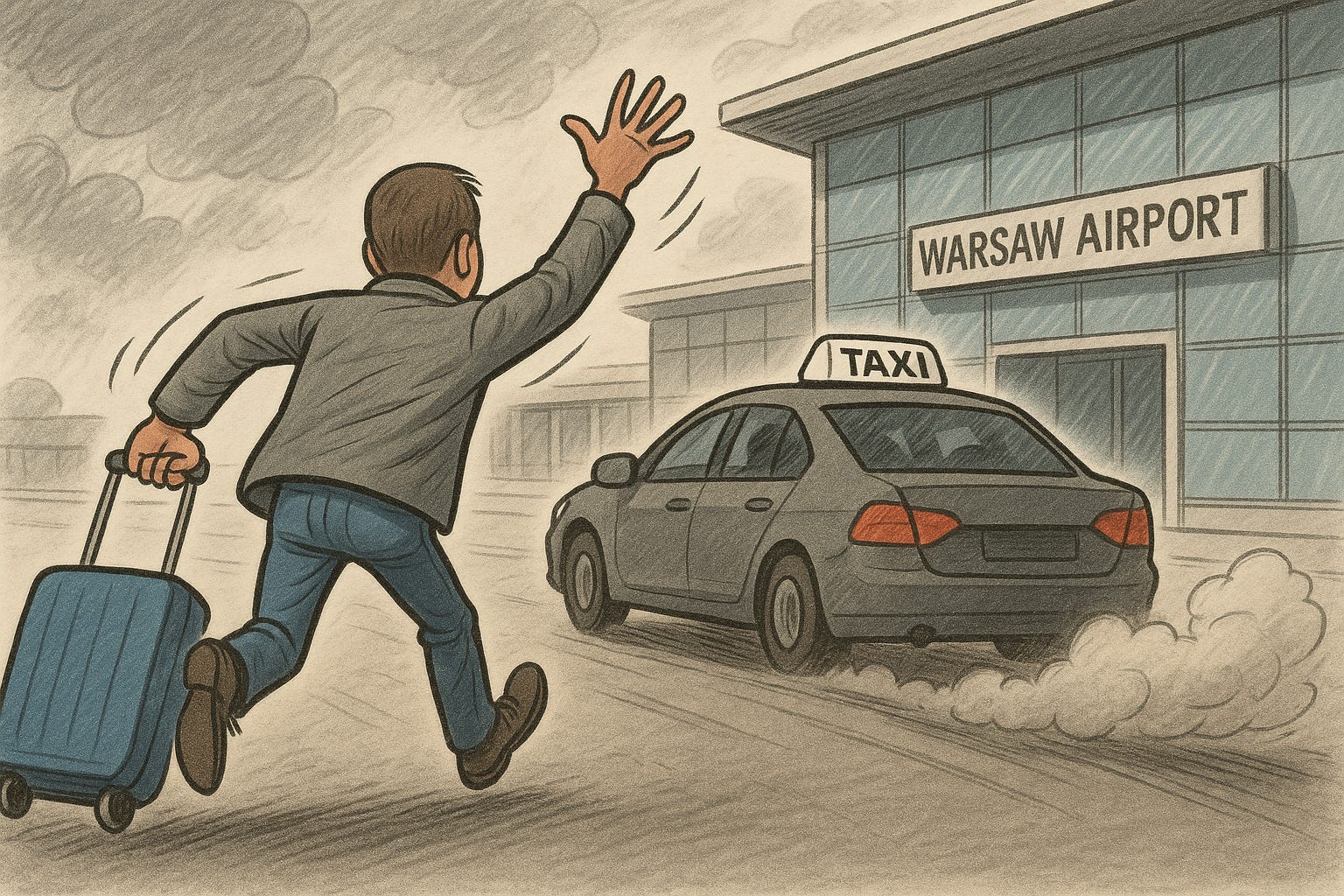
As we reached the airport, I suddenly realized there might be more than one terminal. While I rifled through my papers to check, Mehmet leapt out, pulled my carry-on from the trunk, and barked, “D! Terminal D!” — pointing toward an entrance further back. He was in a hurry, clearly done with me. I got out, flustered, said, “Okay, okay,” and closed the door.
That’s when I realized my phone was still on the seat, where I had put it as I was checking my papers.
I shouted “Mehmet Mehmet!” – which was ineffective, on account of his having driven away like a madman. I gave chase, waving the cold Warsaw air while dragging the carry-on behind me. I ran after him for about 200 meters until he disappeared past a gate. I stopped, panting and miserable. My phone was gone.
We are slaves to these damned things! We depend on our smartphones for communication and navigation, to entertainment and banking and work. They’ve become our maps, calendars, cameras, and news feeds. Losing this gadget is a nightmare. I dragged myself into the terminal and asked at the information desk if there was an Uber office. “Downstairs” said a disinterested man. After much inquiring I located the Uber counter — manned by a serious young Pole with the expression of someone who’d rather be anywhere else.
“Emergency!” I said. “I left my phone in an Uber.”
“I don’t work Uber,” he said immediately. At moments like these, you don’t argue with the working class — or, I suppose, the non-working class. You plead. “There must be something you can do. The driver’s name is Mehmet and I can tell you the number from which he was ordered.”
Pavel — pronounced “Pah-vel,” — inspected me with a weary patience. “Many, many Mehmet,” he said. “Also,” he added, “Uber airport it is not Uber regular. Also, we have had Uber drivers raping and the police it cannot do nothing.”
“Please!” I shouted. “Be creative!” He said “I check something,” disappeared for a bit, then returned shaking his head. “Nothing to do. Maybe you ask police to check airport cameras. But it take many days.” My flight was in two hours. I began to sink into despair. And just as I was about to walk away, considering that wodka was now the only path forward, Pawel said something brilliant.
“I am having an idea. Let’s call your phone.”
Why had I not thought of that? Because crises at times can make you very smart, but more usually will make you very stupid. We called my phone. “It not rings,” said Pawel. “Have you turned off it?” Then I remembered: my Polish eSIM had data only. “We can call on WhatsApp,” I shouted, unnecessarily. “You have WhatsApp?” Everyone has WhatsApp, so Pawel called my number via the app. After a while, he began speaking Polish into the phone. A good sign!
Pawel hung up, seemingly dejected. “I am speaking five languages, but sometimes this is not enough. He is very very bad Polish. Also bad Russian.” “Call him back!” I demanded. Pawel tried. “Not answer. Problem.” We considered our situation. Then Pawel said: “He say he go back where he drop you. In 10 minutes however.”
I cannot explain such things.
“Great! Do you not believe him?? This seems great! No?”
Pawel shrugged. “Is Uber driver. Very bad Polish.” Then we texted Mehmet on his regular phone, from Pawel’s. Much use of Google translate, or perhaps ChatGPT.
“A problem,” Pawel said, showing me the text. “Now he say 15 minutes.”
I began to suspect Pawel did not fully understand the meaning of “problem.”
Pawel guided me back upstairs to the drop-off area. I waited, scanning every approaching vehicle. I couldn’t even remember what Mehmet’s car looked like, only that it oddly had a taxi sign — a strange hybrid of Uber and official cab. Every cab that approached caused me to wave at it. My flight time was approaching, and I was calculating how long I could wait before abandoning hope. I began to resolve that if Mehmet were to actually arrive, and indeed produce my phone, I would be a better person in every conceivable way. We all can do better. Across from the airport access road was a Renaissance Hotel; should I stay the night, mucking up my plans but buying time to track down Mehmet?
High beams flashed twice and a car pulled over. Mehmet rolled down the window and presented me with the phone, palm upturned, as it it was a diamond bracelet. He also beamed at me — basically the first smile I had seen in Poland. “Thank you, thank you, Mehmet!” I said. I handed him fifty euros — all I had left.
He but did not refuse, but placed the banknote on the passenger seat, in manifest indifference. I find it unsettling when people leave cash lying around, waiting for the wind to blow it away. But this was not the moment to pursue that inquiry.
I stood there, clutching my phone, breathing out a sigh of relief, as Mehmet drove off for a second time. I realized I should have photographed him – but did not, as I was not yet once more in full command of my journalistic instincts.
I walked slowly to security, clutching my phone in disbelief. Then I remembered to check WhatsApp, as one does. Pawel — my savior of the Uber desk, who does not work for Uber but now does have my number — had sent a message:

But what does it all mean? Why did it work out? Is there a method to random madness? Are we all just the victims of a series of accidents? Or does the nun in the church actually have it right? I have no idea about that, but I do know this: We don’t appreciate things we should until confronted with their loss.
It can be a phone. It can be something more important.
