














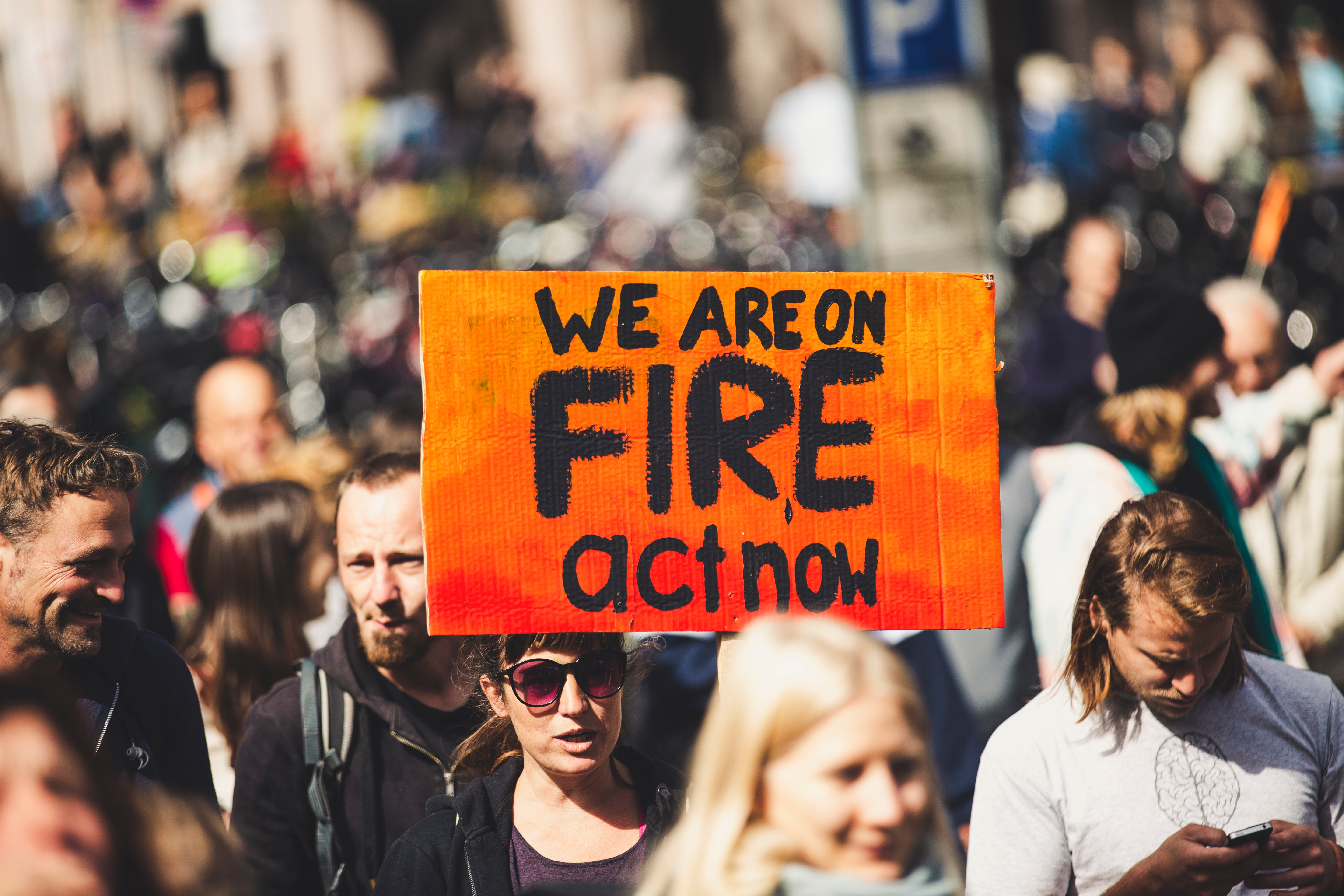
Making his case for a Nobel Prize, Donald Trump dismissed global warming as “the greatest con job ever” and again tilted at windmills (which he seems to hate as much as he loves tariffs).
Fresh off unfounded claims that Tylenol and vaccines cause autism, Trump took the podium at the UN General Assembly where he mocked global warming as a “green scam” and “the greatest con job ever,” waving away climate science as a hoax. And of course, he criticized “huge, terrible windmills,” which he hates.
It was sad to see a reasonably intelligent person like Marco Rubio needing to listen respectfully to this idiocy, so as a public service I offer a basic primer on why climate change is real, dangerous, and overwhelmingly manmade.
Start with first principles. Greenhouse gases trap heat; that is laboratory physics known since the 19th century. Add more of them, and the planet must shed less heat to space. We are, in fact, adding more—vastly more. Carbon dioxide in the air averaged about 280 parts per million before industrialization; this August it hovered around 425 ppm at Mauna Loa, and weekly readings this month are in the 424 ppm range. That is from thermometers for the sky.
The planet is heating, and we are the cause. And what makes this different from past episodes of warming is the speed. When the last Ice Age ended, temperatures climbed by about five degrees over five millennia. We have already risen more than one degree in little more than a century, most of it in a single lifetime. That is a rate of change without precedent in human history.

At 1.5 degrees of warming, coral reefs vanish, summers become punishing, and floods batter coastlines. The world is scarred but still recognizable. At 2.5 to 3 degrees—the path we are now on—the picture darkens. Seas rise by close to a meter, swallowing parts of great cities. Tens of millions are displaced. Crops falter, food insecurity spreads, and vast regions of South Asia and the Middle East become barely habitable. Migration surges, governments strain, and conflict over water and land becomes routine.
Beyond 3 degrees lies the truly unthinkable: collapsing ice sheets that lock in meters of sea-level rise, the Amazon tipping into savannah, thawing permafrost releasing methane in great bursts. Feedback loops take over, amplifying the crisis, and human civilization faces pressures it has never known. All this is the predictable outcome of physics and chemistry, playing out on a planetary scale. Every fraction of a degree makes the difference between a battered planet and one that risks becoming ungovernable.
Do the extra gases come from us? Yes, in ways we can fingerprint. Isotopes of carbon in the atmosphere have shifted exactly as you’d expect when the source is long-dead plant matter — coal, oil, gas — rather than volcanoes or the biosphere. Then ask the harder question: even if we’re adding CO₂, is it really driving modern warming? On that, the world’s most conservative climate document — the IPCC’s Physical Science Basis — does not hedge: it is “unequivocal that human influence has warmed the atmosphere, ocean and land.” Observed warming can’t be explained by the Sun’s cycles or volcanoes; when you include human emissions, the simulations match the real world. Remove them, they do not.
And it’s not just the amount of warming; it’s the pattern. The lower atmosphere warms while the stratosphere cools; nights warm faster than days; the Arctic warms faster than the tropics. These are signatures of greenhouse forcing, not solar forcing. Recent research shows the stratospheric cooling pattern extending high into the middle and upper stratosphere, a human-caused fingerprint that internal variability simply doesn’t produce. If you’re looking for the smoking gun, it’s not one thing; it’s an entire crime scene whose details all point to the same culprit.
.SUBSCRIBE TO ASK QUESTIONS LATER
A skeptic hearing all this will offer counter-arguments.
- The first: “Climate’s always changed.” True — and irrelevant. The question is what’s driving the present change. The timescale and pattern of today’s warming, alongside the observed greenhouse fingerprints, show a forcing far larger and faster than the slow wobbles of Earth’s orbit or the modest ebb and flow of solar output. Those natural drivers are in the models; they can’t reproduce the 20th–21st century warming trend unless you add human emissions.
- Second: “It’s the sun.” If the sun were the driver, we would expect both the lower atmosphere and stratosphere to warm. We see the opposite aloft. Solar activity since the late 1970s shows no sustained increase that could explain the rise. The vertical temperature profile is the giveaway here, and it points away from the sun.
- Third: “Models are unreliable.” Models are imperfect; they’re also tools that encode physics we test every day in weather forecasts and engineering. Crucially, attribution studies don’t depend only on model projections—they test whether known forcings can recreate the warming we’ve already seen. With only natural forcings, they can’t; add human greenhouse gases, they can. That’s not faith in models; it’s pattern matching anchored in measurements.
- Fourth: “CO₂ is a tiny fraction of the air.” So is a match’s flame in a forest. Trace gases can dominate energy balance because they interact strongly with infrared radiation. You don’t need much of a potent absorber to change the throughput of planetary heat. The measured rise from ~280 to ~425 ppm is enormous in radiative terms. That’s why the planet’s energy budget is out of balance, and why heat is piling up in the oceans and air.
- Fifth: “Temperatures were just as high in the past.” In deep paleoclimate, yes — at CO₂ levels also much higher than preindustrial. In the span of human history, no period shows a global spike like the last 50 years, and certainly not while the stratosphere cools and the lower atmosphere warms. The IPCC’s summary line about the scale and speed of recent change being “unprecedented over many centuries to many thousands of years” isn’t rhetoric; it’s an assessment across multiple data streams—ice cores, tree rings, ocean sediments, satellite records.
- Sixth: “It’s all alarmism; look outside.” That’s weather. Climate is the thirty-year distribution of weather. The averages, extremes, and probabilities are shifting. We see it in earlier springs, hotter nights, heavier downpours, longer wildfire seasons, and accelerating sea level rise — trends that match expectations from greenhouse forcing and are documented across national climate assessments and international reports. The details you can argue; the direction you cannot.
- At this point, some pivot to policy: even if it’s real and human-driven, perhaps the costs of action exceed the benefits. That’s an economic debate, not a scientific one, and it’s fair to argue over the mix—how fast to move on clean power, how to protect workers, how to invest in adaptation. But that’s a different conversation from whether the physics is true. Dismissing the problem as a hoax does not make the radiative properties of CO₂ vanish, any more than railing at gravity makes a falling glass reassemble on the floor. The energy transition can be designed to be pro-growth, pro-jobs, and pro-security—especially as clean energy now competes on cost in much of the world—but again, those are policy levers, not scientific facts. Today’s UN floor lines about “green scams” are political choices, not refutations of spectroscopy.
- There is one more claim worth addressing: That recognition of a problem is itself a scam by global institutions hungry for control. The trouble with that line is that climate science does not live inside a single institution. Independent national academies, space agencies, weather services, and university labs — many of them rivals for funding and prestige — converge on the same conclusion: humans are warming the planet. When different clocks tell the same time, you don’t accuse them all of collusion; you accept that time has passed.So where does that leave us after the speeches? CO₂ keeps rising, week by week. The fingerprint patterns keep sharpening as the signal emerges further from the noise.We still have tools to blunt the damage. Cutting greenhouse gas emissions at their source means phasing out coal, oil, and gas and accelerating the shift to clean energy — solar, wind, nuclear, and storage. Efficiency gains in buildings, transport, and industry can slash demand. Protecting and restoring forests and wetlands keeps carbon locked away, while smarter farming reduces methane and nitrous oxide. Pricing carbon, ending fossil fuel subsidies, and investing in resilient infrastructure align markets with reality. None of these measures alone is enough, but together they can keep warming closer to 1.5–2°C—still dangerous, but vastly safer than the path we are on.American voters can fix much of the problem by wiping out the Republican Party in the 2026 midterms. For that we’d need the Democrats to get their act together and stop worrying about transgender bathrooms. I’m not holding my breath.Beyond climate change, Trump’s U.N. address was a truly extraordinary rant.He attacked the UN for a malfunctioning escalator and boasted that his wife is in “great shape” – but so is he. He rambled at bewildering length about the UN unfairly denying him a refurbishment contract in which he would have filled its halls with marble and mahogany at lower cost. He again claimed credit for ending 7 wars, falsely. He lied that tariffs — paid by Americans — brought “hundreds of billions of dollars flowing into our country.” He continued his ungracious attack on his “sleepy” predecessor and spread lies about his sanctions on Russia (Trump is blocking them). He suggested London’s “terrible mayor” supported Sharia law. “I’ve been right about everything,” he said, adding that he is very good at predictions.
All if this is ridiculous — and should be embarrassing to Americans who elected such a buffoon — but the world will survive. Climate change is where it gets dangerous. The bottom line is simple. The planet is warming. We are the reason. We know it from physics, from the gases we measure, from the way the atmosphere is changing vertically and geographically, and from the inability of natural drivers to explain the trend without us. Our choice is whether to respond to measurements with policy, or to succumb to a culture of rank idiocracy.
Sort of confusing for the Average Joe: Macron defends Russian assets while preparing France for war
