














This is the first in a series of articles about Romanian treasure shipped to Moscow in 1917 that was never returned. The issue remains of national importance for Romania.
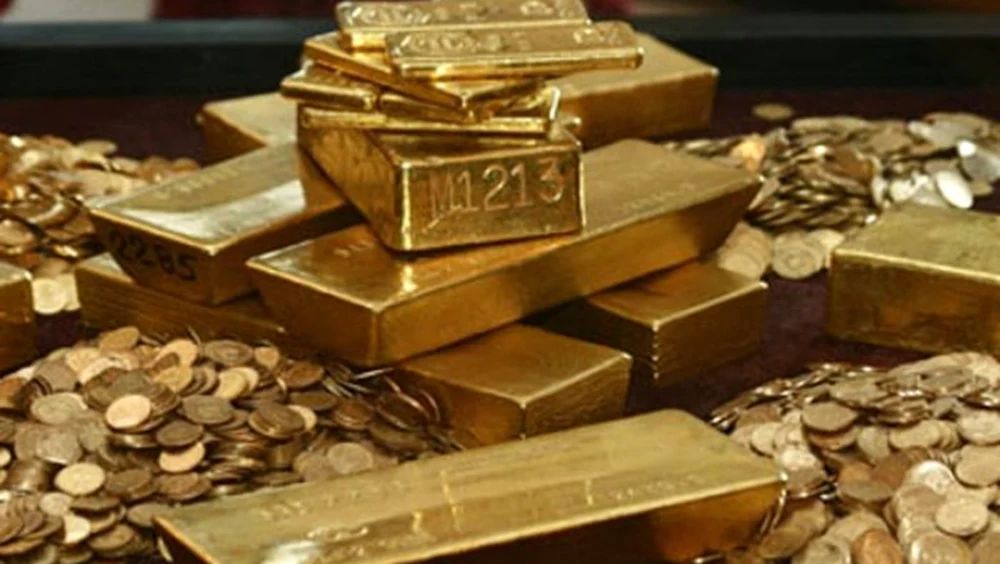
More than a century ago, Romania sent 91 tons of gold and artifacts for safekeeping to Moscow. Russia never repatriated the treasure as promised which is estimated to be worth between 8 and 15 billion euros.
However, Romanian officials now believe they have a chance of getting back the monetary value of its lost heritage following a March 2024 breakthrough resolution in the European Parliament.
Even if Russia refuses to return the treasure (Mikhail Shvydkoy, Russian presidential envoy for international cultural cooperation called the resolution ‘illegitimate’ and a ‘pointless provocation geared to fan hatred toward Russia in the EU’), the West holds more than 200 billion of Russian assets after its brutal invasion of Ukraine in 2022 led to sanctions and the seizure of Russian assets.
The fact that the West holds those assets is to Romania’s advantage.
Armed with the resolution, Bucharest plans to take the issue to an international court of arbitration to rule on the issue, Universul.net has learned.
How the odyssey of Romania’s national treasure began
Romania sat out the first two years of World War I, finally entering the war in August 1916, joining the ‘entente’ of France, the United Kingdom and Russia.
After some initial victories, Romania’s situation became increasingly challenging, and it found itself fighting a war on two fronts against the central powers: Germany and the Austria-Hungary Empire in the northwest and Germany, Bulgaria and the Ottoman Empire in the south, along the Danube.
In December 1916, the Romanian Army was forced to retreat to the northeast province of Moldova and cede two-thirds of its territory, including Bucharest, its capital city to the central powers.
All its government institutions — the royal house, parliament, the government, the National Bank of Romania (at the time a private institution) — relocated to Iași, in northeast Romania.
Romania was now at risk of being totally occupied by the armies of the central powers, so the government decided to send the treasure which was kept by the National Bank of Romania, to Moscow.
The decision was made because Russia was the only ally Romania shared a border with, and the ruling Romanian royal family was closely related to Russia’s imperial family—Queen Marie was the first cousin of Czar Nicholas II. It wasn’t a decision that was taken lightly, however.
Finance Minister Emil Costinescu, mentioned, among other things, the precedent set by the Bank of France which had decided to transfer its treasure to the United States. He also mentioned the option of transferring the treasure to London but considered the route too dangerous, considering the risky transport across the central powers and the threat posed by German submarines in the North Sea off the British coast.
Romania’s Council of Ministers approved the transfer of the treasure to Russia, sealing its fate for the next 108 years.
Romania ships its treasure to ally Russia
Following the decision, the gold reserves of the National Bank of Romania, consisting of 91.5 tons of fine gold (in coins and ingots), Queen Marie’s jewels, and important historical and cultural objects were sent by railroad to neighboring Russia in two stages_ December 1916 and August 1917.
Representatives of the Romanian and Russian governments signed protocols stating that the gold belonged to the National Bank of Romania, that it was being shipped to Moscow for safekeeping and was under the guarantee of the Imperial Russian Government in terms of the security of the transport, storage and return to Romania.
After the shipment arrived in Moscow, representatives of Romania’s National Bank and the Moscow offices of the State Bank of Russia made a full inventory of the gold, which was then duly signed and stamped by both parties.
But just two months after the last shipment of gold, history took a dramatic turn, leaving the gold effectively sequestered by Moscow. The Bolsheviks seized power in October 1917 and Romania’s gold and treasure was effectively sequestered by the new regime ever since.
Romania’s diplomatic representative was arrested and the National Bank of Romania treasure, and Romania’s cultural and historical valuables that had been transferred to Moscow were confiscated.
Missing Romanian gold remains national issue
Romania’s confiscated gold remains a national issue and has prevented the two countries from having good relations even when Romania was part of the Warsaw Pact and under the Soviet Union’s umbrella.
But now Bucharest hopes there may be a solution in sight after Russia’s full-scale invasion of Ukraine in February 2022 and a resolution was adopted in the European Parliament in 2024.
Following the invasion, the West placed sanctions on Russia. To date, the EU, along with the US and its allies, has frozen around $300 billion in Russian state assets, with the bulk held by Euroclear, a major international securities depository based in Belgium.
These assets include cash, shares and sovereign bonds owned by the Russian Central Bank remain trapped in its accounts. The interest generated by the assets has been playing a significant role in Europe’s financial support for Ukraine.
Romania secures breakthrough with European Parliament Resolution
In March 2024, the European Parliament passed a motion calling on Russia to return Romania’s national treasure.
The resolution emphasizes that the continued retention of this treasure by Russia is a breach of international law and customs and a matter of deep concern for Romania. Moscow cannot wash its hands of the issue, as “the Russian Federation is the legal successor to the Soviet Union, which continued the legal personality of Czarist Russia, and is thus under an obligation to return these assets belonging to Romania“
In short, the European Parliament is urging Russia to return the treasure and to pay any accrued penalties or interest for the period it has been held.
More importantly, the resolution also encourages the European Commission and other relevant bodies to support Romania’s efforts to recover its national treasure through diplomatic means and international cooperation.
After the vote, National Bank of Romania governor, Mugur Isarescu, explained that Russia had been reluctant to discuss the repatriation, arguing that it had been received and deposited by the Soviet Union which broke up in August 1991 and no longer exists as a state.
Eugen Tomac who proposed the resolution hailed it as a “historic vote” and “a matter of national dignity”. “Romania cannot and must not accept anything less than the return of 91.5 tons of gold and the entire Cultural Treasure,” he said.
Cristian Terheş one of the signatories of the European Parliament resolution argued that Romania’s national heritage should be returned unconditionally.
“We demand the immediate and unconditional return of the Romanian national treasure, which has been illegally in Russian possession for over 100 years, as well as compensation and current interest for the fact that the Romanian nation has not been able to enjoy and use this treasure in its own interest, to which it rightfully belongs”, he was quoted as saying.
Ex-EU commissioner, Corina Creţu, a Romanian lawmaker noted that the resolution was adopted by the vast majority of European Parliament lawmakers.
Mr. Terhes went on to say that Romania’s case was not unique with Russia having seized assets from other countries such as Poland, Lithuania, Latvia, Estonia. He concluded that Russia’s attitude continues to this day and is reinforced by the Kremlin.
The resolution called for the European Commission “to expand the scope of the EU policies governing the protection of cultural goods to include the recovery of national treasures relocated during wartime under bilateral agreements between states.”
It also asked the Commission and the European External Action Service “to include the return of the Romanian national treasure on the diplomatic bilateral agenda governing EU-Russia relations once the regional context permits the resumption of political dialogue between the parties.”
Central bank governor Mr. Isarescu has publicly backed the initiative of the Romanian MEPs saying Romania’s demands are legitimate.
Background
Over the years, Romanian authorities have made numerous attempts to get the treasure back, but their efforts came to nothing. A few cultural items were returned by Soviet authorities in 1935 and 1956, but not the gold which likely does not exist any more.
In 2003, when Ion Iliescu was president, the two countries set up a joint commission to improve cool bilateral relations, and also work on the issue of the missing gold. President Iliescu and President Vladimir Putin set up a joint commission to work on the missing gold, but the issue was never progressed.
Since the gold was shipped, there have been two international motions demanding Russia return the treasure to Romania. The first one was during the Genoa Conference of 1922 which had little to no effect.
Russia has historically dismissed the issue as trivial claiming Romania has outstanding debts, not the other way round. Victor Vladimirovich Iscenko, Secretary of the Joint Commission, Deputy Director of the Institute of Universal History of the Academy of Sciences of the Russian Federation said some time ago that the gold no longer exists.
Other Russian researchers have argued that Moscow does not want create a precedent to avoid possible future claims from other countries. In principle, the Russian government does not want to return old debts.
Russia indignant with Romania for not condemning Ukraine for violating its airspace
