










The United States has provided the bulk of military equipment and intelligence to Ukraine which might not have survived without Washington’s input after Russia’s 2022 brutal invasion.
In a frank assessment, a leading international affairs expert also said that without the U.S., Finland and Sweden would not have joined NATO. They abandoned their historic neutrality and applied for membership shortly after Russia invaded Ukraine. Sweden became a member in March 2024 and Finland a month later.
But despite its authority, the U.S. is also performing “a very delicate balancing act,” Professor Michael Cox told Universul.net in an exclusive interview. It does not want to escalate the war against “a very aggressive” Russia as opposing sides in the “meat-grinder war” consider what victory means for Ukraine, and whether Russia is actually interested in a peace deal.
The short answer is that victory means: “Making sure Vladimir Putin doesn’t win,” Professor Cox said on the sidelines of the Ratiu Dialogues on Democracy conference.
Ahead of the televised debate between American vice-president Kamala Harris and ex-president Donald Trump, Prof. Cox said Mr. Trump was not a political one-off or novelty, but merely tapping into deeply embedded populism in the United States and vibing with the Brexit mood.
Even Trump’s promotion of family members is not original: it happens in the Chinese Communist Party (and in Nicolae Ceausescu’s Romania), he said.
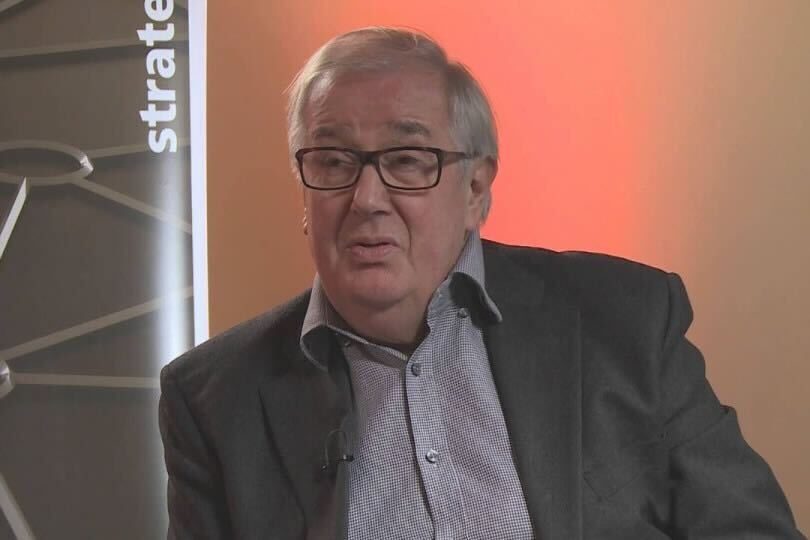
Professor Cox is a founding director of the London School of Economics think tank LSE IDEAS and a leading world expert on international affairs, and author of many books on international politics, the Cold War and U.S. foreign policy.
Here is the interview:
Universul.net: America, which is a key player in this war, has given Ukraine enough weapons to hold off the Russians, but not enough to win the war. How do you see that?
Professor Michael Cox: Well, it’s a very delicate balance for the United States.
Firstly, without the United United States’ military help, intelligence and other things there’s a very good chance in the end Ukraine might not have survived so far. There have been other players, British and every other European country, but let’s be blunt eighty percent of the military equipment which has come…has come from the United States which is also playing in other roles you know in terms of intelligence…America’s played a big big role in mobilizing NATO..and NATO you would not have done it by itself. ..I think the secretary general of NATO (Jens Stoltenberg) was very good in many ways… but you needed the United States mobilizing NATO, bringing it together.”
“Under (US President Joe) Biden…. the two new additions to NATO in the shape of Finland and Sweden would not have come on board unless they knew the United States was part of the part of the deal. So, we’ve got to put a lot down to the United States and its contribution. We’ve got to get the balance right when we’re thinking of the United States…I know where the question is coming from: “Is the United States doing enough? Is it allowing Ukraine a free hand to do what it wants to do? The answer to that is it’s not allowing Ukraine a free hand to do what it wants…because it’s it’s in that peculiarly weird position where on the one hand you want to give Ukraine everything it needs to survive but do you want to give Ukraine everything it “needs” if possible to win. And what does it mean to say to win well it would mean giving Ukraine a lot more offensive capability which would then start hitting Russian territory…I think the United States and …a large number of European allies are quite nervous about that.
“So it puts Ukraine in a very difficult position between a highly aggressive Russia, on the one hand, support from the West on the other, but a support from the West on the other that doesn’t want to see a full-scale escalation of the war, which would then engage NATO very directly against Russia.”
“It’s a very delicate balancing act and if I were Ukrainian, which I’m not, but if I were, I kind of would feel …” thank you United States I just wish you would do more.” Zelensky has said this so many times over and over again but I’m not quite sure it’s easy to escape from that dilemma. There are some people on one side saying escalate the war, take the war to Russia, start bombing around. Well, that would escalate it beyond what the United States and indeed even more so a number of European countries would be prepared to support. Britain might be stronger on that, France and Germany less so, you know, so you’ve got to hold the NATO alliance together and that also involves some degree of compromise because that’s what NATO is essentially.”
“So I see the dilemma…That’s where we are, and I wish I could find an easy way out, but there’s cleverer people than I who have not worked out how to square that circle.
Universul.net: So what would success mean in Ukraine for America, do you think? For America, as opposed to Ukraine?
“Making sure that Putin didn’t win.” Professor Michael Cox
“Now, that is not a clear answer, because there is no clear answer, because as far as I can and see nobody has provided a clear answer what is victory, what is defeat. For many Ukrainians I know in London and elsewhere, they would say that a defeat for Ukraine would be allowing Russia to keep any territory of Ukraine including Crimea….Some people are saying that a win for Ukraine might be just to contain Russia and prevent it taking over more territory…but that’s not the same thing as getting Russian forces completely outside and away from Ukraine.”
“But we’re going to be kind of stuck in this situation I think for some time to come because you’ve got two immovable forces. You’ve got a Russia under Putin and I honestly don’t see where this pressure for negotiation is coming from on the Russian side; I don’t see where it’s coming from. They talk about it they say they want peace. China says it wants Russia to have a peace deal when you look at the peace deal that has been proposed either by China or by Russia you know it’s not acceptable to the Ukrainians and if you look at the peace the peace terms that the Ukrainians have put forward you know what 10 point or 12 points then that’s clearly not acceptable to Russia.So you’ve got two entirely irreconcilable forces.”
“I’m not sure that a Putin would just stop if there was a freezing of the conflict that doesn’t prevent the conflict going on at another time..Russia clearly doesn’t want to see NATO in any way on its border so that would be another stumbling point so …we’re locked into what now is a kind of a an attritional meat grinder, they call it a meat grinder which is a horrible word to use and it’s very difficult at the moment to see how we can get out of this meat grinder. I’m not a military expert_ all I do is kind of repeat what other people say about it..ut it is one of those situations.
“I’ve heard other kinds of solutions like North Korea, South Korea. I just don’t think that’s a good parallel. I don’t think that works. Does Ukraine have the military capacity and the capability of pushing Russia back to the border? People who know more about military than me say they don’t. And at the moment, Russia grinds on: half a kilometer two feet a huge cost it seems …to their to their conscripts and to the soldiers fighting on the Russian side many of whom of course are ex-prisoners and … come from far away distant areas of Russia. There are not many people from Moscow or St Petersburg who are affected by this war. Putin has also built up a kind of military-industrial economy, which…sustains it.
“The sanctions are working, but they’re not stopping the war… And China at the moment, although it keeps talking to Russia about coming to some sort of peace deal, I just don’t see the Chinese putting much pressure on Russia to do what the West wants China to do in terms of Russia. The Americans have gone back to China and said, saying, hey, President Xi Jinping, how about stopping these guys doing this? Well, it’s not our problem, it’s your problem to deal with. And by the way, the real problem, really, in Ukraine isn’t Ukraine, the real problem is NATO. So… we are locked into a kind of frozen, long-term, meat-grinding situation. And I just don’t know what path it’s going to take us.”
Prof. Cox spoke about the US elections a few hours ahead of the debate between Kamala Harris and DonaldTrump.
Universul.net: The big topic on all people’s minds at the moment at this conference is the debate we’re going to have tonight between Trump and Harris. So let’s move to American politics. So just a couple of questions. …If Trump doesn’t win, what will happen? If Trump doesn’t win.. what will happen to Trumpism, that style of politics, do you think, in the US?
Professor Michael Cox: “Well, you know, what is Trumpism? Take it away from Trump. Call it populism. I mean, there’s a very deep embedded populism in the United States. It’s been there, by the way, for over 100 years. It’s not new. You know, not liking elites, not liking East Coast liberals, not liking snobbish intellectuals. You know, there’s always been a deep current of populism in the United States.
“In the late 19th century, there was a deep populist strain in the United States of agrarian populism so populism is not entirely novel in the United States.”
“What Trump has done of course is to tap in to that strain which is already there, which is for the small guy, for the guy without a college education, for the people who kind of don’t like liberal ideas, and you know and all that he’s tapped into that and he’s exploited it very successfully.”
“But it was there to be exploited and he’s exploited it, let’s be honest, rather brilliantly and of course he can pick up on certain big questions which are real_ he’s not making it up_ he’s not inventing it. You know I sometimes think Liberals construct a picture of Trump which doesn’t quite understand the sources, the deeper sources of his appeal. One is that large-scale immigration coming from the south: you know build the wall. It’s a crazy idea I think, but it taps into a fear that unchecked migration is changing America, undermining ordinary American workers.
“One, he’s tapping into the whole question, have a lot of jobs been lost because of China in the manufacturing base? He’s tapping into the fact that a cheap, low cost economy like China undermines workers’ jobs. He’s tapped into a kind of an economic nationalism and much of that is pretty American, but what he’s done is put it all together into a kind of a kind of toxic synthesis. It’s quite good and he’s …given an election an electoral capability. I actually predicted this, it’s one of of the things I got right…that in 2016 he would win. I had a feeling he would win after Brexit.”
“And that brings the last point up. There’s been an internationalization of populism. So if he was just standing alone, well, that would be interesting and important, of course, because it has an impact on the world as a whole. But, you know, it came after Brexit.”
“It’s very interesting that Trump actually recognized in Brexit something international and something important and not just for Britain, but for him, and he actually said it’s wonderful this Brexit, it shows that the world is moving in my direction, so it’s not just Trumpism. I mean there’s a volatile populism out there amongst many many many people and yes without Trump it might not be as effective, and that’s the point. Trump gives it a real voice …and he’s taken over the Republican Party and transformed it into Trump Party. You know he is the number one in the United States as people are preoccupied by him in Europe. Therefore without that leadership that he provides it won’t be as potent but it will still be there.
Universul.net: So you’ve sort of already answered the next question we’ve gone to which is what will happen to the Republican Party if he wins?
Professor Michael Cox: There is no longer a Republican Party. The Republican Party historically created by Abraham Lincoln of course goes back a long way, but if you look at the Republican Party in the post-war period, what is it? It’s Eisenhower, let’s take the key people: Eisenhower and Nixon, Ronald Reagan, George Bush senior and George W. Bush too. And what was it? Well, it was free trade. It was kind of…bourgeois, respectable. You know, they had their golf clubs, they were the respectable bankers. They had their big estates up in the northeast.
“It was a thoroughly bourgeois political party, they were respectable, they all wore suits and ties and they were all generally quite well off. It was patrician and that party no longer exists. I’ve met a lot of people, I’m sure you have interviewed them too, which says I can’t vote for Trump because he’s not a Republican.You know I’m a Reaganite, I’m a Reagan Republican. Look at Cheney, both Dick Cheney the former Secretary of State and his daughter. His daughter was extraordinarily very conservative on a lot of issues. But Liz Cheney came out against Trump. George W Bush has not said anything and I have a feeling he’s not going to but I think I could imagine what he’s thinking. There’s a lot of what I call real Republicans out there who can’t vote for Trump. They may not be able to vote for Kamala Harris but then some of them might, and I’m sure the Democrats are hoping that enough if you like old-fashioned standard normal Republican voters, middle of the road, largely center-right, might come over to Kamala Harris, or might just stay at home because they can’t vote for the Republicans. ”
“So it’s no longer the Republican Party, as defined by Reagan going all the way back to Eisenhower.”
Universul.net: Trump put daughter in law on the board, members of his family. It’s become a very nepotistic party.
Professor Michael Cox: “Look at the Trump family itself. But that often happens in politics, let’s be honest. Trump’s not unique in wanting to promote his children.That certainly happens everywhere, doesn’t it? Even in the Chinese Communist Party, too, by the way. So there’s nothing unique about that side of it. But there is a kind of issue with Trump, I suppose, recognizing if you’re in presidential office, you are the president, and therefore you shouldn’t have any interests either side.”
“But it seems that Trump doesn’t see those distinctions between the public and the private. They seem to blur into one. I don’t think he sees it as a problem, whereas I think quite a lot of other occupants of the White House might have seen that as being problematic. about it. Nobody’s squeaky clean in America when it comes to politics I accept, but perhaps Trump has kind of defined a new level of private public. Does it matter?
Journalist Iulia Hau provided technical assistance for this interview.
US elections, Romania’s King Michael and Grappa at the Ratiu Dialogues on democracy
