








Telling American troops they must follow only lawful orders is not treason — rather, calling on the military to fight the enemy from within is
The uproar over a short video posted by Senators Mark Kelly, Elissa Slotkin, Jason Crow, and several colleagues — urging US service members to remember that they must refuse illegal orders — has produced one of the most legally incoherent debates in recent American history. The lawmakers’ message was simple: “Our laws are clear: you can refuse illegal orders,” which is undeniably true.
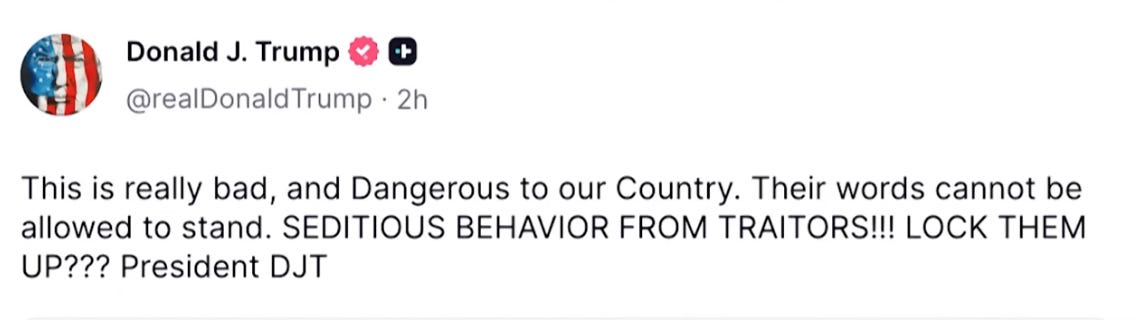
The reaction from Donald Trump was anything but simple. He accused the lawmakers of “seditious behavior” and said their conduct was “punishable by DEATH,” demanding their arrest. These accusations are not merely exaggerated; they are legally backward. The senators’ statement is not sedition. It is the law.
Under the Uniform Code of Military Justice, Article 92 requires troops to obey lawful orders only. The statute is here. The Department of Defense’s Law of War Manual goes further, stating that service members have an affirmative duty to disobey manifestly unlawful orders—language that has been part of U.S. military doctrine for generations.
in our community! To support the defense of democracy and reason, unlock full access to Ask Questions Later by upgrading to a Paid Subscription (unless you have one). Here’s the link. UPGRADE HERE
This principle is not obscure. It is drilled into American troops from basic training onward and was reinforced in the landmark 1969 case United States v. Keenan, in which the U.S. Court of Military Appeals held that “just following orders” is not a defense when the order is clearly illegal..
The doctrine has deeper roots still. The United States helped write it into international law at Nuremberg. The “superior orders” defense — the idea that soldiers can escape responsibility by obeying an unlawful command — was rejected outright.
Modern international humanitarian law now codifies the obligation succinctly. The International Committee of the Red Cross’ Customary IHL Rule 154 states:
“Every combatant has a duty to disobey a manifestly unlawful order.”
Far from being controversial, this is the standard in nearly every modern democracy. Germany rewrote its military code after reunification to eliminate any notion of blind obedience; soldiers may not carry out orders that violate human dignity or basic rights (see explanation here). The United Kingdom and Canada built their modern military law on the same Nuremberg foundations, treating the refusal of manifestly unlawful orders as a duty rather than an option.
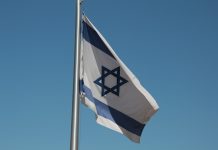
Israel’s doctrine is perhaps the most famous. After the Kafr Qasim massacre of 1956, the Israeli court introduced the “black flag” test: an illegal order is so clearly wrong that a “black flag of illegality” flies over it, and soldiers must refuse to carry it out (Halevy’s analysis is here). In practice, this doctrine has been adopted by the Israel Defense Forces and taught to conscripts for decades (the controversy over Gaza notwithstanding).
In other words, the senators’ message was not some radical new theory. It was a restatement of a legal principle shared across the entire democratic world.
It is important to acknowledge the genuine difficulty embedded in this doctrine: service members are not lawyers, and determining whether an order is unlawful can be challenging in the field. That is why the law uses the term “manifestly” unlawful — the kind of order any reasonable person would recognize as illegal (“Her name is Karen! Shoot her! We hate Karens!”). The existence of borderline cases does not negate the rule. Rather, it places responsibility on commanders, military legal advisers, and training systems to help troops understand their obligations.
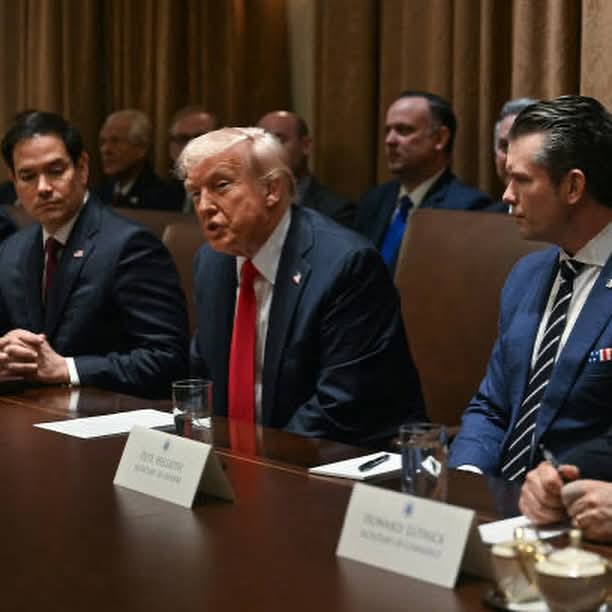
What complicates the current situation is not the law but the politics surrounding it. Only weeks before condemning the senators, he told hundreds of generals and admirals at Marine Corps Base Quantico that the US military must prepare to fight “the enemy from within,” describing the United States as being “at war from within” and “under invasion from within” – and that “if they spit, we will hit.” He went further, proposing that American cities should serve as “training grounds” for the military.
This rhetoric directly challenges longstanding American norms on the military’s domestic role. The Posse Comitatus Act restricts the use of federal troops for domestic law enforcement, except under narrow circumstances. Trump’s “enemy within” framing blurs the line that the law has maintained for almost 150 years. Sedition? To me that sounds like treason.
In that context, lawmakers reminding the military of its legal obligations is a necessary guardrail and a public service. A president can issue orders. A president cannot make an unlawful order lawful.
Trump’s lickspittle political allies either don’t know any of this of are – more likely – pretending as part of their overall post-2016 campaign of grovelling. House Speaker Mike Johnson called the video “very dangerous” and “unprecedented.” Others claimed the orders at issue were not illegal because, in his view, they fell under the president’s Article II authority. Trump adviser Stephen Miller accusing the lawmakers of “openly calling for insurrection. You
You want enemies from within? Look no further.
The United States cannot maintain a military bound by the rule of law if the simple act of reminding troops of their legal obligations is treated as sedition. The senators’ message was politically charged, but fundamentally accurate. The law is clear, the doctrine is clear, the history is clear, and the oath that service members take is clear: Obey lawful orders and refuse unlawful ones.
That is the opposite of sedition. It is the backbone of democratic civil-military relations.
