













Qatar and the other mediators must take a hammer to Hamas, right now, to force true acceptance of the Trump 20-point plan – including disarmament
Is the Gaza “peace” already falling apart? I argued on Al Jazeera English (above) that the central, critical, pivotal thing right now is for the mediators, especially Qatar, to move like a hammer to force Hamas to explicitly accept the 20-point plan, including its disarmament. Otherwise, there will be a lot of embarrassment after Trump’s theatrical festival in Egypt, and a Plan B will be needed, which might conceivably, and catastrophically, include a resumption of the war.
As of today, Hamas has only returned four of the 28 bodies of hostages (one of them misidentified) — amid clear signs that it has no intention of disarming. Rather it is appointing local chieftains and executing dozens of clan figures it finds insufficiently loyal. These are not actions of a group planning an exit.
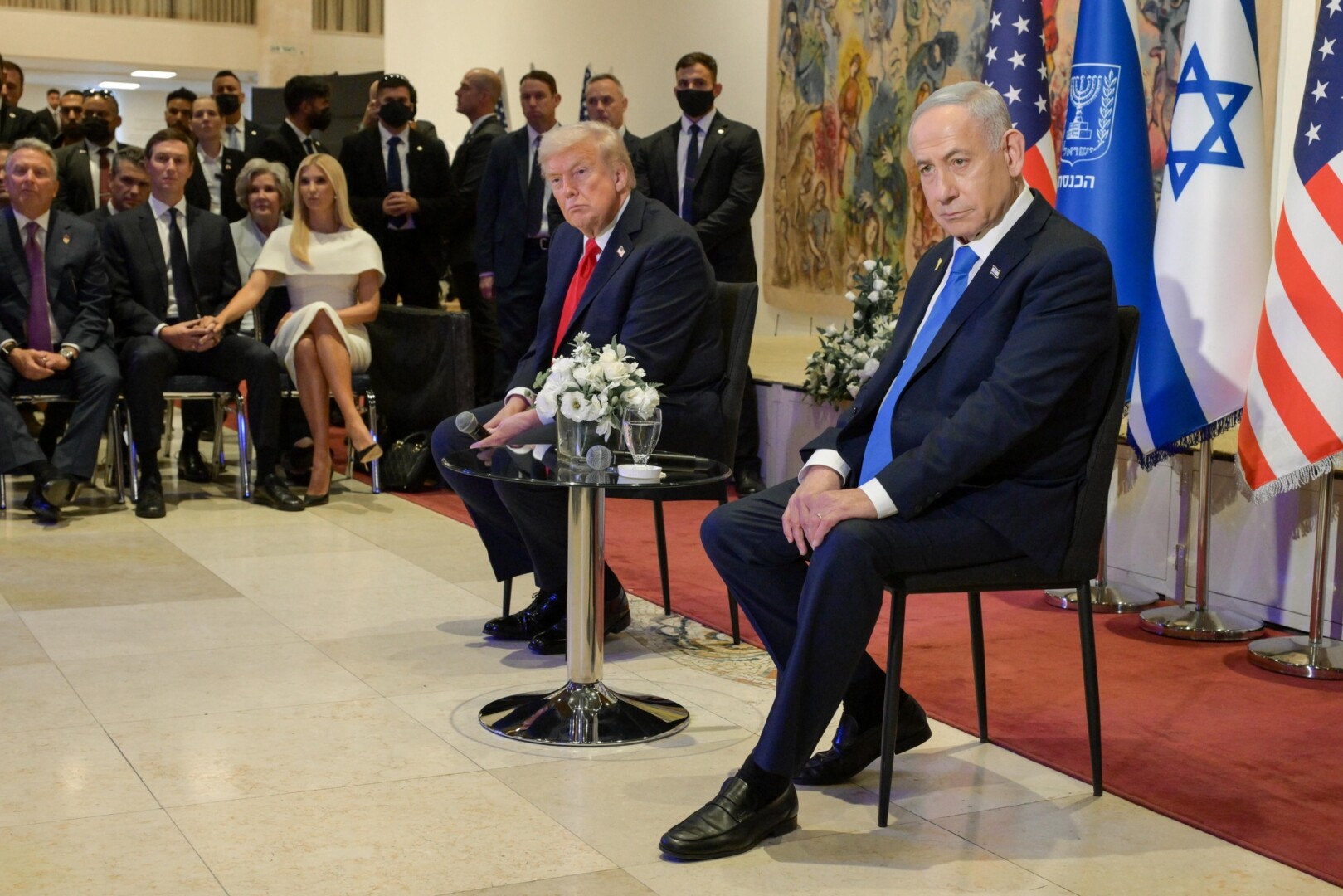
Trump (see above) seems to know there is a problem — but he may in the end prove too invested in the end-of-war narrative to let Israel resume the fight, nor is that a great idea. But the Arab world — especially the Gulf financiers — can finish the job by conditioning any reconstruction monies for Gaza on Hamas honoring the Trump plan, down to the point that requires the terrorist group to lay down its arms. And while everyone considers all of this, Israel should allow Gazans out, transport them through its territory and let them decamp in the Palestinian Authority areas in the West Bank, where all the aid that is needed can freely flow. I see no other way, unless Egypt, which also borders Gaza, agrees to take them in (a farfetched scenario, barring a trillion-dollar bribe).
It was only days ago that by sheer force of will and a style bordering on mafia-like, Trump seemed to have dragged the Middle East to the brink of an unlikely peace. Basking in applause at the Knesset on Monday, he declared that the long war was over. It was perfectly in tune with Trumpian spectacle, but on the ground it’s far from clear that the war is truly done.
The deal Israel actually agreed to two weeks ago is a 20-point plan which includes Hamas disarming, going into exile, and making way for a civilian Palestinian government backed by a complex regional and international oversight committee. This agreement was backed not only by most Western and Arab countries but by Qatar, Hamas’ one-time patron. The show this week — both in Israel and in the Egyptian resort of Sharm-el-Sheikh, to which Trump dragged several dozen world and regional leaders, was predicated on the idea that this plan is now in place. Trump and Arab leaders “signed” documents to prove it—but without the presence of the two actual combatants, Israel and Hamas.
No one has actually heard Hamas agree to disarm. What we have heard is Trump saying the group agreed to “PEACE.” If Hamas still possesses arms and actually refuses to lay them down, Israel may soon want to resume the war, and it would have a point. Yet doing so will now will be excruciatingly difficult after everyone from British PM Keir Starmer and French President Emmanuel Macron to Azerbaijan’s Ilham Aliyev and Armenia’s Nikol Pashinyan feted Trump’s “peace conference.” Trump has invested so much of America’s prestige in the claim of victory that he cannot allow facts to contradict him.
It is possible that in Sharm-el-Sheikh Trump secured Arab backing to ensure that Hamas is brought to heel. But it’s just as possible that Israel, the region, and the poor Gazans will continue to be saddled with the militant group going forward. Indeed, it has been appointing local chieftains and executing dozens of accused “collaborators”—not exactly signs of an impending surrender.
Trump’s approach to the region has always been an extension of his personality, which is very much based on bluster and bluff, with leverage applied where possible. In the Ukraine war, Trump lacks sufficient leverage over Russia—but in the Middle East he has leverage over all involved. Israel cannot continue the war without him, Qatar and other Gulf countries want security guarantees and business access, Turkey wants F-35 planes, and Egypt wants Yemen’s Houthis to stop impeding maritime trade headed to the Suez canal.
Trump’s approach to the region has always been an extension of his personality, which is very much based on bluster and bluff, with leverage applied where possible. In the Ukraine war, Trump lacks sufficient leverage over Russia—but in the Middle East he has leverage over all involved. Israel cannot continue the war without him, Qatar and other Gulf countries want security guarantees and business access, Turkey wants F-35 planes, and Egypt wants Yemen’s Houthis to stop impeding maritime trade headed to the Suez canal.
Trump’s flatter-and-pay-off methods are crude, but in this part of the world they can work. A culture that respects power, intimidation, and humiliation more than polite consensus sometimes responds better to a man who projects force than to one who preaches peace and deals with problems with politeness and propriety.
The effectiveness — and the danger — of Trump’s approach were evident in June, at the end of the 12-day war between Israel and Iran. The Iranian regime had been badly schooled—its nuclear and ballistic missile programs badly degraded, its air defenses laid waste as Israel controlled its skies, its top military (and nuclear scientist) cadres wiped out in mass assassinations. Tehran wanted the war to end, especially after the U.S. bombed its three main nuclear sites with bunker busters. Israel wanted to go on, and perhaps bring down the regime.
So on June 23 Trump announced the war was over, daring either of the sides to call him a liar. And the war was over. He then passed on the chance to force Iran to sign surrender terms—for example, agreeing to end sponsorship of militias in the region—because he wanted credit for having finished the job with the bombing. Now Iran is rebuilding, unchastened, its regime secure.
The Gaza War could prove to be precisely this kind of premature declaration of victory. If it turns out that Hamas has pocketed the peace and refuses to disarm, then Netanyahu will face a massive political problem: this kind of deal — the hostages for an end to the war — was attainable a year or more ago, before dozens of hostages and hundreds of soldiers (as well as many thousands of Palestinians) were killed. It will add to his woes in elections, which must be held in a year at most.
And the past two years of warfare have been devastating. In the coming weeks, as international media—and truly independent and impartial global NGOs and humanitarian groups—arrive in Gaza, the devastation they will find will not be pretty, and Israel may face hard questions about the destruction it wreaked on Gaza. Could it not have been reduced? Was everything strictly necessary? What did it achieve?
On the other hand, one could argue that the strategic equation—for Israel, for moderate Palestinians, for the region, and for the world—is immeasurably better than it was before the war.
- Israel managed during the war to meaningfully degrade the Lebanese militia Hezbollah, which had been undermining its host country for decades, and which began bombarding Israel recklessly in the wake of October 7.
- That led to the fall of Syria’s murderous Assad regime, which Hezbollah propped up and which in exchange deprived Hezbollah of its weapons superhighway from Iran through Syria.
- Iran has been weakened as well, with its nuclear program and ballistic missile program significantly set back.
-
- Hamas has been pulverized too, even if they can still hold Gazans hostage.
All of which seems to have emboldened the Arab world to turn against jihadism. Not unhelpful. Consider this:
The newly signed so-called Trump Declaration for Enduring Peace and Prosperity is a far-reaching and courageous diplomatic text. It unambiguously denounces radicalization and violent extremism, signaling that the Arab states are no longer willing to indulge militancy as a permanent fact of life — a major move in shifting the balance of the Arab-Israeli conflict away from jihadism.
The declaration also does something else extraordinary: It explicitly acknowledges the Jewish historical and spiritual connection to the land of Israel, and insists on “friendly and mutually beneficial relations between Israel and its regional neighbors.” The text envisions new efforts to create peace between Israelis and Palestinians, on the heels of the Gaza war, not as working toward a reluctant truce, but rather as a civilizational project grounded in tolerance, education, opportunity and shared prosperity. All of this — if it is to be enforced — will represent a moral revolution for a region long trapped in denial, grievance and violence. It suggests the assembled are truly ready for an end to the cycles of violence.
The symbolism does have meaning. That Qatar and Turkey, both of which have long existed in enmity with Israel, lined up behind a statement calling for peaceful coexistence is no small thing. For a region so long dominated by grievance, that alone suggests a tectonic shift.
But what is needed now is for the Arab world to put muscle behind those words. Everything now rests on this.
