












This astonishing new reality holds grim suggestions for the future of Israel’s democracy. A massive test approaches. Also in the United States
Two extraordinary developments illustrate how unsettled Israel is in advance of elections this year: Supreme Court Justice Noam Solberg, chairman of Israel’s Central Elections Committee, publicly outlined the legal conditions under which elections could possibly be postponed during a national emergency, and former Prime Minister Ehud Barak warned that Prime Minister Benjamin Netanyahu might try to sabotage elections and have to be physically removed from office.
The fact that such scenarios are now being openly discussed by figures at the center of Israel’s democratic system reveals how close the country’s democracy is to a breakdown — and the country’s character to a fundamental change. For almost 80 years, Israel prided itself on maintaining democratic continuity under near-impossible conditions. Through wars, terror campaigns, coalition collapses and corruption scandals, there remained an unspoken assumption that elections would occur and governments would leave office when they lost. Now, for the first time, much of the public fears that this assumption no longer stands.
“If Netanyahu tries to sabotage the elections, we will have no choice but to drive him out with sticks and stones,” Barak said on Israel Radio. The astonishing thing is that no one was astonished or called him a hysteric.
The atmosphere surrounding the expected election, which must take place before the end of October, is marked by increasingly apocalyptic rhetoric as Netanyahu faces negative polls. A poll by the Israel Democracy Institute found that 61% of Israelis believe Netanyahu should not run for reelection at all. Another poll found that 63% of Israelis fear for the future of Israeli democracy itself, while 56% said that internal divisions pose a greater threat to Israel than external enemies. So in a country historically defined by external security fears, many now believe the gravest threat facing the country is internal. Read on for the grim details.
Justice Solberg’s remarks last week, which took place at a closed academic event and were reported later, added fuel to the fire. Solberg, who is a conservative and considered politically sympathetic to Netanyahu, outlined six principles that would have to govern any decision to postpone elections, including a clearly defined plan for a return to normal electoral procedures.
Solberg emphasized that no election should be postponed merely because a crisis exists. Rather, authorities must demonstrate that the emergency has materially impaired the country’s ability to conduct free, equal and genuine elections. He concluded by expressing hope that Israel would never face circumstances requiring such a decision.
The fear that Israel is actually quite close to such a postponement cuts across much of Israeli society. I’ve heard it expressed by secular liberals, military veterans, former intelligence officials, legal scholars, journalists, centrist politicians, and even some conservatives who once supported Netanyahu enthusiastically. What unites them is the growing belief that Netanyahu now considers remaining in power to be an existential necessity — and that his radical base will back him no matter what outrage he attempts.
Yair Golan, former deputy IDF chief and leader of the opposition Democrats Party, has become one of the loudest voices warning that the danger is no longer theoretical. Golan warned publicly that Netanyahu’s camp could “sabotage, falsify, lie and intimidate” in order to remain in power. He also warned against attempts to alter election rules before voting takes place, and announced plans for extensive election monitoring operations to try to help safeguard the vote.
A decade ago, such statements from a senior Israeli political figure would have sounded deranged. Today, many Israelis hear them as sober preparation.
If all this sounds uniquely Israeli, it is worth remembering that another democracy has been wrestling with remarkably similar anxieties. In the United States, Donald Trump spent years refusing to accept the legitimacy of the 2020 election, encouraged efforts to overturn certified results, and has never clearly abandoned the claim — first articulated in a 2016 debate with Hilary CLinton, and dismissed as a joke — that any election he loses must be fraudulent.
Since returning to office, his administration has sought greater federal influence over election administration, pressed states for voter-roll data, pursued tighter restrictions on mail voting, revived sweeping investigations based on largely unsubstantiated claims of voter fraud, and repeatedly cast doubt on the integrity of electoral institutions. Many of those initiatives have already been challenged or blocked by the courts. The cumulative effect has been to erode confidence in the principle that elections are legitimate regardless of who wins.
Nor is the United States alone. Over the past two decades, democracies around the world have demonstrated how elected leaders can gradually tilt the political playing field without formally abolishing elections. In Turkey, Recep Tayyip Erdogan has used the machinery of the state to weaken the opposition, dominate much of the media, and make elections progressively less competitive while preserving their formal existence. In Hungary, Viktor Orban (of late mercifully defenestrated) managed to transform the country into what he himself calls an “illiberal democracy,” reshaping electoral rules, public institutions, and the media landscape to entrench his party’s dominance. In Poland, the Law and Justice government spent years politicizing the judiciary and state institutions before being voted from office. At the far end of this spectrum stands Vladimir Putin, Gold Medalist of chicanery, who has ceased pretending and is now a dictator.
None of this means Israel is destined to follow the same path. Its institutions remain independent, its civil society is vibrant, and its elections have historically been fiercely competitive. But the international pattern is unmistakable: democracies rarely collapse in a single dramatic moment. More often, they deteriorate through a steady erosion of trust, institutions, and accepted rules, until elections themselves become objects of political struggle rather than the means of resolving it. Israel’s own vulnerabilities, however, are unusually acute because they intersect with perpetual security emergencies and a governing coalition that has repeatedly demonstrated its willingness to test constitutional limits.
Netanyahu’s current term, after a very close election in 2022, has been calamitous, starting with his hugely unpopular effort to eviscerate the judiciary, then continuing with the Oct. 7 Hamas massacre and a three-year multi-front war with unsatisfying conclusions. Most Israelis believe he extended at least one branch of the conflict, in Gaza, to satisfy ultranationalists in his coalition.
Which means there’s precedent for believing Netanyahu might invent or invite an emergency to further his personal goals.
One possibility is yet another external war, involving a manufactured escalation with Iran or Hezbollah, or in the West Bank, where radical settlers terrorize Palestinians while Israeli authorities look the other way. Another, and the most obvious, would involve a sudden change in the status of the Temple Mount — a goal toward which some far-right members of Netanyahu’s coalition have been agitating — or other combustible religious sites.
Any domestic route Netanyahu might choose would invite a direct confrontation between the executive branch and the judiciary over the legitimacy of democratic procedures themselves.
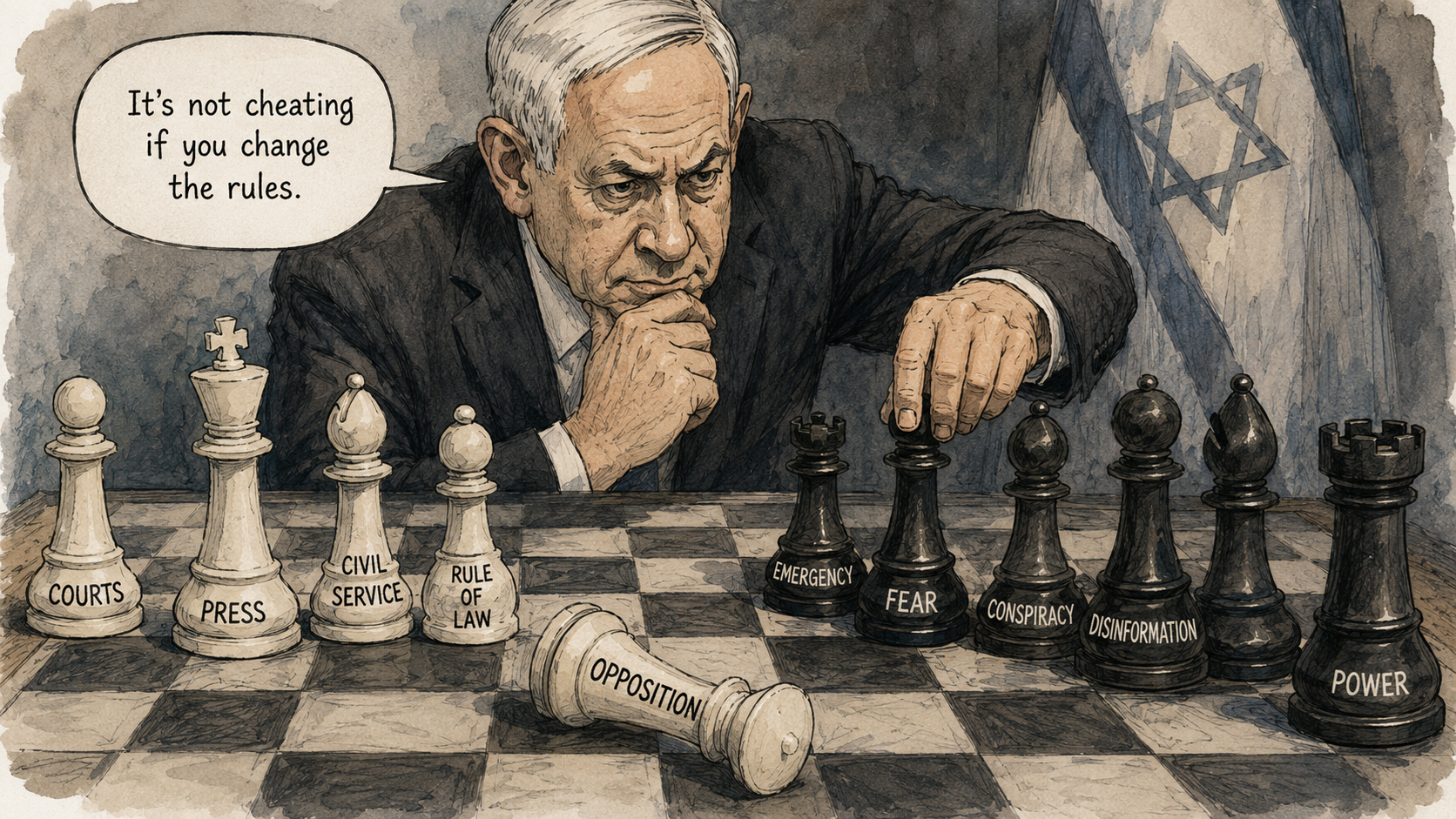
If the Supreme Court ruled against Netanyahu, many fear the coalition could refuse compliance outright. After all, Netanyahu has spent years seeding the idea that the Supreme Court — and also prosecutors, the attorney general, and the civil service — are liberal fronts which do not necessarily need to be obeyed.
The columnist Ravit Hecht recently argued in Haaretz that significant portions of the coalition no longer merely oppose liberal democracy, but reject democracy itself. As Netanyahu has increasingly aligned himself with these forces, Hecht wrote, he has adopted “more and more dictatorial characteristics,” leading to “real fear for the purity of the coming election or even that it will be held.”
At the same time, much of the right has mainstreamed conspiracy theories surrounding the Oct. 7 attack and the Gaza war. Because of the Netanyahu machine’s jackhammer agitprop, almost a third of Israelis now believe the “betrayal from within” theory in which Israel’s security services assisted Hamas on Oct. 7 to harm Netanyahu.
Figures such as Likud Knesset member Tally Gotliv have openly accused the Shin Bet, military officers, protest leaders, judges and the attorney general of betrayal or collaboration with Hamas. Instead of being marginalized, such rhetoric increasingly receives tacit acceptance from parts of the governing coalition.
Yediot Ahronot columnist Ben-Dror Yemini compared the phenomenon to the Nazi-era “stab-in-the-back” myth after World War I, which blamed Jews for Germany’s humiliation. Yemini warned that societies consumed by conspiracy theories eventually destroy trust in every institution capable of holding democracy together.
Given this level of agitation, it is fair to view Israel’s coming election as something far more significant than a contest between left and right or rival policy agendas. Increasingly, it looks like a referendum on whether the country remains the democracy it has always claimed — and largely managed — to be.
(And to the people who have, in the past three years, become harsh critics of Israel: Do not be over-harsh, because, yes, however flawed, it indeed did manage.)
