




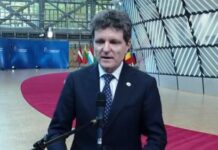


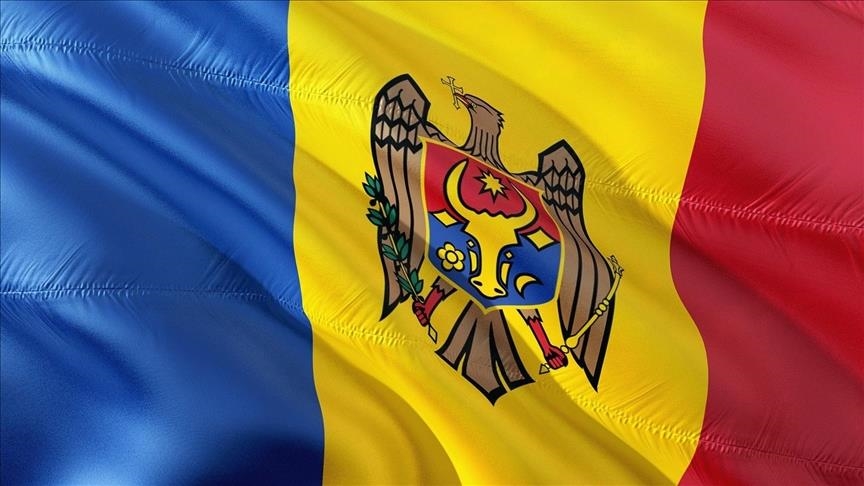
Moldova’s Deputy Prime Minister Eugen Osmochescu has suggested that union with Romania is a potential fallback for the Republic of Moldova if direct accession negations into the European Union fail after 2028.
He called this “Plan B” in an Euractiv interview.
Moldovan authorities continue to insist that full EU membership remains their preferred objective, with the government aiming to sign an accession treaty by the end of 2028.
The deputy prime minister stressed that Moldova urgently needs visible progress in its accession talks, warning that delays could strengthen Russian efforts to undermine public support for European integration.
“We need to send a signal to the population,” he said.
He also acknowledged Moldova’s vulnerability compared with Ukraine, arguing that the country lacks both a significant defence industry and the military capacity demonstrated by Kyiv since Russia’s full-scale invasion: “We are not as resilient as Ukrainians,” he said.
Therefore, Moldova could not fight Russian invasion in the same way that Ukraine has.
Osmochescuhas reported that Moldova is awaiting negotiations to begin this month, as the European Commission expects to open the first negotiating cluster covering fundamental reforms for both Moldova and Ukraine.
The minister also expressed support for proposals that would allow candidate countries to participate more closely in EU institutions before full membership, including forms of associate membership that have recently been discussed by German Chancellor Friedrich Merz.
Asked whether reunification with Romania could eventually become necessary if Moldova’s EU ambitions were frustrated, Osmochescu openly endorsed the idea as a possibility worth considering.
Support for reunification is estimated at roughly 40% in Moldova, where around 850,000 people hold Romanian citizenship, while surveys in Romania have generally shown higher levels of support.
“There is a cost,” Osmochescu acknowledged. “It will have to be absorbed by Romania and by the EU. But the cost would not be as large as the one faced by East and West Germany when they reunified.”
Notably, the deputy prime minister framed reunification largely as a decision for Moldova itself, without discussing whether Romania would be willing to absorb its eastern neighbour or under what conditions Bucharest might support such a move.
Any reunification project would require political support on both sides of the Prut River, as well as agreement on complex constitutional, economic and security questions.
While support for union has traditionally polled higher in Romania than in Moldova, the issue remains politically sensitive in both countries. Osmochescu’s remarks, however, appeared to reflect a common assumption among Moldovan pro-European politicians that Romania would remain broadly receptive to reunification if Moldova ultimately chose that path.
