












Guest writer Ronnie Smith was born in Glasgow, Scotland. He attended the University of Strathclyde, graduating in Politics and History. He has traveled widely and published in Romania, France, the U.K. and Australia. Among other things, he has taught IB Diploma History in Romania and France.”
The world clings to the hope that sustainable negotiations, aimed at creating the conditions for a ceasefire in Gaza and a future lasting peace, are possible. A ‘Two-State Solution’ which may, possibly perhaps, one day when the wind is blowing in the right directions and all ducks are in line, be agreed between the current State of Israel and representatives of the Palestinian Arabs, is pretty much all anybody has as an alternative to the horrific final victory of one side over the other.
We talk about the current Middle-East crisis starting on the night of October 7 2023 when militant Palestinian groups led by Hamas, attacked Israel from Gaza. It was a move clearly designed to elicit the most brutal response from the Israeli state, and as we have subsequently seen, the strategy has worked perfectly. The region now stands at the point where some or even all of the countries and entities involved in the ongoing conflict face catastrophe.
Following the destruction of the second Jewish Temple in Jerusalem by the Romans in 70 AD (CE) and the subsequent collapse of Jewish social and political society in Judea, the Jewish people became a unique diaspora. A diaspora, as we tend to understand it, is normally characterized as an identifiable population living beyond the borders of a home country that still exists.
One example is the current Romanian diaspora initiated after 1989 populated by people seeking better conditions and rewards abroad for themselves and their families, many of whom remain in Romania. Another could be the Irish diaspora created during and after the catastrophic famine of the mid-19th century. In both cases the home entities – Romania and Ireland – did not cease to exist.
In the case of the Jewish people after their homeland did cease to exist after 70 AD (CE). They became a diaspora without a stable host or, as it turned out, a diaspora increasingly hoping to return ‘home’. Again, we could say that the prime but not the only victims of the Nazis’ ‘Final Solution’ eventually decided to find a decisive historic solution of their own, regardless of the terrible consequences for the people who had been living in that space for two thousand years.
This ‘right of return’ to what is called ‘Eretz Israel’ has been exercised by Jewish people for at least 1500 years, in one form or another. However a stringently political and lately para-military element to what could have been called a ‘movement’ evolved in Europe from the mid-19th century. That movement is what we have come to call Zionism, greatly strengthened motivation by the ‘Shoah’ across Europe during the period 1933-45.
In my professional life I traveled a great deal on business. One of my many destinations in Africa was Kampala, Uganda. To get there by plane I would enter the country through the international airport at Entebbe on the shores of Lake Victoria and yes, it was as exotic and beautiful as it sounds.
I traveled this route three times and whenever I disembarked, always amid the roar of US Air Force transports supplying another war in the neighboring Democratic Republic of Congo, I would look ruefully over at the notorious but derelict old terminal skulking shamefully in its inactive corner of the airfield.
The building fascinated me because, of course, it is where the final act of the hijack and hostage crisis of June/July 1976 played out. Briefly; a French airliner was hijacked by a terrorist group consisting of members of the Popular Front for the Liberation of Palestine and the Red Army Faction (Baader-Meinhof Group) from Germany. As many of the passengers were Israelis citizens, the Israeli government sent a detachment of special forces to free the hostages and kill their captors.
The mission was famously successful and only one member of the Israeli force was killed in the inevitable gun battle, Lt. Colonel Yonatan Netanyahu, Benyamin Netanyahu’s older brother. I continue to ponder the significance of this astonishing personal connection and its effect on the uncompromising political career of the man who is now pushing his country towards… what?
What indeed. Netanyahu’s retribution for the attack of October 7 2023 immediately included the entire population of Gaza (Hamas) and increasingly the West Bank (Fatah/Palestinian Authority). In addition, Israel is now openly at war with Hezbollah in what remains of Lebanon, the government of what remains of Syria, the exceedingly belligerent Houthi rebels in Yemen, other militant Palestinian groups and the Islamic Republic of Iran (actually at war with Israel since its founding in 1979).
Israel has, since October 7 2023, achieved the hitherto impossible feat of uniting all of these enemies against them at the same time. Never has the ‘Two State Solution’ seemed less realizable than at this moment, bearing in mind that it took the world Since November 4 1995 to get here. That is when Prime Minister Yitzhak Rabin was assassinated in Tel Aviv by a young Israeli Law student, stopping the momentum behind the Oslo Accords, the last serious attempt to find an agreed and lasting end to the bloodshed, dead in its tracks.
When I see individual politicians and diplomats around the world proclaiming that a greater effort, a final push, must now be made to implement the ‘Two-State Solution’, I have to ask;
1 “Which two states?”
2 “Within which agreed boundaries?”
The Israeli government is not promoting any ‘Two-State Solution’, nor is Hamas, the power in Gaza. Nor Fatah who run the West Bank. Nor for that matter, is Hezbollah in southern Lebanon nor the Islamic Republic of Iran. For them to accept this compromise would require each of them to recognize the legitimate existence of Israel. They along with Israel are the actors who would take responsibility for establishing, maintaining and developing two viable states, presumably existing in peace, side by side. I just do not see this ideal forming any part of anyone’s current idea of the future.
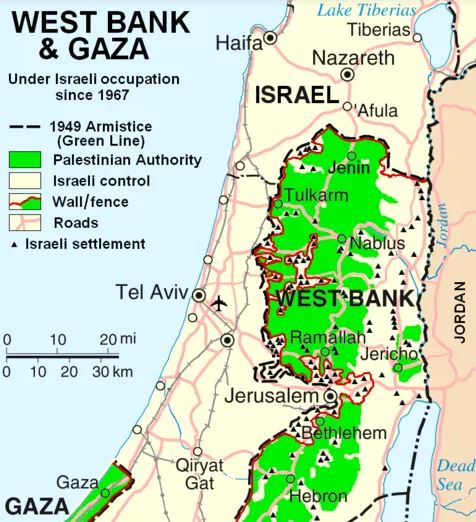
Even now, Israel continues to expand its territory through settlement in the West Bank at the expense of the Arab population. The major Western governments continue to provide the tools that Israel uses to destroy Gaza as a social, economic and political entity. The Kingdom of Saudi Arabia and the fabulously wealthy Gulf Arab states, who have the power needed to create compromise, continue to protect their own interests including massive global investments in Western projects, infrastructure and institutions.
One of the consequences of Yitzhak Rabin’s assassination was that the world was forced to understand that Israeli society and politics was no longer united in its purpose as it had been in the era of General Moshe Dayan and Prime Minister Golda Meir. As we have seen recently, that fragmentation has only increased.
Finally we come to the issue of natural gas, as we always seem to. In 1999 British Gas announced large deposits of Gas off the coast of Gaza. Under the terms of the Oslo Accords, sovereignty of these gas fields would be held by the Palestinian Authority and, in normal circumstances, the PA would accrue very significant earnings and development potential from the exploitation of these resources. *
*Source ‘International Action Centre’, 14 November 2023
However, normal circumstances do not apply in Gaza, more so since October 7 2023 and whatever commercial and territorial negotiations related to said gas were being held before that date are now undergoing the drastic revision that we see on TV news and social media every day.
Experience shows us that states such as Israel simply do not hand over sovereignty of important energy resources to entities like the Palestinian Authority. Nor do they engage in negotiations over a ‘Two-State Solution’.
