










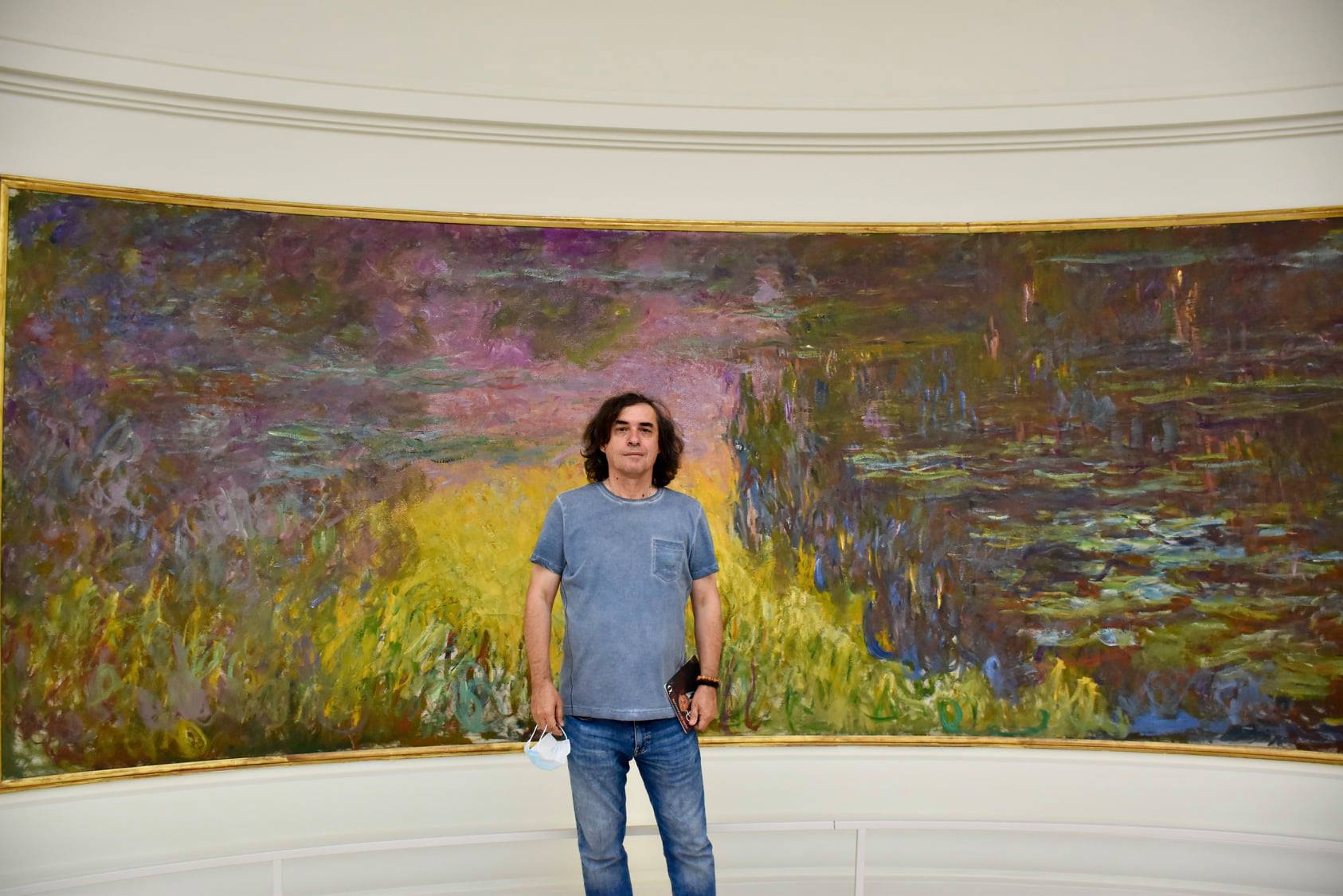
Romania’s greatest living writer Mircea Cărtărescu has failed to get a seat on the country’s highest cultural and scientific forum apparently after he previously linked two historical figures to antisemitism and fascism.
Well-known poet Ana Blandiana criticized the Romanian Academy, after Cărtărescu, 68, didn’t get the votes to be part of the forum on Sunday, while lesser known figures were elected.
Another writer, Radu Vancu, said that among “the arguments against Cărtărescu were that he would denigrate (Romanian national poet Mihai) Eminescu and (philosopher Emil) Cioran, as he would call the former anti-Semitic – and the latter a legionnaire (things which are), obviously true and historically proven.”
Radu Vancu claimed “a large part of the Romanian Academy is inhabited by the spirit of extremist nationalism” which is why they failed to elect Cărtărescu, who is not known for his nationalism.
“Cărtărescu remains the same writer,” Mrs Blandiana wrote, calling the rejection “a stain on the image of the Academy, yet another one in addition to so many since 1948 (when communists took over) that will not be erased,” she wrote on Facebook.
“I feel deeply humiliated by the fact that I feel obliged to speak in the general assembly of the Romanian Academy against such an outpouring of hatred, vulgarity, slander and obscurantism.”
Romanian actress Oana Pellea said Cărtărescu was part of the “National and universal cultural heritage.”
During his writing career, Mr. Cărtărescu has published over 40 books and countless articles which have been translated into over 25 languages. In 2005, he wrote an essay on antisemitism in Romania, where he mentioned Eminescu and Cioran. Antisemitism is uncomfortable issue for some Romanians who were taught that they saved the Jews during World War II and did not learn about pogroms or Jews transported to their deaths during the war.
Cărtărescu’s novel Solenoid was named one of the Best Books of 2022 by the New Yorker, Publishers Weekly, The Financial Times, and Words Without Borders.
It won the 2024 year’s Dublin Literary Award and judges described it as ‘wildly inventive with passages of great beauty.’
Blandiana said she “took the floor to address the scientists who occupy most of the seats…. the scientists who do not have time to read (his) novels … even if they are translated into many languages and win major international prizes.”
“We each serve in our own way… and build not only our own destiny but also the destiny of our country. I took the floor to implore you not to let yourselves be twisted by hatred, envy, and frustrations …and to stop you from placing another stain on the cheek of the Romanian Academy in addition to the many others after 1948,” Ana Blandiana told them.
National poet Mihail Eminescu’s work is widely appreciated but not without controversy, however. His Doina poem, which is expressly anti-Russian, is also considered anti Semitic and anti-Ukrainian and anti-Hungarian.
In a book published in the mid-thirties, the philosopher Cioran openly praised Hitler and Lenin and compared the leader of the fanatical Romanian Iron Guard to Jesus himself. Cioran was active in the 1930s and 1940s, a time of xenophobia, anti-Semitism, racism, Nazism, and Stalinism when he wrote The Transfiguration of Romania.
The Romanian Academy organized elections on February 12 in which its General Assembly elected four corresponding members and two honorary members from abroad in a secret ballot.
Mircea Cărtărescu failed to be elected a corresponding member, although the Philology section of the forum had proposed him unanimously. Rodica Zafiu, interim president of the Philology section of the Romanian Academy, told Edupe “It is a great regret for us, because it was warmly supported by the section”.
The corresponding members elected were: Dan-Cristian Vodnar – Department of Agricultural and Forestry Sciences; Romiţă Iucu – Department of Philosophy, Theology, Psychology and Pedagogy; Gheorghe Remete – Department of Philosophy, Theology, Psychology and Pedagogy; Dorin Ştefan – Arts, Architecture and Audiovisual Department.
Honorary members from abroad: Paul Michelson (USA) – Section of Historical Sciences and Archaeology; Jean-Pierre Sauvage (France) – Department of Chemical Sciences.
Romanian writer Mircea Cărtărescu becomes writer-in-residence at Columbia University, NY
