












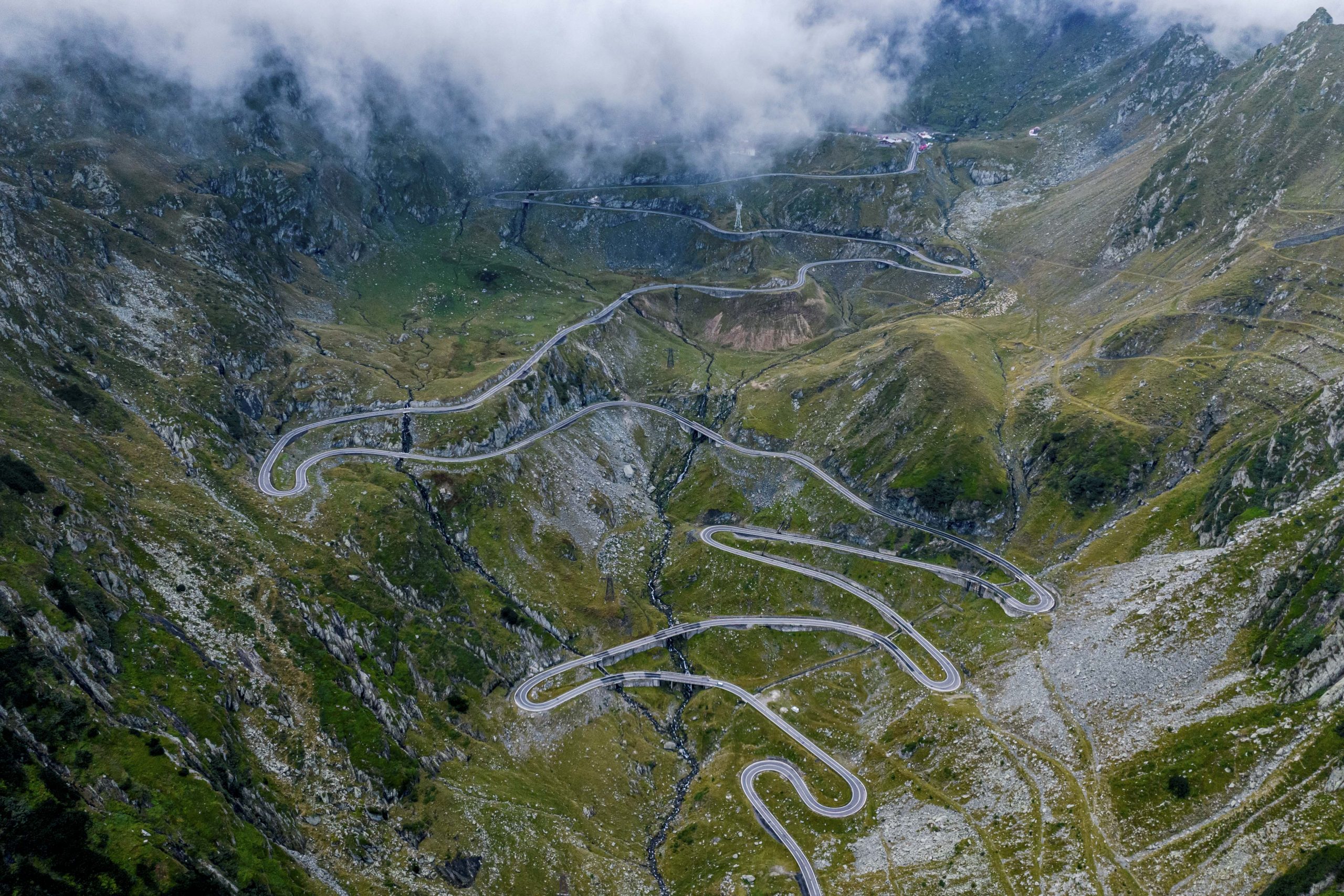
Romania’s most famous and scenic road, the Transfăgărășan, snakes across the Carpathians linking Transylvania to southern Romania.
The spectacular road was built 50 years ago as a strategic military route and is a feat of modern engineering. It took just six years to build (unthinkable today) and was in response to the Soviet invasion of Czechoslovakia.
One-quarter of a million troops from the USSR, Hungary, Poland, East Germany and Bulgaria invaded Czechoslovakia in August 1968 fearing it was becoming too free.
Romania and Albania were the only two Warsaw Pact member states that refused to participate. Fearing that Romania faced a similar fate, Communist leader Nicolae Ceausescu ordered the road to be built to ensure quick military access across the mountains in case of a Soviet invasion.
It was not an easy task. Catastrophic floods derailed the building and Romania’s focus shifted to repairs, as priorities changed in favor of rail and naval transport. Conditions were difficult as junior military personnel hollowed out the road at an elevation of 2,000 meters. Some 6,000 tons dynamite were used to blast thousands of tons of rock.
Officially just 40 soldiers lost their lives, but unofficial estimates by workers put the number in the hundreds. The 90-kilometer road was officially opened on 20 September, 1974.
“The Transfagarasan remains a national pride with entirely Romanian design and execution! A less evoked thing is the initiation of this large infrastructure project in the geopolitical context of the invasion of Czechoslovakia, which determined the emergency execution of the Transfagarasan,” the National Company for Road Infrastructure Administration (CNAIR) said on its Facebook page.
It is renowned for its stunning landscapes and spectacular view on clear days, but the moment temperatures drop, snow closes it from late October until the spring.
Understandably, it is one of Romania’s most attractive tourist spots, with thousands of Romanian and foreign tourists every year: cyclists, motorists, hikers and bears.
In 2009, the BBC’s Top Gear’s Jeremy Clarkson, Richard Hammond and James May tested three high-speed cars on the road.
“This is the best road in the world! Romania, thank you for having this path. Can we stay here forever?”, Jeremy Clarkson said at the end of the show.
Romania’s national road authority, the CNAIR, has plans to modernize the route, to keep it open for most of the year.
The project will spur the development of tourism in the area, with more parking spaces and the construction of special “viewpoints” for visitors to enjoy the breathtaking landscape.
“The Transfagarasan is one of the indisputable proofs of the greatness of Romanian engineering. We want to continue this excellence. In recent years, we have demonstrated Romania’s capacity of building modern infrastructure, even in difficult conditions. We have exceeded the milestone of 1,000 km of high-speed roads in Romania (highway and expressway), and we still have another almost 800 km in the works,” a statement from CNAIR reads.
“A developed road infrastructure plays a decisive role in developing the economy and positioning Romania among the strongest European states” general director of CNAIR, engineer Cristian Pistol said.
The project to modernize the Transfagrasan are already underway, for the km 104 – km 130+800 section, with Rutier Connex XXI S.R.L., winning the bid according to deputy Transport Minister, Irinel Ionel Scrioșteanu
Bear Alert: tourists who feed roadside wild bears in Romania risk double fine
.
The Transfagarasan remains the pride of those who work today in Romania’s road sector, CNAIR said.
