










The European Commission has added ‘Sturgeon ham’ or ‘Batog de sturion’ to its register of protected geographical indications (PGI), making it the 16th Romanian product recognized at the EU level.
The announcement made Wednesday by the Romanian Agriculture Ministry confirms that the Dobrogea region in eastern Romania deserves its title of European Gastronomic Region.
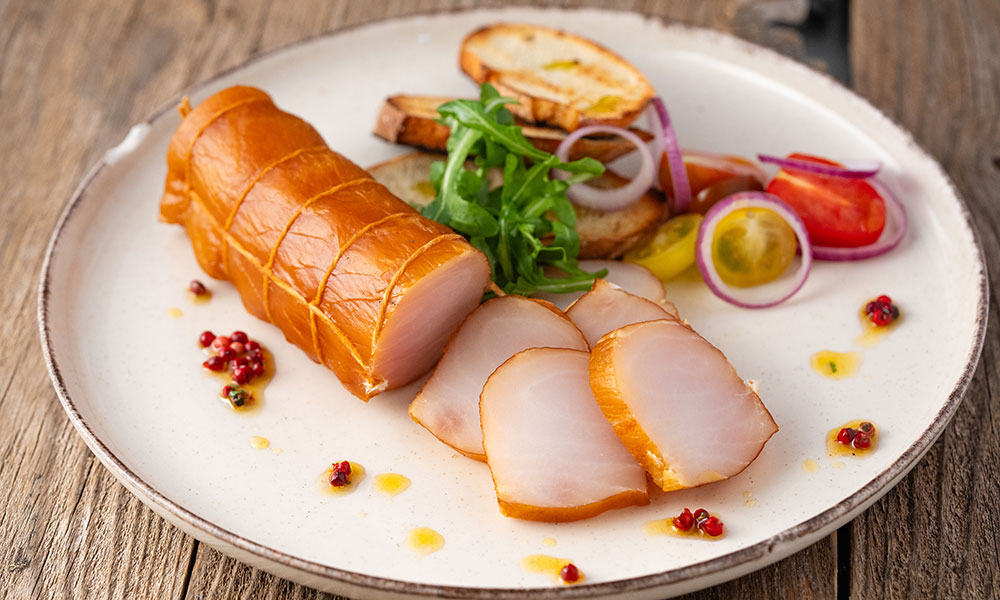
Made from farmed sturgeon dorsal fillet, it is distinguished by its sweet-salty taste and compact texture, the result of the smoking process with hardwood. It is made in the Danube Delta region which is in Dobrogea.
The manufacturing process includes salting, drying, and smoking, which contribute to obtaining the specific taste and color. The sturgeons used are raised in controlled conditions, free from contamination to ensure the quality of the product.
The fillets are hand-cut, skinned, and portioned, resulting in a compact texture that allows for easy slicing, the European Commission said in a statement.
Wild species are protected from farming. The result is a fine taste, surprisingly close to poultry, and a firm but delicate texture.
‘Sturgeon batog’ PGI joins other recognized Romanian products, such as Topoloveni plum jam and Sibiu salami.
The sweet-salty taste is accompanied by a meat flavor specific to the sturgeon species.
“Batog de sturion” is the 16th Romanian product recognized and registered at European level, the Ministry of Agriculture announced in a separate statement. Romania previously had 15 registered products under EU quality schemes.
Romania has 13 more products under review by the European Commission: four seeking registration as Protected Geographical Indication (PGI) and nine as Traditional Speciality Guaranteed (TSG), Agerpres reported.
A Protected Geographical Indication (PGI) shows the link between the specific geographical region and the name of the product, where a certain quality, reputation or other characteristic can be attributed essentially to its geographical origin. In order to benefit from this quality label, at least one of the stages of production, processing or preparation must take place in the region.
More than a simple sausage. Romania’s most famous salami gets its own book
