











And other tales from Bad Bunny’s Isla Del Encanto
Bad Bunny’s halftime show in Spanish at the Super Bowl got me thinking about the complicated issue of minority language rights in a country. It seems the spectacle, watched by well over 100 million people, impressed the hell out of many people and offended certain others — basically for being in Spanish at a time when violent federal troops are hunting immigrants from coast to coast.
Careful readers of AQL will know how I feel about ICE. But putting that aside, there is a lot of virtue signaling around this, alongside the mountain of xenophobia. In the United States, the non-chauvinistic side of society tends to prize multiculturalism and multilingualism, almost ashamed of monolingualism. It’s as if the more Spanish one hears in public, the better. Let’s take a look at that.
I myself am rather polyglot because of my background. I speak multiple languages at a native or near-native level, and others rather badly. But I have also seen enough of the world to know that the one thing that might hold a society together is a common culture, and that begins with a common language. Time after time, I have seen societies that lacked this sense of commonality either fall apart, disintegrate as state entities, or simply fail to function properly.
This happens not only in ramshackle parts of the world, but even in wealthy democracies. Take Belgium, for instance. The French-speaking Walloon half and the Flemish, Dutch-speaking half have so little in common that one can hardly speak of a coherent Belgian identity. The result has been chronic political dysfunction. There is almost nothing to be said for Belgium as a state — except, perhaps, that it happens to host the institutions of the European Union (and for many people, obviously, that doesn’t amount to much). And heck, Canada experiences so much trouble that even Trump wants, it seems, to save it.
My inclination, therefore, is to keep at least some limits on multiculturalism and multilingualism at the level of the country — while in the case of nation-states, largely defined by a dominant ethnic, cultural, and linguistic group, then minorities living within those states must of course be treated with respect. But it’s probably best that countries have a language that everyone speaks well.
If minorities wish to preserve their language to the point of running schools in that language, and if there is sufficient geographic concentration or another practical means of doing so, it is difficult to argue that this should not be allowed. But it is also wise — indeed essential — to then also do everything to ensure that those minorities nonetheless achieve native-level proficiency in the language of the country. This applies to Hungarians in Romania, with roughly 6 percent of the population. It applies to Arabs in Israel, who are a fifth. And yes, it applies to Hispanics in the United States, who are around a fifth of the population as well.
The idea that minorities should maintain a distinct culture has value up to a point. But if that distinct culture becomes so separate that people do not feel part of the country itself, then the country has a problem. Since this sense of belonging cannot truly be imposed, the wiser course for states that wish to function is to create conditions in which the dominant language is embraced.
All of this crossed my mind as I listened to Bad Bunny’s performance in Spanish, and then heard Trump’s claim that “no one understands the language” — a claim made all the more absurd by the fact that the game took place in Santa Clara, California, whose very name reflects America’s Spanish heritage.
The issue also took me back to my own experience over a quarter century ago living in the native land of Mr. Bunny, as the New York Times might say: Puerto Rico, a US territory whose residents are all US citizens. The overwhelming majority there are ethnic Puerto Ricans, and their natural language is Spanish. Throughout most of my stay, as AP’s bureau chief for the Caribbean, I found myself lamenting that more than a century after becoming part of the US, the level of English proficiency remained rather poor. While that works well enough on the island, it becomes a problem when Puerto Ricans move to the mainland — as each one of them has the right to do at all times, and millions indeed have done.
Puerto Ricans would sometimes lament, in turn, that my Spanish was inadequate for their purposes as well. True to my own belief in assimilating into the culture of the place one lives, I did my best to learn the language.
Not initially, though — that’s true. At first I resisted, figuring that in a US territory its residents should instead adjust to me. One night in the streets of Old San Juan, where the beer did flow like wine, I encountered one of our staffers in a state that might be described as tired and emotional. Falling down and the leaning on a car, she said this: “Si quieres ser el jefe de los puertorriqueños, tienes que hablar español con ellos!” Google can explain that phrase, and those that follow.
The next day I called a staff meeting of the “Puerto Rico Service” and told the dozen of so attendees: “Desde este momento, hablaremos en español.” They stared at me in disbelief, which can be easy to confuse with disinterest. But the most senior among them, a mustachioed and wily fellow named Ismael (pronounced, in the local dialect, “Immael”), followed me to my office and pronounced: “Lo que tu has dicho me ha tocado el corazón. Seré tu profesor de español.” And so it was, for about ten minutes a day, every day for the next several years, my Spanish improved marginally all the time, until it reached the status of being mediocre.
Until events blew up my existence on my island paradiso.
Early on in this San Juan chapter, I received a crateful of my newly published book, Israel at Fifty. The introduction was written by former Prime Minister Shimon Peres (who would eventually become president), and I was feeling pretty good. I wanted to go somewhere to have a drink while leafing through it, on my own and at my leisure. I considered El Batey, a degenerates’ dive that had been condemned by the authorities at some point, which I loved for its mutant pool table and dark wood decor, initials engraved on every wall. But I wanted something classier for this occasion. Colleagues sent me to the Parrot Club.
I snagged a bar stool in this colorful, happy place, and within minutes was accosted by a beaming and robust fellow with the air of being much in charge. “Welcome to the Parrot Club!” he roared, slapping my back and grabbing my shoulder. “Who are you, man? And what’s your story?? And what the hell you readin’???” I explained, and instantly he seemed overcome with emotion, and soon gathered a crowd around us: “People! We have here el presidente of the Associated Press!! He wrote a bestseller which he has brought to Puerto Rico!!! We drink!!!!’“ In vain did I protest. Emilio Figueroa was not at all times a listener, but certainly generous to a fault, and so the drinks were free.
Emilio, who not only owned the Parrot Club but hosted a radio show and was considered by some the informal mayor of San Juan, was the kind of guy who can instantly become a friend. A few weeks later I attended his bachelor party. Then I visited his family home on the eastern coast. At some point I wrote an article about him, trying to figure out how he could feel Puerto Rican and American at once in equal measure. To him it was the most natural thing in the world (see the story here). He spoke lovingly of Frank Sinatra as he chomped on his cigar.

It is difficult to overstate the Ricky Martin mania that gripped Puerto Rico back then, and also in the United States, where he was constantly on TV with a fluency in English that, as I’ve said, was sadly rare. So when the AP culture writer was awarded an interview, I made it a co-production. Not elegant, but essential.
At six-foot-one, then 28, he seemed sculpted from magical plasteline, then buffed and scrubbed and shined by tireless elves. Dressed in black slacks and tight shirt that could have been painted on, he greeted us with a dazzling smile and a finger-crushing handshake — as his handlers kicked the photographer out of the room. “No photos of Ricky except publicity shots,” one said. “You guys got 20 minutes.”
I asked Ricky whether he would like to write his own songs, but he swatted this aside. “I’m not a writer, man,” he said. “I’m a storyteller.” I moved to politics and asked him direct questions some locals struggle with. Does he view Puerto Rico as a separate country? A pause. “Yes. I do. I do. I do.” Does he feel American? No pause. “I’m Puerto Rican. In America, I never felt American. I don’t know – it’s like going to China and trying to feel Chinese.”
After more back-and-forth like this, a thought occurred to me. “Listen, Ricky, I gotta tell you something,” I said. He listened closely, seeming concerned; if necessary, I felt sure, he would even write a song for me. “The thing is that I have a four-year-old girl who is, well, just a massive fan of yours. Now, I know that pictures are forbidden. I do. But she would be so excited if, uh, if…” I produced the little camera. The handlers froze, as if they’d seen a gun. For a second I thought that anything might happen. My colleague seemed terrified for his life.
Ricky Martin grabbed the camera before I knew what was going on and tossed it to the most capable of his handlers, seizing me by the arm and positioning us effortlessly by the window. “Let’s do it!” he barked. The handler did as he was told. I had the film developed on the way home, and that evening presented my daughter Maya with the photo. Her little face lit up. “Mickey Martin!” she cried, looking at the image. Then, confused, “Daddy,” pointing at me. She went back and forth, perplexed. “Mickey Martin … Daddy… Mickey Martin …”
She looked up at me and asked: “But why is he real?”
up at me and asked: “But why is he real?”

Because of my career as a foreign correspondent, I have happily voted for American presidential candidates from bases in Romania, Britain, Israel, and Egypt. You get an “absentee ballot” and vote in your last state of residency, generally—in my case Pennsylvania. But in 2000, I could not vote; that’s because I was living in Puerto Rico. I was not outside the United States. But also not in a US state, and not in the District of Columbia. Which makes you shit outta luck. I’m not sure how that’s said in Spanish.
For a brief moment there was hope. A group of activists for redefining Puerto Rico as a US state asked the US District Court in San Juan to order the government of Puerto Rico to hold a presidential election, a function that in the US is carried out by local authorities. The Hon. Jaime Pieras, a statehooder himself, ended up ordering Puerto Rico to do so “with all possible expediency,” instructing Congress to count the resulting electoral votes. “By negating the U.S. citizens residing in Puerto Rico the right to vote, the federal government, particularly Congress, would be acting outside its scope of authority and denying a right that flows from national citizenship,” Pieras wrote.
The local governor, Pedro Rossello, a statehooder too, told me in an interview that Puerto Rico was “a disenfranchised ghetto.” He rammed through a law enabling the vote, drew up a local electoral college based on the number of electors Puerto Rico would have as a state, and happily printed up Gore-Bush ballots to boot.

That’s when the Justice Department woke up and appealed the ruling to the 1st Circuit Court of Appeals, which has jurisdiction over the states of New England plus Puerto Rico. That court overturned the San Juan ruling a month before the election but called on Congress to fix this ridiculousness, with the chief judge in Boston, Juan R. Torruella, writing: “The perpetuation of this colonial condition runs against the very principles upon which this nation was founded.”
It simmers still. The islanders became US citizens in 1917, and in 2020 voted to ask for statehood in a referendum (by 52.5 percent). They’re still waiting.
US politics are blocking any progress, because Puerto Rico is assumed to be solidly Democratic. Florida Gov. Ron DeSantis, who as a congressman co-sponsored legislation to establish a process to allow Puerto Rico to be the 51st state, no longer supports his own initiative. When asked about it recently he said this: “I would never do anything to give Democrats any additional Senate seats.”
He’s shameless but not exactly wrong. Remember that 2000 election? Even after the theft of Florida (the recount was stopped as former Vice President Al Gore was about to take the lead), George W. Bush‘s Electoral College margin was 271-266. If the Boston Court had not stepped in, the eight electoral votes of Puerto Rico would have swung that election, from which everything else has followed in this nightmare of a century, to President Alberto Gore.
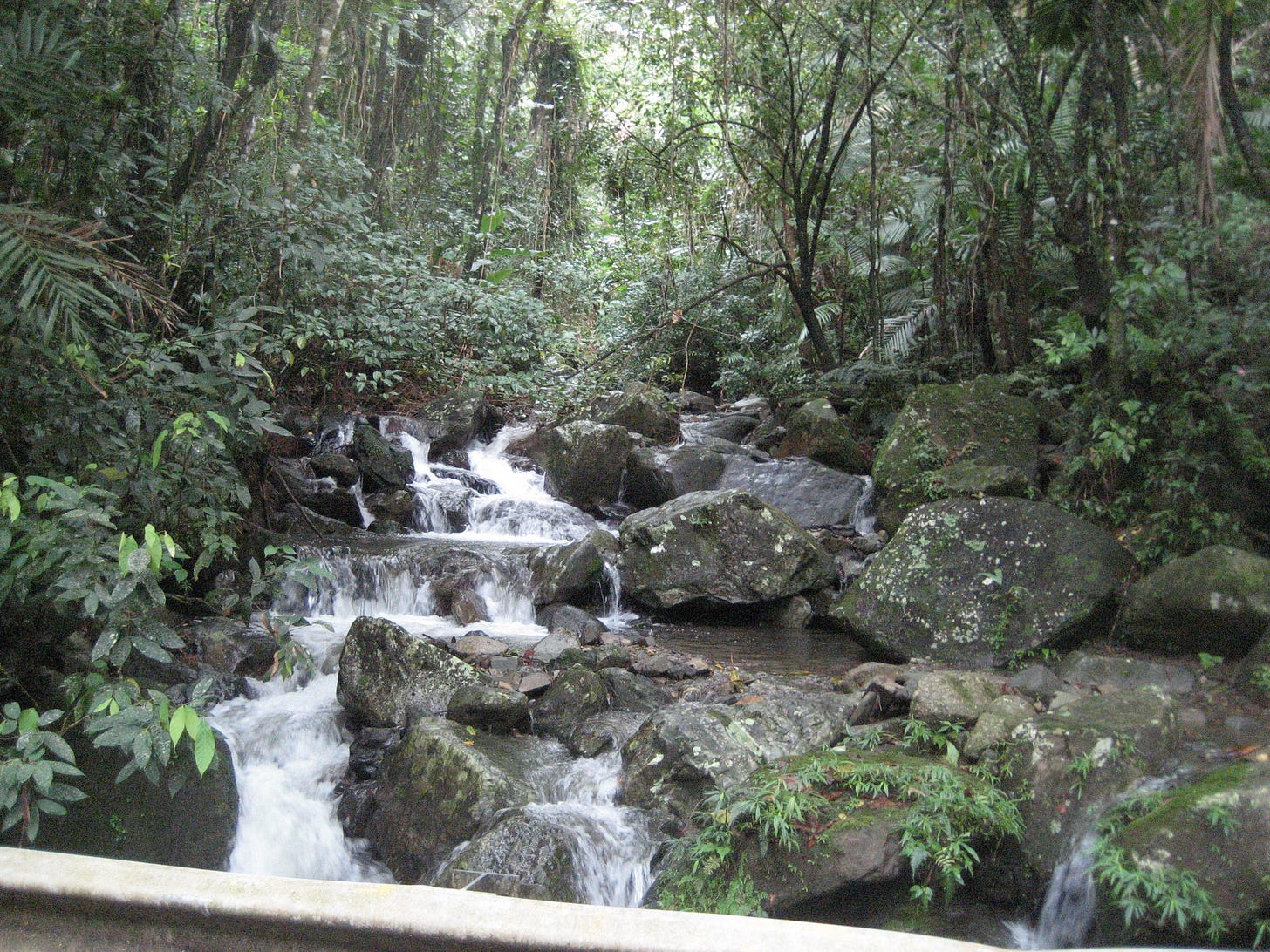
Meanwhile, what a vida loca! I remember treks through the El Yunque rain forest, smoking a big cigar next to a little waterful. I remember evenings at the packed lobby of the El San Juan Hotel, beneath one of the world’s largest chandeliers. I remember nonstop visits from friends; the place would never disappoint.
I remember a moonlit night in the hills with local hippies, when my turn came, as we stood in a circle amid the scent of a certain substance, to thank the universe in some manner. I recall something earnest about the stars and the moon. Hippies politely nodded. One smiled at me, amused. Smoke filled the nighttime air.
I remember the pristine beach at Rincon, on the island’s western extreme, which was beloved by surfers, who would flock to it from all over North America, comparing it favorably even to Montawk, Long Island, if you can imagine that.

“This stretcha beach,” said a guy with long blond hair, gesturing widely with tanned arms, pointing to the north, “has some of the best breaks in the world, man.” This refers to spots where sea waves break in a way that’s rideable. He looked at me closely, gauging my reaction. “I mean it, man. The best.”
I remember Maya running around the huge, grassy approach to the El Morro — a castle, built in 1539, to discourage pirates and maritime misunderstandings, standing watch over San Juan Bay.

I remember our second daughter Noa being born — she is a boricua and that’s a fact. Her US passport says: Lugar de nacimiento: San Juan, Puerto Rico, USA. Just in case anyone’s confused about the status of the place, I have official documentation.
I remember the owner of the San Juan Star, an agitated fellow named Gerry, calling me just as I was about to order the shutdown of the AP service on account of shameless and persistent arrears. “I’m in the hospital, that’s why we haven’t paid!” he shouted. “I have a thrombosis! You canNOT shut down the sports agate!” That meant the baseball scores, for which you needed the paper back then.
I remember a goodbye office party at which, again, to come full circle, everyone was tired and emotional.

And on my next to last day in Puerto Rico, as we were already checked out and basically waiting for our flight out, I got a call from Ismael (who I do believe was an independentista). He invited me to lunch the following day. “Hablaremos de la filosofía de la vida,” he said. “No como patrón y empleado — pero como hermanos.”
Like brothers — and so it was. With that my time in La Isla del Encanto had come to its appropriate end. This was one of the happiest periods for me, and for my family as well. Let Bad Bunny sing in Espanol.

