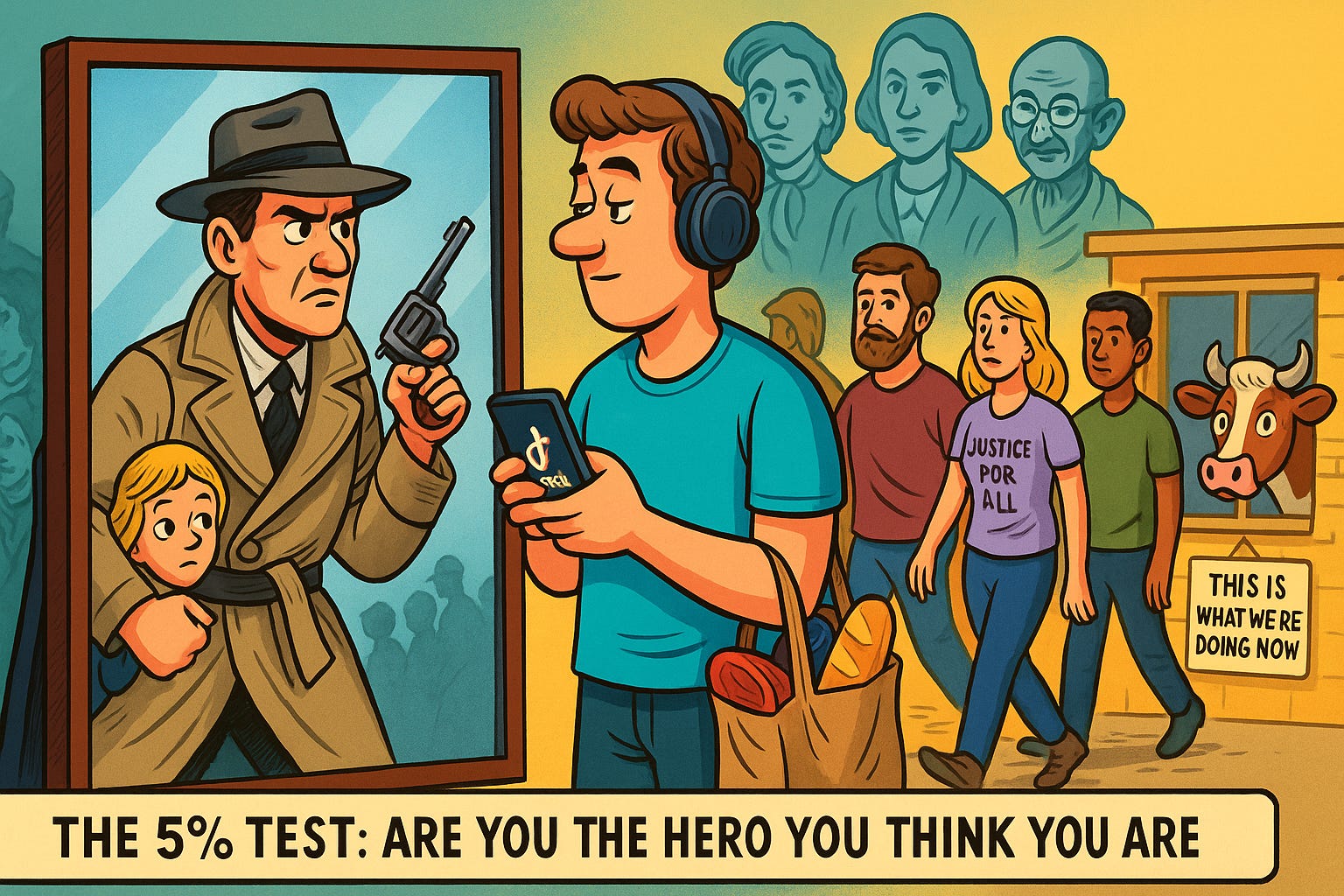
LUCA WOLFE MURRAY WRITES: Most people in history sided with power — not justice. Would you really be any different today? And might it relate to veganism?
We like to believe we’d be on the right side of history. That if we were alive during the Holocaust, for example, we’d be hiding Jews in the attic. That in the American South, we’d be abolitionists, risking status and safety to end slavery. And so on.
SUBSCRIBE TO ASK QUESTIONS LATER
But let’s look at reality.
In Nazi Germany, fewer than 1% of citizens actively resisted the regime. In the antebellum South, only a sliver of white Americans opposed slavery. Most people complied — not necessarily out of cruelty, but because the dominant culture normalized the cruelty. Resisters were ridiculed, ostracized, even punished. They weren’t celebrated for their moral clarity — they were treated by their societies as dangerous pariahs.
Which brings us to a question: What would it actually take for you to stand up to injustice today?
In liberal circles, there’s a recurring meme that whereas they would have opposed Hitler, today’s Trump supporters would have cheered him on. But this self-image is too easy.
Being anti-Nazi in 2024 is not hard. It’s widely accepted, socially rewarded, and taught in schools. Being against injustice in real time, when it’s still socially acceptable and economically profitable, is a different story.
To take a moral stand today — to truly parallel the rebels of the past — you’d need to be willing to be disliked. To be called extreme. To inconvenience yourself for people (or beings) you may never meet.
There is one group that fits this mold more than most.
Vegans.
Now, before you roll your eyes — hear this out.
Studies show vegans are among the most disliked groups in Western society. In a 2015 University of Kent study, vegans ranked just behind drug addicts in terms of public dislike — lower than immigrants, lower than religious minorities. It’s odd, but true.
Why? Because vegans challenge a core societal norm: That eating animals is natural, normal, and necessary. They push back on what most people prefer not to examine.
No, they’re not being imprisoned or executed for it. But the social penalties —mockery, exclusion, ridicule — are real. And still, they persist.
My mentor called this comparison “risky.” He said it might alienate readers. Maybe it does. But isn’t that the point? Being a moral outlier has never been easy.
You might say, “You can’t compare the 2020s to Nazi Germany.” But that’s the “end of history illusion” — the belief that we, unlike past generations, live in a moral and enlightened time. That we have reached the top rung of the ethical ladder.
What if we haven’t?
We slaughter billions of animals — many in factory farms that systematically deny them any semblance of a natural life.
According to Food and Agriculture Organization (FAO) and other sources, roughly 70–80 billion land animals (like chickens, cows, pigs, and sheep) are slaughtered globally each year. That breaks down to about 200 million animals per day on average. Put another way: By the time you finish reading this article, more than half a million animals will have been killed.
Vegans argue that this violence is unnecessary and indefensible. That it mirrors past moral catastrophes in which the powerful harmed the powerless because it was convenient.
The common defenses — “it’s part of our culture,” “they’re not like us,” “change would hurt the economy” — are chillingly familiar. They echo justifications once used for slavery, colonialism, and other atrocities we now universally condemn.
In Patterns of Childhood, Christa Wolf, who grew up in Nazi Germany, writes: “We had been trained to look away, to not question. It was only later that the full extent of what we had accepted as normal became clear.”
So ask yourself: what have you accepted as normal that future generations might find horrifying?
Ethical veganism, at its core, is the belief that we shouldn’t cause unnecessary harm. It’s simple. But in a world built on that harm, simple truths can be the hardest to swallow.
The moral rebels of history didn’t look cool. They weren’t applauded. They were mocked, shunned, and ignored.
And yet — they were right.
Maybe it’s time to stop assuming you’d be the hero in history’s great moral battles.
And maybe—just maybe—history isn’t done testing us yet.
Luca Wolfe Murray is a 22-year-old blogger and aspiring entrepreneur. He spent the last two years traveling around Asia and Europe, including volunteer stints in Bangladesh and frontline Ukraine, and is working towards becoming a content creator who might positively impact the world.