














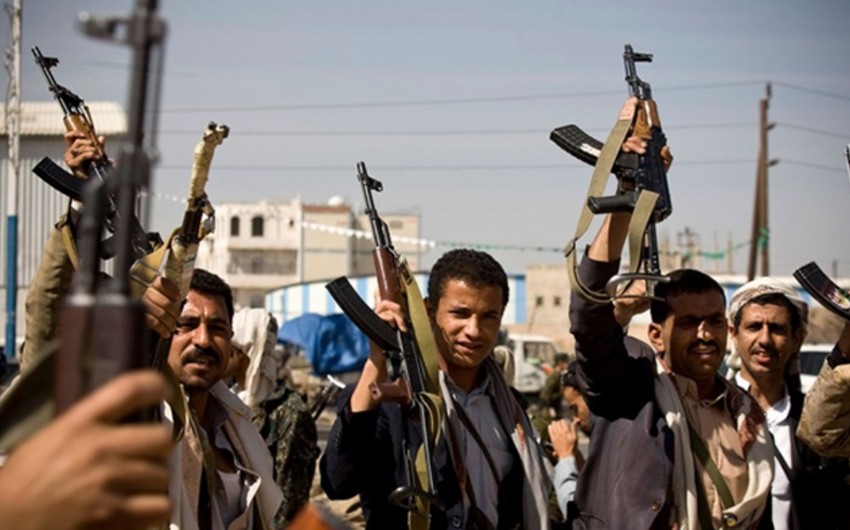
IN-DEPTH BRIEFING: From mass death and torture in Yemen to global shipping disruptions, the Houthis show the cost of tolerating jihadist movements. PLUS: Remembering AP’s Pulitzer prizewinning package
Arab leaders are to hold a summit in Doha tomorrow, convened in the wake of last week’s Israeli missile strike on a building housing Hamas leaders in the Qatari capital. The anger at Israel’s violation of Qatar’s sovereignty is understandable, but much of what will be said risks defaulting to lip service: many of the same attendees would quietly welcome Hamas’s elimination and have long been at loggerheads with Doha over its sponsorship of the Muslim Brotherhood. So alongside condemnations of Israel, if Arab states truly want to do something useful, they should also use the opportunity to address themselves to a fire burning in their own backyard: Yemen’s Houthis.
For now, they are leaving the dirty work to Israel. It’s strike in Qatar appears to have failed (and indeed is looking like a reckless gamble) — but about two weeks ago, Israel carried out a far more successful and defensible strike at other enemies far away, assassinating half the “cabinet” of the Houthis. This wiped out the group’s “prime minister,” several “senior ministers” and large sections of its military leadership in a feat of precision originating more than 1,000 miles away.
Yet what is most astonishing is not the reach of Israel’s military arm, but the fact that the Houthis seem completely unmoved. They have since staged about a dozen missile and drone attacks at Israel. Eventually Israel will be compelled to do more, like blockading or disabling the vital port of Hodeida, bringing more misery to the poorest Arab country. That may be the Houthi’s diabolical plan.
These criminals have already brought Yemen to the brink. Since they seized much of the country in the mid-2010s, their war, and the famine and disease it unleashed, is estimated to have killed almost a half million people. Millions hover near starvation, dependent on aid shipments the Houthis regularly plunder.
The West’s clueless campus and social media activists, of course, have proven indifferent to this outrage, which is in no way a “resistance” or a nationalist uprising. The Houthis are a fanatical mafia in religious garb, backed by Iran and dedicated to harming the West and fomenting jihad. They have entrenched themselves as the de facto rulers of northern and southwestern Yemen, taxing trade, controlling aid and building a military machine with Iranian help.
In recent years they have badly disrupted the world’s (and Egypt’s) economy with their attacks on ships headed to the Suez Canal, which accounts for a sixth of global trade and about 30 percent of container traffic, forcing shipping giants to reroute around Africa, driving up prices for oil, insurance and goods of all kinds.
For years, Western governments denounced, aid agencies documented, the UN convened fruitless talks, and the Houthis carried on. After Palestinian jihadists launched their current war against Israel on Oct. 7, 2023, the Houthis went into overdrive, launching wave after wave of missile and drone attacks on Israel.
When Trump returned to office, he sought a quick foreign-policy win. In June, he brokered a deal in which the Houthis pledged to cease attacks on commercial shipping. The deal succeeded in calming that crisis. But it had a gaping hole: It did not cover Israel.
Israel has intercepted most Houthi attacks against it — only one person has been killed, by a drone strike. And Israel had other fish to fry: its effort to wipe out Hamas in Gaza; its successful war last fall against now-degraded Hezbollah in Lebanon; and the war against Iran three months ago, which set back Tehran’s nuclear program. Moreover, the Jewish State has no quarrel with Yemen. Yet the Houthis, intoxicated by their slogan — “God is great, death to America, death to Israel, curse on the Jews, victory to Islam” — feel otherwise.
The Houthis’ top leader, Abdul Malik al-Houthi, remains standing, and he appears to be doubling down, and dragging Yemenis with them. If Israeli strikes harm civilians in Yemen and world opinion turns against Israel on this front as well, the Houthis will be nothing but delighted. The anti-Israel mob will howl.
This reflects the pathology seen in Hamas, Hezbollah and other Islamic fundamentalist groups such as the Afghan Taliban, which endured two decades of assault by the world’s top militaries, and are somehow back in power in Kabul. Just like fellow travelers ISIS and Al Qaeda, the Houthis evince an indifference to death and an ability either to indoctrinate their desperate societies or to terrify them into submission.
It is a disgrace that the world leaves this to Israel. The Houthis’ brazen assault on the world economy should be punished so severely that no one will ever dare contemplate such moves again. And as for the Arab world, the Houthis embody the danger of leaving jihadist movements unchallenged: they metastasize, drawing in regional powers, wrecking economies and holding entire nations hostage to their cult of death. Critical to their efforts are selective readings of their scriptures like Quran 9:111 (“Allah has purchased from the believers their lives… they fight in His cause, so they kill and are killed”). Originally about defending a persecuted community, it’s recast as a universal license for martyrdom.
So leaders, clerics and educators should step up and draw a bright line between Islam as a faith and jihadism as a pathology. Arab governments, including Saudi Arabia and the United Arab Emirates, must use their influence in Yemen not only to contain the Houthis militarily but to expose their ideology as ruinous and un-Islamic. Yemen’s next generation needs education and opportunity so that they see reasons to live rather than to die.
The Arab nations should also consider helping Yemen’s internationally recognized government which is now confined to the east (no saints to be sure, but less vile than the Houthis) retake the country. (For details on the failed efforts in the recent past, see the full briefing below.)
The Arab League’s recent call for Hamas to disarm was a hopeful sign. But the reckoning must go further. Just as Europe after 1945 confronted fascism head-on, the Middle East must confront jihadism. Until it does, groups like the Houthis will keep rising from the rubble, indifferent to death and dragging nations down with them.
What follows is a full briefing on the Houthi calamity that befell Yemen:
The roots of the Houthis lie in Yemen’s northern Saada province, home to a branch of Shiite Islam known as Zaydism. Formally known as Ansar Allah, they began as a revivalist Shia movement in northern Yemen in the 1990s. Initially focused on resisting religious marginalization and central government neglect, it evolved into an armed insurgency against President Ali Abdullah Saleh’s regime in the 2000s.
When the Arab Spring upheavals toppled longtime strongman Ali Abdullah Saleh in 2011, the Houthis surged into the power vacuum. In 2014, they seized the capital, Sanaa, forcing President Abdrabbuh Mansour Hadi to flee. Soon they controlled much of northern and western Yemen.
Alarmed by what they saw as Iranian influence, Saudi Arabia and the United Arab Emirates launched a military intervention in March 2015, forming a coalition to restore Hadi’s government. The campaign relied on airstrikes, naval blockades, and local proxy forces. The UAE in particular built militias in the south, while Saudi Arabia led the air war. The coalition, however, failed to dislodge the Houthis, who entrenched themselves in Sanaa and along Yemen’s populous highlands.
The war quickly became a stalemate. The Houthis proved resilient, using guerrilla tactics, drones, and missiles to strike Saudi cities and oil facilities. Meanwhile, Yemen’s infrastructure collapsed: hospitals, schools, water systems, and food supplies were decimated. The UN described the conflict as the world’s worst humanitarian crisis, with hundreds of thousands dead from violence, hunger, and disease. At its peak, more than 20 million Yemenis required humanitarian aid.
By 2022–2023, the UAE had largely scaled back direct involvement, focusing on southern separatists, while Saudi Arabia grew eager to exit an unwinnable war. A truce in 2022 held for months despite no formal peace deal, reducing large-scale fighting. In 2023–2024, Saudi–Houthi talks advanced, spurred by Saudi-Iran rapprochement. By 2024, with the Houthis now attacking global shipping in the Red Sea, Riyadh essentially shifted from war to uneasy coexistence.
Today, the Houthis remain in firm control of northern Yemen, including Sanaa and key Red Sea ports, while the south is fragmented between UAE-backed separatists and the weak internationally recognized government. Yemen as a whole is devastated: its economy shattered, infrastructure in ruins, and millions displaced. The war left the country fractured, impoverished, and dependent on humanitarian aid—an enduring reminder of the limits of external military intervention.

The Houthis may have bitten off more than they can chew, however, after Hamas attacked Israel on Oct. 7, 2023. Beginning in mid-November, the Houthi movement significantly escalated attacks on hundreds of commercial shipping vessels in the Red Sea corridor, including missile and drone strikes.
Their stated motive was solidarity with Palestinians and pressure on Israel to end its war in Gaza; they said any ship with links to Israeli interests (including ownership, service to Israeli ports, or companies that deal with Israeli ports) could be considered a target.
The economic and logistical damage has been substantial:
- Freight / shipping delays and rerouting: Many vessels now avoid the Red Sea route and Suez Canal, instead sailing around the Cape of Good Hope (southern Africa), adding days of travel, more fuel costs, and longer journey times.
- Cost increases: Insurance premiums in the route have ballooned. Freight rates from places like Shanghai to Europe have surged (in some cases more than doubling) due to the risk and rerouting.
- Losses for ports and trade hubs: Israel’s Red Sea port of Eilat lost about 90 percent of its activity since the attacks began. The Suez Canal’s revenues dropped (for example from about $9.4 billion to about $7 billion over one fiscal year) as usage of the canal fell.
- Overall disruption to the global economy: Global container traffic, especially Asia-Europe trade, has seen marked delays and cost increases. Estimates suggest goods worth on the order of $1 trillion in merchandise have been affected or disrupted due to delayed shipments, rerouting, and higher insurance/shipping costs.
- Due to risk, many carriers have rerouted their vessels around the Cape of Good Hope rather than use the Red Sea/Suez Canal route. This adds about two weeks to voyages, raising fuel, crew, and time-costs considerably.
- Insurance / war-risk premiums have more than doubled for ships transiting the Red Sea. For some vessels, war risk cover has gone as high as about 1 percent of the ship’s value (up from about 0.4 percent), meaning a $100 million ship’s cost to insure might go from about $300,000 per voyage to about $1 million.
- Inflationary pressures: analyses estimate that disruptions in shipping contributed about 0.7 percentage points added to global core goods inflation in the first half of 2024. That’s a cost borne by much of the world’s population.
Several years ago, when I was the Cairo-based Middle East Editor for the Associated Press, I helped lead a package of stories in text, video, and photos that exposed the war’s hidden toll on Yemen—work that won the 2019 Pulitzer Prize for International Reporting for our extremely brave reporters Maggie Michael (text), Nariman El-Mofty (photos) and Maad al-Zekri (video). What we uncovered pierced the fog of an underreported conflict.
- We documented a coercive Houthi detention apparatus built on abduction, ransom, and torture. Survivors and families described clandestine “black sites” in mosques, castles, and colleges; men strung from ceilings by wrists or genitals, smashed with batons, and burned with acid. The Abductees’ Mothers Union counted roughly 18,000 detainees in four years, with over a thousand torture cases and more than a hundred deaths. Crucially, a leaked video from an internal Houthi committee—including the leader’s brother—acknowledged abuses before hard-liners shut the inquiry, one of the rare on-record fissures inside the movement.
- We traced the industrial-scale recruitment of children—boys as young as ten—indoctrinated at “culture centers,” promised stipends or coerced at checkpoints, then rushed to the front. A senior Houthi official privately put the figure at about 18,000 child fighters since 2014. The boys we met spoke of paralysis, panic attacks, and classmates returned in coffins; they were the war’s “firewood.”
- We showed how politics and profiteering worsened the world’s largest modern cholera outbreak. Houthis blocked an early vaccine shipment while bargaining for equipment; in the south, phantom clinics and siphoned stipends hollowed out response efforts. With half of Yemen’s health facilities damaged and clean water scarce, a preventable disease became a mass casualty event.
Together, these findings shifted the frame: not only a proxy war, but a system of rule that preyed on civilians — torture as governance, children as cannon fodder, and disease as leverage — while reminding readers that corruption and impunity were not the monopoly of one side.
The world community has this information, and has done nothing as the stakes kept getting higher. It is time to focus minds.
