














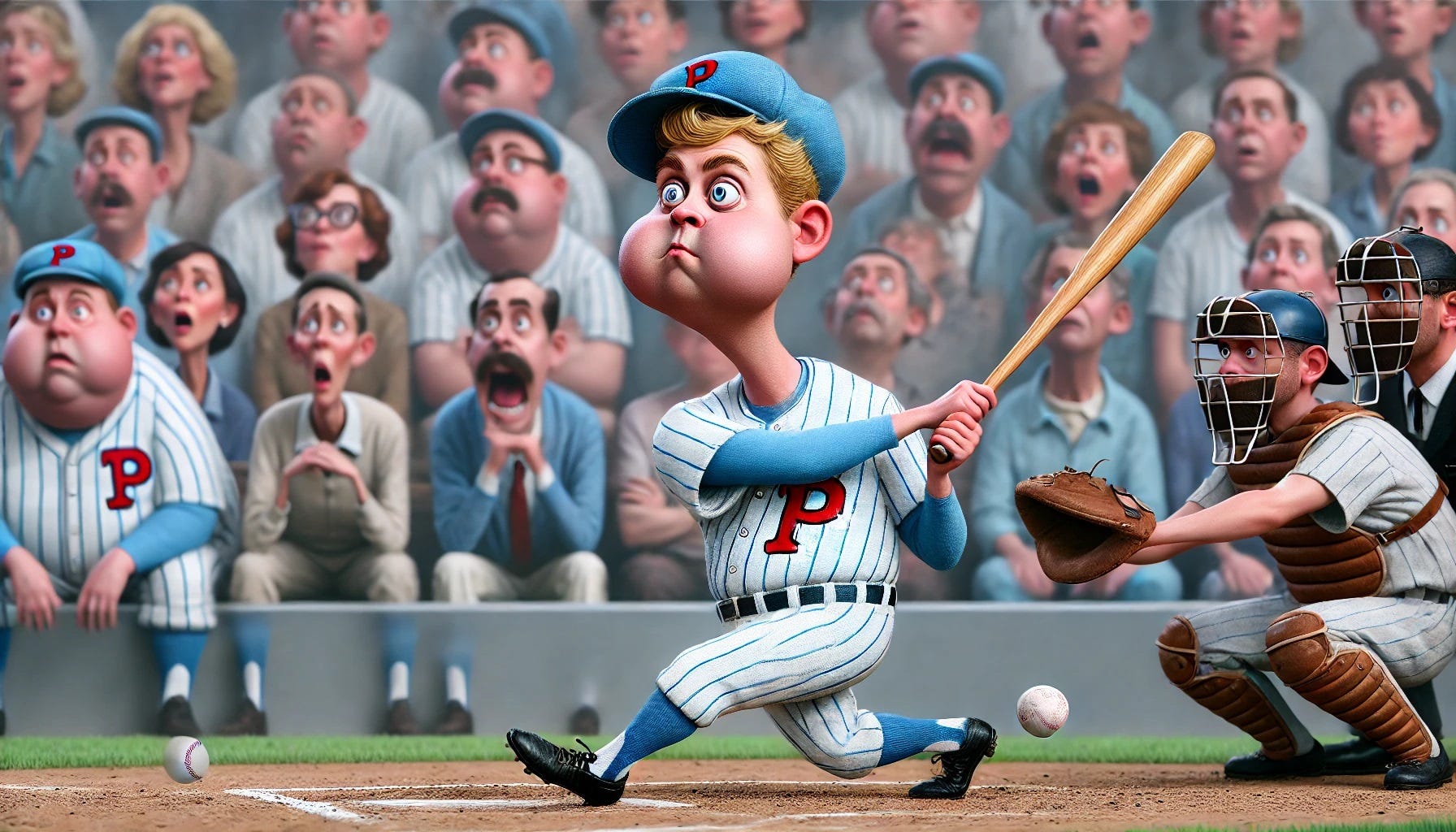
Another in our series on Expat Sports Disorder, the unheralded digital affliction. This October, my beloved team forgot how to play baseball. But why should I care?
Being a sports fan can feel like embracing a life of frustration, anger, and confusion.
And this goes double for Philadelphia fans: The city is big enough to acquire talent, is close enough to New York and Washington that it has massive rivalries, and as the pre-Washington capital, where much US history was made, it is aggrieved. Somehow the result is that the teams are quite good at an above-average rate yet win championships far too rarely to meet the expectations of the fans. So they seethe, and are mocked across the land.
The absurdity of dealing with any of this goes through the roof for expats like myself who, through the digital magic of newish technology, have the choice of deciding to suffer before screens, faraway from teams they love, in the middle of the night. Which was the case for me in Tel Aviv this week, as I stayed up till 3 a.m. my time to watch the favored Phillies fall to the hated New York Mets. That prematurely ended a season in which I must have seen over 100 games, mostly till the morning hours. And it is almost a relief.
For despite the intense emotion fanhood generates it makes so little sense. The teams we think we love aren’t even made up of players from our cities, most of the time – and realistically, we barely love the cities that we generally have happily escaped.
The teams are businesses, not family – not matter their protestations. Every decision is driven by financial gain, from player trades to overpriced tickets and merchandise. The players are millionaires, the owners are billionaires, and the suckers on the sidelines and emotionally invested in something that’s mostly a corporate venture. The players we are supposed to adore can be traded, often on the whim of general managers we disdain.
And even if your team is great they rarely win it all, so your season will likely end in disappointment. For most fans of most US team sports, the setup is such that the season concludes in loss and heartbreak if they make the playoffs — or in irrelevance if they don’t. (This is a little different in the UK and Europe, in soccer/football for example, where the championship and the cup are two different things to be celebrated with arguably equal joy).
And that’s the truly maddening part — the paradox of supporting a good team. Since we are rooting for our teams to win, logic suggests that at least fans of a good team would experience greater or more frequent joy. Wrong: Given the way most people are wired, the better the team, the worse the experience for the fan.
This is due to human psychology: Studies reveal the dominance of expectations in determining happiness. So for sports fans, yes, the highs are high – but the lows are devastating, to a more powerful degree.
If a team is expected to win, the disappointment of an early playoff exit is crushing – especially for baseball fans who invested an excruciatingly long season of 162 games in the expectation of October playoff joy (about a third of the teams make the tournament). You stop enjoying the games and instead live in a constant state of anxiety, praying that your team doesn’t blow it. By the end of the season, you’re more likely to feel anger than love for your team, unless they win the championship (called, with wonderfully unaware American hubris, the World Series).
The bizarre and cruel truth is that it’s psychologically better, for many, to root for a mediocre team where the stakes are low. A losing team lets you shrug off losses without agony. There is a chance – a small chance, but it exists – that you might experience what they tell us is the actual purpose of the enterprise: love of the game.
The Philadelphia Phillies for a perfect case study. I began to follow them as a kid in a place called King of Prussia in 1976, and they made the playoffs three times in a row with stars like Mike Schmidt and Steve Carlton – only to break my heart each time, the pain growing mightier each season.
In 1979 they acquired superstar Pete Rose; that year my buddy and I broke into the Phillies dugout at Veterans Stadium in the middle of a game with a TV camera, and I asked him if the team would finally win. “Every team thinks they got a chance of winning,” he said. “If you don’t there’s no sense in playing.” And that year indeed they won it all.
I declared their World Series victory over the Royals to be the highlight of my life and expected to never feel this good again (my family hates the idea that the next time I did was when they won the World Series again – 28 long years down the road).
Since 2008 it has been a drought, despite some very good talent on the team.
In 2022, after a decade of mediocrity, they barely squeaked into the playoffs. It was thrilling to watch them overachieve, advancing all the way to the World Series. But the lost the series 4-2. What should have felt like a glorious run ended in a storm of questions and and bitter disappointment.
In 2023, they were expected to compete for the World Series. They made the playoffs, advanced to the League Championship Series (the semifinal) and were up 3-2 against an inferior Arizona team. Then their vaunted offense vanished in the final two games, leaving fans in a veritable state of fury.
So the stakes this time were seriously sky-high. Sure, there are horrible wars in the Middle East and Ukraine and Africa and a critical US presidential election coming, but the Phillies won their division, the National League East! They secured a playoff bye and faced the New York Mets in a best-of-five torment. We knew anything short of a World Series win would have ignited rage – but certainly going down 3-1 for an early exit was not expected.
The team collectively forgot how to play baseball, to a degree rarely seen in professional sports (my only equivalent experience was … a year ago with the the Philadelphia Eagles, who forgot how to play football to a degree that the Guardian called “the wildest in-season unraveling in NFL history”).
Last week, at any rate, the Phillies looked like the caricature at the top of this article (below, the undignified conclusion). Fans now feel the crushing weight of expectations unmet so abysmally that the result is not dismay but anger. There is little joy in the experience.
For expatriates, the situation is especially absurd. Work and home life suffer amid a constant grogginess. The derision of one’s foreign friends is limitless. The syndrome has a name, which I made up: “Expat Sports Disorder” (and which I have written about before on these pages). Why does it exist – how could all this be? That, clearly, is the question.
Because being a fan is a devotion that defies logic, as we have seen. But there is certainly something else. An optimist – or a lover of the counterintuitive – might view it as a beautiful madness. It’s not about joy, obviously. Not really. Perhaps it’s about shared suffering – rising the highs and lows with a group of people who care just as irrationally as you do. Community, even among strange people, is a powerful urge that can overcome constraints of space and time. Or maybe it’s about reliving the years of one’s youth.
I grew up in King of Prussia, just outside Philadelphia, and once told my friend Roger that I would dedicate my life to the study of human stupidity (some would argue that as a journalist, I have actually done just that). “You’ll never get out of King of Prussia,” quipped Roger. We laughed and laughed and laughed, adolescent elitists that we were. But the joke is now on me.
I did get out of King of Prussia, but Philadelphia somehow stayed in me. Now my study of stupidity focuses squarely on myself.
VIDEO | Hundreds of police lock down locality after baseball-wielding rival clans rampage hospital
