















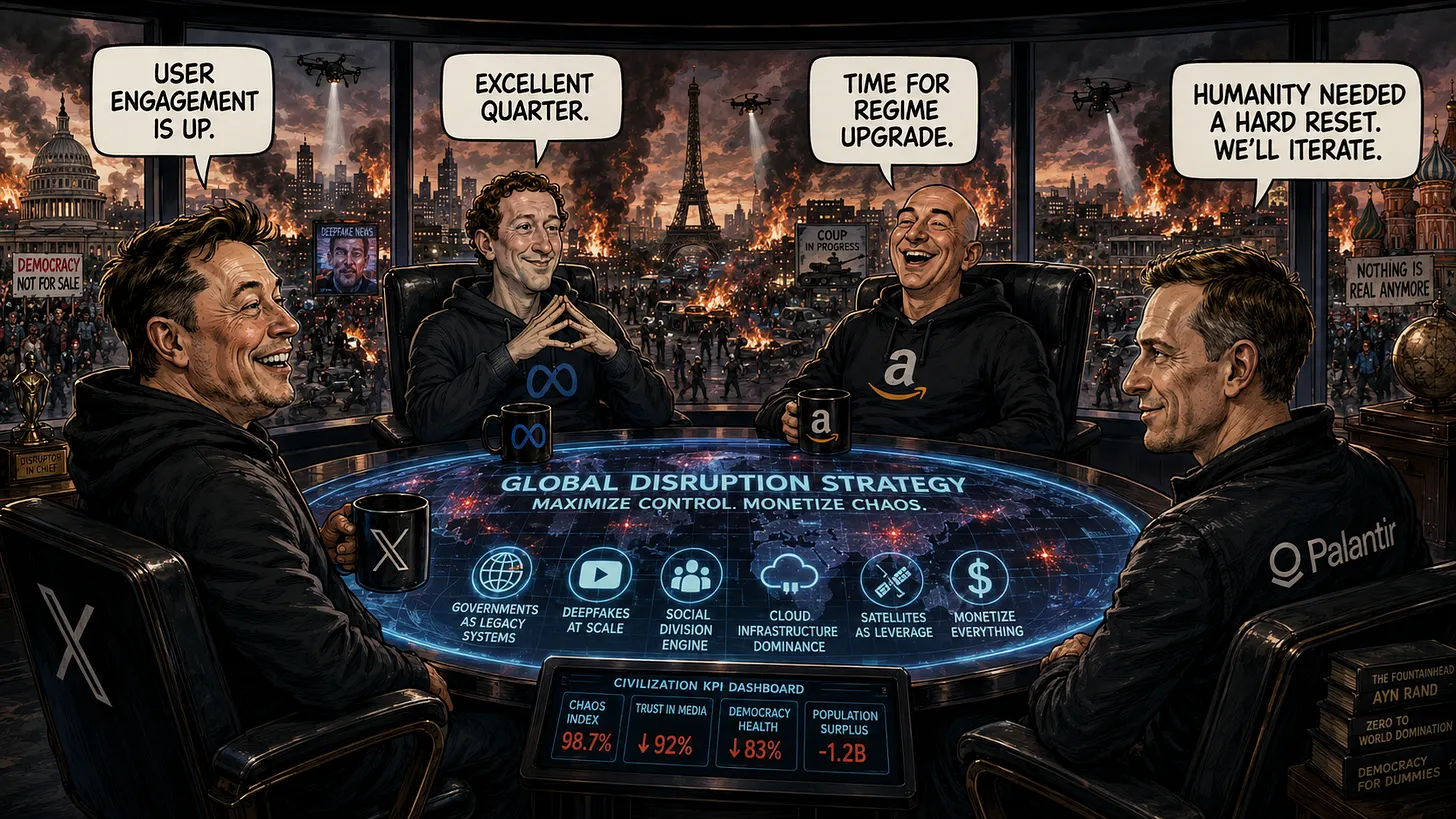
Mountainhead, a movie about tech tycoons gone jargon-spewingly berserk, is a sign of the times
There is a scene in Mountainhead, the engrossing film by Succession creator Jesse Armstrong, in which four jargon-spewing tech moguls, two of them vying for World’s Richest Man, discuss how to leverage the deadly global pandemonium that one of them directly caused. They are appreciating the “disruption.”
Having engineered a coup in Argentina, they contemplate another in the United States, for the benefit of humanity, which they believe will soon “meld with machine.” The absurd thing is that none of this feels entirely absurd. Because something very strange has happened to our society.
The billionaires in Mountainhead are monsters. Gathered for a weekend at a luxurious mansion, they watch as new AI deep-fake video functionality unleashed by one of them causes an epidemic of riots, coups and crises. They see the deaths as a useful culling and brainstorm getting to the “next level” with gleeful contempt for anyone outside their tiny class of tech supermen.
These guys are so insular that they’ve developed their own vernacular, applying the logic of venture capital to everything including a comical attempt at murder, which they brainstorm, test, iterate and pivot their way through as if developing a minimum viable product. Even terminal illness becomes a KPI: One of them, who owns much of the global “cloud,” describes his cancer as “net-net, a big positive … Wisdom: 50% increase. Purpose, meaning: both way up.”
Mountainhead is not a great film — do not expect the best-in-class veneer of Succession — but it is a fascinating reflection of its time. Two decades ago, popular culture imagined the tech billionaire as Iron Man Tony Stark. Today we get Lex Luthor crossed with Darth Vader – and it feels like documentary.
When exactly did the tech geniuses become the villains?
The title of the movie evokes Ayn Rand’s The Fountainhead and its hero, Howard Roark, the brilliant architect who refuses to compromise his vision for the mediocrity of the crowd. That wasn’t so far from the image many of us once had of Silicon Valley. Let geniuses build and innovators disrupt. Government is slow, bureaucrats “don’t get it” and exceptional people see the future.
For a long time, this was not an unreasonable position.
Bill Gates was the dork who helped put a computer on every desk. Steve Jobs could be difficult but produced astoundingly useful tools for all. Jeff Bezos sold books on the internet. Mark Zuckerberg connected college students. Elon Musk helped create PayPal, then set about building electric cars and reusable rockets.
Sure, Microsoft faced a historic antitrust case. Jobs was a weirdo, and hardly a model employer. Amazon devastated independent booksellers. But the larger narrative was overwhelmingly one of progress. These people were not yet personally controlling the world’s cloud storage, deciding which countries should have access to critical satellites, or making humanity lose its mind.
I studied computer science (yup! a master’s degree) and I always believed technology is overwhelmingly a force for good. History gave me every reason to think so. Over the past three or four centuries, steam power, electricity, sanitation, antibiotics, aviation, telecommunications and computing have transformed human existence. People live longer, healthier, freer and more prosperous lives because of technological progress.
It was a “net positive.”
Nuclear physics gave us the atomic bomb, but also nuclear power and lifesaving medical technologies. Cars kill people but also offered extraordinary freedom of movement. The internet brought fraud, pornography and misinformation, but it also gave much of humanity access to almost the entirety of human knowledge.
Part of what seems different is that in an age of celebrity, too many of the tech moguls themselves appear to have gone off the rails.
Zuckerberg ended up before Congress clumsily evading questions about what Facebook does with people’s data. Peter Thiel, early Facebook investor and PayPal co-founder, believes freedom and democracy are incompatible and has supported efforts to create communities beyond the jurisdiction of governments. Larry Ellison, billionaire co-founder of Oracle, is trying to help Trump control the media in exchange for vastly valuable access and favors. Not cool.
And then there is Elon Musk, the most spectacular of all. He called a British cave rescuer a “pedo guy” because the man criticized his proposed miniature submarine. He tweeted about taking Tesla private at $420 a share, an apparent marijuana joke that prompted action by the Securities and Exchange Commission. He bought Twitter for $44 billion, walked into headquarters carrying a kitchen sink, fired most of the staff, renamed it X and turned it into an unregulated cesspool. And in 2020, seeming to threaten Bolivia over his lithium interests there, Musk tweeted: “We will coup whoever we want! Deal with it.”

Was that a joke? It’s not so funny when Musk spends over a quarter billion dollars helping Trump win the presidency and is rewarded with control of the so-called Department of Government Efficiency, from which he and his goons eviscerate regulators, dismantle federal agencies and fire tens of thousands of civil servants seemingly on a whim. (Sure, sure, efficiency. Need to check on your tax rebate these days? Guess what? There is no one to talk to.)
A weird millionaire is colorful. A weird billionaire who thinks he rules the world is a menace. As, potentially, are their monumental companies. Amazon now controls a significant portion of the global cloud infrastructure on which governments and businesses depend. Facebook is a faceless behemoth that influences what billions of people see, read and believe. Musk controls satellite infrastructure that can affect the course of wars. In the movie, this is abused by the tech bros. Looking at the real-life equivalents, does that seem so unlikely?
But blaming everything on strange billionaires is too easy. Something deeper has happened. Our feelings about the people who build technology have changed at precisely the moment our feelings about technology itself have changed.
Social media was going to connect the world but is very obviously making children addicted and depressed and turning adults into the worst versions of themselves. Democracies have as a result become more polarized and, in some cases, nearly ungovernable.
Artificial intelligence may help cure diseases, accelerate scientific discoveries, revolutionize education and generate extraordinary prosperity. It may also eliminate hundreds of millions of jobs and entire professions and wipe out any hope of knowing what is really going on.
A few years ago the ability to generate realistic images was impressive. Now it is terrifying. Imagine if any troublemaker with a premium account could create unlimited videos of minorities rioting and pillaging across the United States and, for a few extra dollars to unscrupulous platforms, amplify distribution to white nationalists. Or if millions of Israelis suddenly were made to believe the Palestinian Authority had invaded Tel Aviv. Or that Turkey attacked Greece?
This is essentially the catastrophe imagined in Mountainhead. And it rings quite real — perhaps a year or two away. So maybe this technological moment really is different. The harms of earlier technologies were generally side effects of machines whose fundamental usefulness was clear. But if these algorithms make more money by making us angrier, is that a side effect or the product?
We don’t know whether AI will primarily liberate human beings from drudgery or make a huge proportion of them economically superfluous. We don’t know whether it will expand human knowledge or destroy the real-world information environment on which that knowledge depends.
The answer cannot be to stop technology. But neither can the answer still be to trust simply the geniuses.
That was the old Silicon Valley bargain – but these systems have become too powerful, too essential and too bizarre to remain as private kingdoms governed largely by the temperaments, ideologies and whims of a tiny handful, some of whom need urgent help for their Messiah complex.
