













And an update on the war, four weeks after it began
We live in an era so strange, and so detached from the norms that long have governed geopolitics, that something extraordinary has passed almost without remark. For decades, there was an unspoken rule that leaders of countries did not kill one another. That seems to be gone — and while the logic seems in Iran’s case compelling, the consequences could be brutal.
UPGRADE TO DAN PERRY’S SUBSTACK HERE
Before we examine that, a quick recap of where we stand after 28 days:
We are in one of those moments when it is hard to avoid cliche, because things really could go either way.
On one hand, there appears to be some version of negotiation underway, certainly indirectly, weirdly enough through Pakistan. The Americans are trying to dictate terms of surrender, which would be logical if one were dealing with rational players who have been thrashed as badly as the Iranian regime has. The terms are right and just: Iran really should end its nuclear and missile programs and support for proxy militias in the region (probably been the regime’s greatest non-domestic outrage). Ideally, it would also agree to democratic reforms.
But the Iranians, seemingly indifferent to the assassination of almost their entire senior leadership, show interest in no such thing. They believe they’re somehow winning by having blocked the Strait of Hormuz; they consider “asymmetry” their friend. Agreeing to this blackmail would be a horrendous precedent. But escalating in order to better persuade is also risky and may simply not work: the regime is reminiscent of the Black Knight in Monty Python and the Holy Grail. who mulishly refuses to capitulate despite ever-more-outlandish setbacks.
Instead the Iranians want reparations, guarantees, and sovereignty over the Strait of Hormuz. This is a shared waterway with Oman. Comparing it to the Suez Canal which is fully in Egypt, so as to make it an Iranian toll booth, is absurd. But that’s where we are. Obviously, this may be an opening gambit only — but even dignifying it seems wrong.
Why is the regime hanging on? And what is the regime? Is it the foreign minister, the president, and the speaker of the parliament? Is Mojtaba Khamenei, the Supreme Nepotist, a real thing? The Islamic Revolutionary Guard Corps in particular is designed to prevent exactly the kind of fissuring people keep predicting. That doesn’t mean cracks aren’t there; perhaps they’re hidden still. There’s always a chance that with a few more blows, the regime will be more interested in peace. But another spectacular thing may need to happen.
So in recent hours there have been reported US–Israel strikes on Iran’s Khuzestan and Mobarakeh steel complexes, which mark a notable shift in targeting — from primarily military or nuclear-related sites to the country’s industrial backbone. These facilities are central to Iran’s domestic economy and export capacity, particularly in steel, one of its most resilient non-oil sectors under sanctions.
The implications are significant. Expanding target sets to include heavy industry blurs the line between military and economic warfare, raising the stakes of the confrontation and increasing the likelihood of sustained escalation. It also signals a willingness to impose systemic pressure on Iran’s state infrastructure, potentially inviting reciprocal targeting of economic assets across the region. At the same time, such strikes risk unsettling global markets tied to energy, shipping, and industrial supply chains, reinforcing the sense that this is no longer a contained security flare-up but a widening strategic contest. And, as even some diaspora activists warn, this is the kind of thing that risks angering the very population that everyone hopes will rise up once more against the regime.
Other escalation scenarios include:
- Seizing Kharg Island: Militarily conceivable, and strategically enormous. It would be a direct strike on Iran’s oil lifeline and almost certainly trigger retaliation across multiple theaters (Gulf shipping, Iraq, possibly Israel). Yemen’s Houthis, who seem to have joined the war over the weekend, will probably again block Red Sea shipping headed to the Suez Canal.
- Holding territory along the Strait of Hormuz: Possible, but even a narrow strip is not cost-free. It invites asymmetric responses —mining, drones, swarm attacks —and turns any occupying force into a permanent target.
- Striking at more and more Iranian energy infrastructure. Dicey. Iran could hit at its neighbor’s energy infrastructure, and that could lead to uncontrolled escalation. As said, even opposition Iranians tend to not want their infrastructure trashed; they will need it, if and when in power.

There is actually an interesting degree of Iranian expatriate optimism — but historically, diasporas often overestimate how close regimes are to collapse. We saw versions of this with Iraq pre-2003 and, differently, with parts of the Syrian opposition. It’s not that they’re wrong about underlying weakness; they’re often early in identifying it. Timing is where they tend to be unreliable. And time may be something the US does not have, given Trump’s capriciousness and the relative unpopularity of the war, especially considering its inflationary consequences.
The key question: Is there a military coup scenario? Iran is not a typical praetorian state. The regular army (Artesh) is deliberately kept separate and weaker politically than the IRGC. Any coup would likely have to involve elements of the IRGC itself—which is both the regime’s backbone and its biggest potential vulnerability. That’s a high bar. It should have been in the planning before the bombing began — but it was either ignored, or has not worked. We come back, therefore, to the need for a paradigm shift.
In the end, we remain with the three possible scenarios AQL identified last week: the low-probablity regime collapse, the medium-probability regime acquiescence to US terms, and the compromise that allows all sides to claim a fictitious victory, lick their wounds and quite possible fight
Here are two essays worth reading:
- Simon Pearce outlines the so-called “escalation trap,” a self-reinforcing cycle in which each side intensifies conflict because backing down becomes politically or strategically unacceptable. Tactical gains are mistaken for meaningful progress, each side views its own actions as justified and the other’s as aggression, and earlier decisions narrow future options. Over time, the conflict hardens into a binary choice—escalate further or appear to lose—leaving actors effectively trapped in a path they can no longer easily exit.
- Claire Berlinski, our podcast partner on Critical Conditions, argues that the Islamic Republic cannot be understood through standard geopolitical logic, as its leadership is driven by a Shiite theological worldview that fuses politics with end-times belief. Rooted in Karbala, martyrdom, and the expectation of the Mahdi (a messianic figure), this ideology casts conflict and sacrifice as necessary steps in a divinely ordained process. The West misreads Iran by treating it as a conventional state, ignoring the fanatical belief system at play.
And now, back to the emerging “decapitation” strategy embraced by Israel and, by extension, the United States in their joint war.
This marks a profound departure from how even bitter adversaries have conducted themselves in the modern era. And it happened reportedly in the first minute of the war, with the assassination-by-bombardment of Supreme Leader Ali Khamenei — and again in last week’s killing of security chief Ali Larijani, believed to have been effectively in charge at the time.
This is significant enough in its potential implications to demand scrutiny as a doctrine – one without precedent in the modern era. States have mounted invasions, overthrown governments, and killed military figures, but have almost never acknowledged or normalized the direct targeting of a head of state. Israel itself has killed terrorist leaders before – and increasingly after the Oct. 7 Hamas massacre which started the current string of wars – but not heads of state.
Even at the height of the Cold War, the United States and the Soviet Union avoided such actions. Both engaged in covert operations, backed coups, and attempted to influence or remove foreign leaders through proxies. The 1973 overthrow of Chilean President Salvador Allende, supported by the United States, is a case in point; Allende was killed in the coup, but not by Americans.
Saddam Hussein was targeted during the 2003 invasion of Iraq and executed after a trial, but it was held by a nominally Iraqi special tribunal – and Muammar Gaddafi was killed during Libya’s civil war with NATO involvement, but by a local mob. Earlier historical periods offer looser precedents, when rulers were sometimes killed in war or intrigue – but under a different international system.
Even the assassination of Archduke Franz Ferdinand in 1914 — a killing that helped ignite World War I — was not the targeting of a sitting head of state by another government. He was the heir apparent to the Austro-Hungarian throne, killed by a Serbian nationalist conspirator, not a state actor.
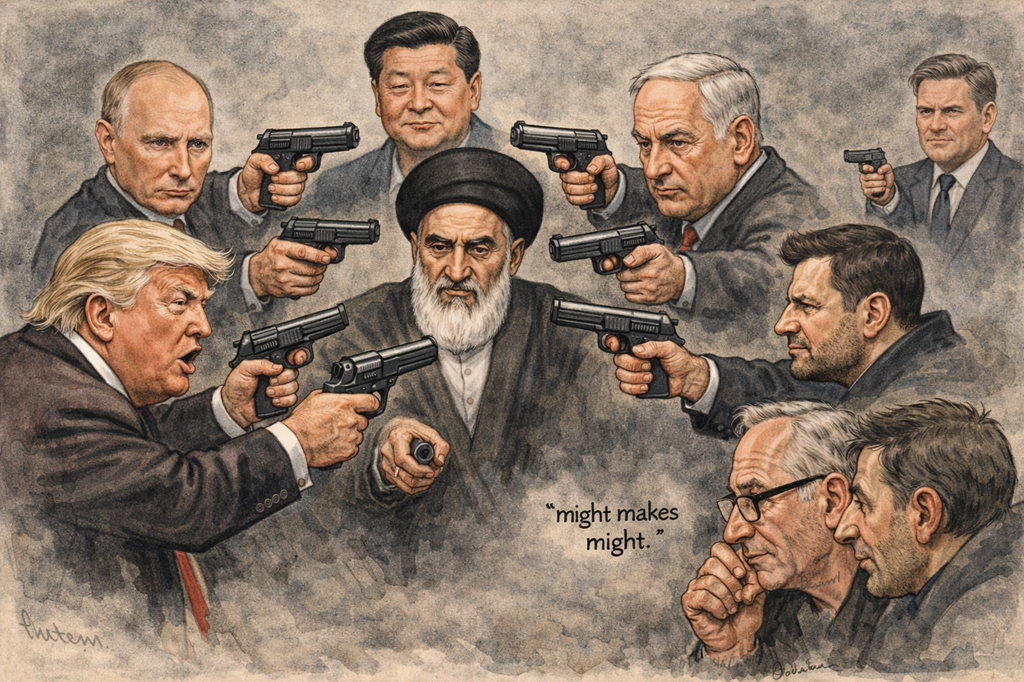
In the modern era, sovereign leaders, however objectionable or hostile, were not treated as routine military targets. There was a preservation instinct at play as well: Once heads of state become legitimate targets, all heads of state become legitimate targets. There might be, rather inconveniently, no end to it.
Indeed, there are now growing fears that American or Israeli leaders could become targets. Iran has threatened President Trump, and there are reports about drone threats against his senior officials. Moreover, the anti-American, anti-Zionist wing of social media is rife with false (and celebratory) claims, which some really believe, that Benjamin Netanyahu has been targeted and killed.
It seems safe to say that the threat level to any leader or any country now travelling around the world has measurably increased – and eventually an attacker might succeed. They – and their supporters – will be as convinced of the justice of their cause as those who support killing the vile Khamenei.
So was this a smart move?
The legitimacy argument is seductive but dangerous. Many would argue that a whole host of dictators around the world, fomenting war and staying in power through repression and mass murder, “deserve” removal from the scene. But especially in a world as polarized as ours, there will be many others who are cynical about the West and would rejoice at the killing of its elected leaders.
Sometimes it can be argued that the ends justify the means. Leadership matters, and systems that appear stable can be brittle beneath the surface. Remove key figures, and perhaps they might collapse amid a general rejoicing.
There are times – rare, but they exist – when a consensus can form around the desirability and legitimacy of interference of this kind. The case in point is Adolf Hitler, and it is instructive: the Nazi regime was monstrous enough – to its own people as well as the world – to justify intervention, and its entire organizing principle depended, incredibly enough, on one highly bizarre man.
In Iran’s case, it may be possible to argue that the first condition is met – not only because of its epic domestic repression, but also and especially because of the insistence on exporting jihadist revolution to its neighbors via proxy militias. But the second condition, alas, may not – there is little reason to believe that Khamenei personally was critical for the Islamic Republic apparatus to survive.
That may not be a fatal flaw. The message, clearly, is also directed at other players – perhaps chiefly at the military, in hopes that it would finally stage a coup. But there is also the possibility that in such situations, anyone willing to step into such dangerous shoes would as fanatical as the departed, or worse.
The Iranian regime may yet collapse – which would be cause for celebration – but it may also double down. The remaining leadership seems to be betting that it can so rattle oil markets that Trump will eventually call it a day. Everyone will claim victory – in the Iranian regime’s sad case, merely for having survived.
So what now should be the strategy? What are the lessons so far?
If the objective is to either force surrender terms on Iran (an end to the nuclear, ballistic missile and militias programs) or to bring down the regime, decapitation alone will probably not suffice. A system like Iran’s will fall only when it can no longer function — when it cannot repress, pay its people, or spread paralyzing fear. That requires a broader effort that offers a credible vision of what follows; if the alternative appears to be chaos, even opponents of the regime may cling to it.
The United States should have been preparing the foundation long before launching the war – ensuring that when the system is in a deep enough shock due to the “decapitation,” men with guns would swiftly take over, backed by massive support on the streets. Such protests would need the people to understand that the regime’s repression mechanism is in chaos. And it would require a swiftly organized and visible new set of civilian figures alongside the military ones, presenting as a transition structure enroute to democracy.
It is actually possible in Iran – because much of its society is quite modern and even Western-oriented. A version of this may still work – even if not now, then not too far into the future.
And if it does, it will be critical to message that everything about this war was an exception, if not a total singularity. There’s no advantage in normalizing killing of leaders. If that becomes a tool of statecraft, every leader is a target. It will blow up a fragile equilibrium that has kept the world even partly sane and stable.
