












Why We Believe (or Pretend To) Science, reason, and democracy challenged God — yet billions still cling to religious faith. Here’s why.
This is the High Holiday season of Judaism, when even some secular people may find themselves engaged in some ritual whose meaning they barely endorse or comprehend — yet which they still feel compelled to honor. It is a season of introspection, of confronting the past year and imagining the year ahead. And as religion is the driver, it seems natural to ask: Why are people religious at all?
The question matters because religion is both ancient and surprisingly durable. From the earliest hunter-gatherer societies, humans have invented gods, conjured spirits, codified rituals, and imposed moral codes. For most of recorded history, to live outside religion was almost unthinkable. And there was a practical reason: Religion gave order to chaos, community to the isolated, meaning to suffering, and promises of continuity to those staring into the abyss of mortality. Whether any of it was true seemed impolite to even ask, and could prove deadly at times.
Then came the Enlightenment, and for the first time in the West, religion’s dominance was challenged. Science revealed natural laws that required no divine intervention. Human rights and democracy offered ethical structures that did not require sacred authority. The 20th century deepened the trend: urbanization, secular humanism, and the dazzling march of technology made faith seem optional, old-fashioned, or even idiotic. In Europe, religiosity plummeted. America held on longer, but there too belief has waned before modernity.
Yet here in the 21st century, something unexpected is happening. Religion, or at least fervent religiosity, is resurgent in some quarters in some ways. In parts of the West, fundamentalism is louder than ever. In much of the Global South, and perhaps most fervently in Muslim-majority areas, it was never lost. Even in secular Europe, large immigrant populations have brought back the sights and sounds of piety. As the below chart from World Health Surveys shows, there is a rise in “non-practicing religious.” And as secularism itself proves unable to provide stability in the face of mass migration, job losses from globalization and digital disruption, and the disorienting cacophony of social media, there is a real possibility (or is it a danger?) that more people will again reaching for religion’s anchor. Certainly the decline in religiousness has been arrested, for now.
Secular humanism promised fulfillment in reason, but many feel stranded in what looks less like rational paradise than a bewildering, uncertain Tower of Babel. So against expectation, religion persists. This has long vexed me, and I’ve conducted extensive field research.
This goes all the way back to high school in Philadelphia, when my friend Alfred invited me to attend Sunday services at his Unitarian Church, which is an unusual branch of Christianity that flirts with humanism and other traditions. My Jewish immigrant parents were scandalized, for in their Romania the Church was the source of antisemitic blood libels and little else. But Alfred’s reassurance that there was no missionary aspect nor supernatural beliefs involved turned out to be true; instead the congregation sang Morning has Broken by Cat Stevens. Alfred was offended at my assertion that without the mumbo-jumbo it was not really a religion; his minister told him that people like me would never understand.
On these very pages, I have published debates with Rabbi Heshy Grossman, who has also labored with me in vain (an example here).
These and other investigations have led me to the conviction that people cling to religion — or appear to — come down to the following.
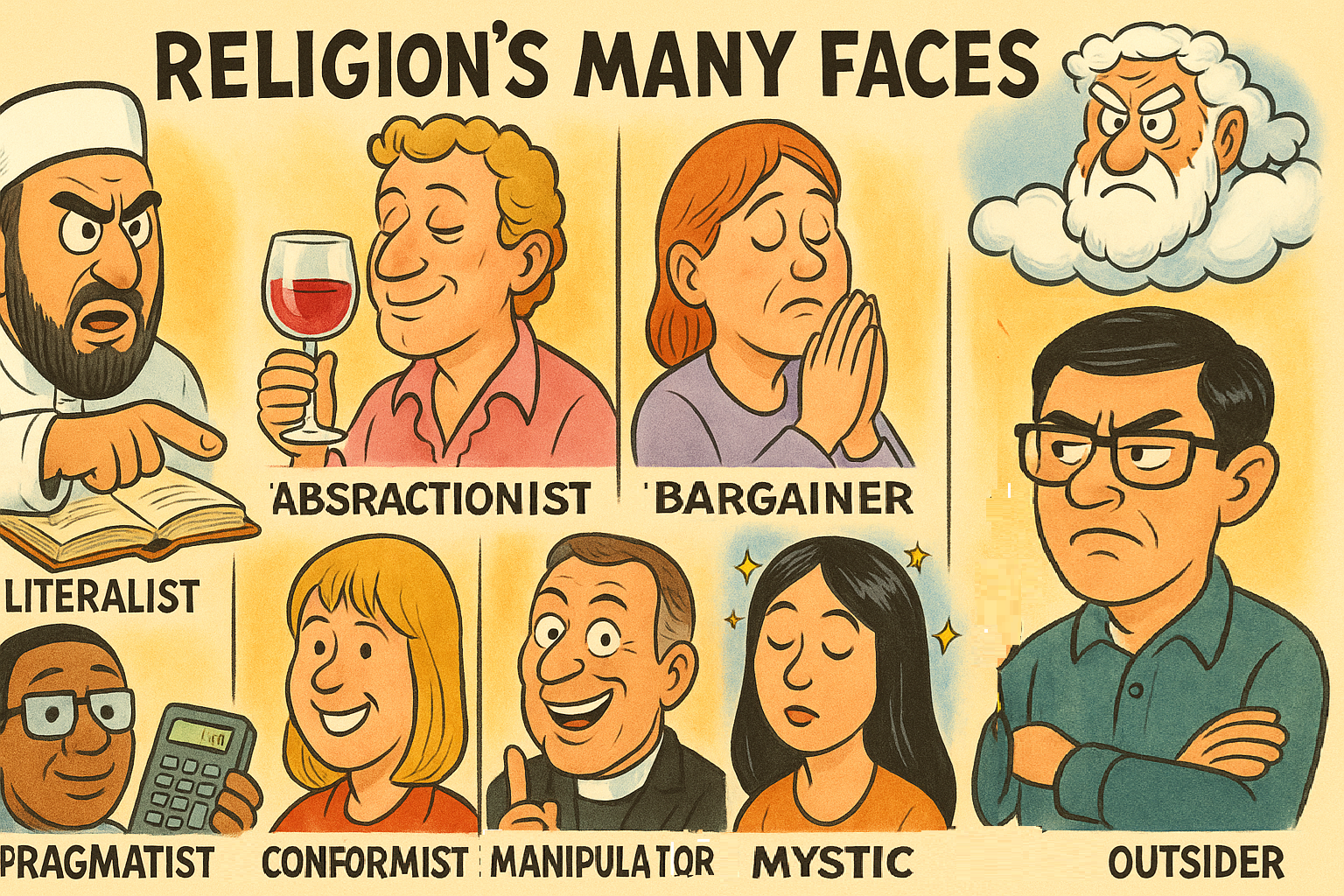
- One face of religion faces is The Literalist. For this person, the sacred texts are not metaphors or myths but plain truth. God is imagined as a personal being — a stern father, perhaps a meddlesome friend in the clouds, almost always a bearded old man, but one who’s in excellent shape — who watches closely, cares about every action, and will dispense reward or punishment in kind. Since there is so much evil and injustice in the world, he must “work in strange ways” – familiar in form but inscrutable of decisions. Other religions are false, for there can be only one truth. Literalists abound across traditions: Christian fundamentalists who see the Bible as the inerrant word of God; Islamist radicals who insist on rigid, context-free readings of the Quran; ultra-Orthodox Jews who treat the Torah as divine diktat. They can be dangerous, since their certainty easily mutates into intolerance. But this approach offers what modern life does not: clarity, stability, and an unshakable anchor.
- A different type is The Abstractionist. These are believers who resist anthropomorphic images of God, and often ridicule the critics of religion for even caring about it. They simply insist that something greater exists — an eternal force, an ordering principle, an energy beyond comprehension. Here, “God” is still deployed (somehow confoundingly to literalist non-believers), as a fluid term for a mystery that is somehow treated with grave certainty. Judaism lends itself well to this abstraction. Even among the strictly observant, God is rarely defined; “His” name – a mysterious Hebrew acronym that roughly spells out “Jehovah” – must never be uttered. Abstractionists may live with great religious rigor, following laws and rituals not because they believe every ancient tale happened literally, but because they sense in the practices themselves a sacred resonance. This position allows modern people to say “I believe in God” without embracing literal impossibilities, a compromise that makes religion tolerable in an age of science – yet can also seem like fuzzy thinking, absurd self-delusion, and craven compromise.
- Then there is The Pragmatist, or what might be called the believer of convenience. For such persons, religion is less about metaphysics than about structure. They may not care much whether the Red Sea really parted or whether miracles happened, and they may not even bother with the cosmic force of the Abstractionist, but they cherish the way religious rituals punctuate life and give it rhythm. Shabbat dinners, Christmas Mass, Ramadan fast-breaking — all are valued less as theological obligations than a social protection. Religion here is the framework that holds families together, the structure that turns time into a cycle of meaning, the vehicle of community belonging. Many modern Jews, Christians, and Muslims fall into this category: they perform the rituals because they work as glue in a society, not because they think the heavens demand them. Jews, who are non-missionary (some might say exclusionist), believe this held them together during millennia of diaspora, which seems true. Some thinkers – Douglas Murray comes to mind – have linked abandonment of religion by Europeans as having led to weakness in the defense of Western civilization. Religion here becomes not faith but heritage, identity, or even beloved cuisine.
- Another category might be called The Bargainer. These are people who will admit, sometimes quite candidly, that belief may be nonsense but is also a kind of wager. It’s encapsulated in a proposition by 17th-century French scientist-philosopher Blaise Pascal: If you believe and you are wrong, you lose little; if you do not believe and you are wrong, you lose everything (assuming, of course, a vengeful and egomaniacal god). But the modern bargain is often less about heaven and hell than about psychology. Believing in God, an afterlife, and purpose simply makes life more bearable – if you’re willing to suspend thought. To live without such beliefs is to confront the possibility of a purposeless cosmos, to stare at mortality without comfort. Why not choose the happier story? What to skeptics is self-deception becomes, for the bargainer, no different from any other life-affirming philosophy. If belief makes life better, that is reason enough. So I’ll believe I am a billionaire.
- Lastly, and arguably most pitiably, sits The Conformist, the believer by peer pressure. This is not about metaphysics or wagers but about the social belonging of the beta. If you are born into a devout family or community, religion is the air you breathe. You participate because it is expected, not because you are convinced. In the shtetl, in the small town, in the traditional village, such “faith” was universal. Yet it is fragile. Transplant such a person to secular Norway or Paris or New York, and the belief may evaporate quickly. The conformist, religiosity is nothing but a pandering to the crowd.
- These six prototypes exist on a sliding scale that binds them together by degree and origin of adherence to the same organized religion (and though I mention only the monotheistic ones, they apply universally). But there is more to the religious urge. One must consider The Mystic, who seeks not dogma but direct experience of the divine through a prayer, meditation, or ecstasy whose essence no words can capture.Lastly and leastly arrives the most cynical category, The Manipulator: This fascinating specimen dons the robes of piety while privately disbelieving). American gospel televangelists have been criticized — even by fellow Christians — for exploiting the poor by promising material blessings in exchange for donations, often living lavishly off contributions from those least able to afford it.
Arrayed against this diverse landscape of real and fake piety, one finds The Outsider – who declines the whole enterprise. Here we must distinguish between atheists and agnostics. The atheist says: There is no God. The agnostic says: I don’t know. Agnosticism seems more modest but risks sounding like a coin flip; in reality, most agnostics believe the odds of a biblical-style deity are tiny —but not zero. This refusal to “go to zero” often stems less from notions of the divine than a philosophy of the world: Just as we cannot prove that our lives are not a hallucination, we cannot prove the absence of God. Viewed through this prism, total atheists are often derided as a version of a believer (a believer in no god) – as intellectually indefensible as the pious. But practically speaking, both atheists and agnostics live as if there is no divine intervention, substituting ethics, science, or humanism as their compass. Realistically, I fall into some version of this last bucket. To me there cannot be faith — only knowledge (or the lack of it), assessment and hope. Faith, from this perspective, is as the fourth dimension.
None of these categories is entirely flattering or completely pleasing. Literalism seems rigid, abstraction slippery, pragmatism shallow, bargaining self-serving, conformity timid, mysticism pretentious, manipulation evil, and atheism bleak. And yet somewhere within this spectrum most of us reside, perhaps shifting categories over a lifetime, sometimes even occupying more than one at once.
Either way, religion’s tangible record of damage in recent centuries is used by critics to blow up the notion that religious is a force for good, even if based on nonsense.
The Inquisition tortured and executed countless people in the name of doctrinal purity. Fundamentalist religion in US politics has helped drive harsh policies seen by many as inhumane in their disregard for individual autonomy and suffering, and Christian nationalist currents overlap with elements of white supremacism: many far-right groups—from the Ku Klux Klan historically to contemporary “Christian Identity” movements—cloak racist ideologies in biblical justification. ISIS built its reign of terror explicitly on Islamist readings of scripture, justifying mass enslavement, sexual violence, and slaughter as “holy duty” – and most Islamic terrorism today is rooted in demonic notions gleaned from religion. In Israel, extremist religious currents drive extremist policies in ways that secular nationalism alone would struggle to sustain.
Yet here we are, nonetheless, with religion hanging in there. So why do we try so hard, go so far and accept so much just to lend our lives some meaning, even when in many cases we know it’s a socially acceptable fantasy? Why, when we can agree on nothing, are we united by the presence of religion? It is connected, I’m pretty sure, to the other thing uniting us all. It is because we’re scared of death.
