









In stark contrast to previous years, Bethlehem lies deserted this Christmas, bereft of celebrations and the thousands of tourists of yore.
The famous Christmas tree, usually in the middle of the square, is not there. There are no carols or Christmas market stands, reports the BBC.
Instead, a nativity scene, which shows a newborn Jesus surrounded by big rocks and barbed wire, has been installed as a tribute to the children of Gaza.
In an unusually empty Nativity Church, Father Eissa Thaldjiya tells me his city feels like a shadow of itself.
“I’ve been a priest in this church for 12 years. I was born in Bethlehem, and I’ve never seen it like this – even during the Covid-19 pandemic”, he says.
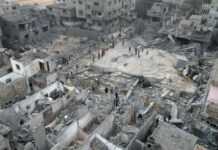
Jawdat Mikhael lives in Bethlehem, but his family is trapped in Northern Gaza. His parents, brother and dozens of other relatives have been sheltering in the Holy Family Church near Shejaiya in the east of Gaza City – an area devastated by Israeli bombardment. On the phone, Jawdat’s father tells him that he’s managed to venture out of the church for the first time in more than two weeks to try to find some food. He says that all is left around the church is rubble and that all the shops are burned. “It’s total destruction”, he says.
He wells up as he says that communications are down and that there is no water. Food is scarce, too – “enough to keep you alive – not to fill your stomach,” he says.
A week ago, Jawdat’s grandmother, Naheda Khalil Anton – who was also sheltering in the church in Gaza – was shot twice in the stomach as she was on her way to the bathroom. His aunt Samar Kamal Anton rushed to help her and was shot in the head.
Jawdat’s family had been sheltering in the Holy Family Church since the beginning of the war. Now, they’ve buried their loved ones there.The family blames Israeli snipers for their death. The IDF says it will continue its investigation.
He apologises to me for crying, and for not being able to speak much: “I’m sorry, but it’s just so difficult. We’ve endured so much.”
This morning in Bethlehem, church bells have been ringing as a few locals gathered around the Jesus in the rubble installation and Arabic songs played out on the speakers, one calling for salam – peace – for children.
Dozens of people are in the middle holding a big Palestinian flag – waving it up and down.
The Latin Patriarch of Jerusalem, Pierbattista Pizzaballa, is in Bethlehem for his traditional address. He was wearing the traditional black and white chequered Palestinian scarf.
A few steps away from Manger Square, souvenir shops line Star Street on both sides but without the usual bustle of buying, selling and haggling. The famous Palestinian stitch scarves, cushion covers and artefacts hang outside shops, untouched.
“We cannot celebrate with a lot of people killed in Gaza”, says Abood Subouh, a shop owner in the local market just off Manger Square.
He tells me that, sad as it is to see his city and his business this way, celebrating Christmas feels wrong this year: “We can’t be happy because we are not on the other side of the world. We are still in Palestine.”
Israel intends to continue its operation in Gaza, despite admitting challenges
