















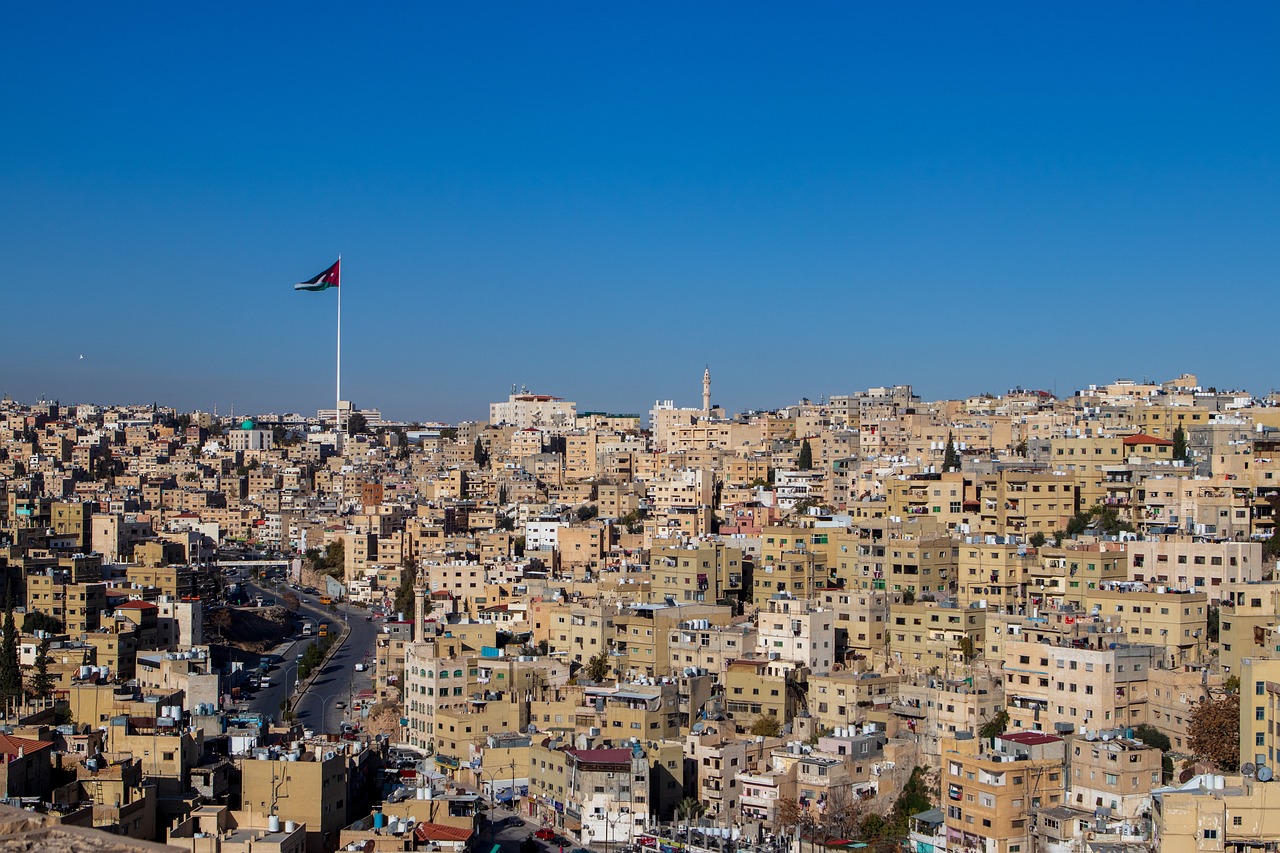
The fall of the Hashemite Kingdom would be a nightmare scenario for the West
With war raging in the Middle East on multiple fronts — Israelis fighting Hamas in Gaza and Hezbollah in Lebanon, with threats of an eruption in the West Bank and even the Houthi militia firing at them from Yemen — this weekend brought the prospect of instability in Jordan as well.
That’s the upshot from Sunday’s attack at the Allenby Bridge crossing, in which three Israeli citizens were killed in a terrorist shooting, apparently by a Jordanian.
With so many other countries in the Middle East falling apart or hopelessly dysfunctional, it can be easy to forget the importance of Jordan. the country holds a pivotal role in the Western alliance and the US’s strategic interests in the Middle East due to its geographic position, political stability, and historical partnerships. And as it is situated at the crossroads of conflict-prone places like Iraq, Syria, Israel, and the Palestinian territories, Jordan serves as a buffer state that helps contain regional instability.
Its leadership, under King Abdullah II, has maintained a pro-Western foreign policy, making Jordan a reliable partner in counterterrorism efforts. It has been a vital member of the coalition against ISIS and continues to host American troops and intelligence operations, making it an essential hub for military and diplomatic activities in the region. The Muwaffaq Salti Air Base, in particular, has been a key site for airstrikes and operations in Syria and Iraq.
Beyond security, Jordan plays a humanitarian role as it has absorbed millions of refugees from conflicts in Syria, Iraq, and Palestine. Its ability to manage these populations without succumbing to political unrest or economic collapse underscores its importance to regional stability, which, in turn, directly benefits Western interests.
Yet despite being a somewhat well-run police state, Jordan’s situation is precarious. The stability of the kingdom, which is run by Abdullah’s Hashemite family with the backing of Bedouin tribes, always appears to be somewhat in question.
Critically, the population of 11 million is probably half Palestinian-descended, and many in this group harbor deep grievances about Israel’s policies in the West Bank and Gaza, going all the way back to the establishment of the country in 1948. Their frustrations have sometimes boiled over into civil unrest. Abdullah has managed to navigate these pressures carefully, but the situation remains delicate. (Indeed, in Israel some muse about a future Jordan which is somehow itself a Palestinian state, easing the pressure for the Palestinians to exercise sovereignty in the West Bank and Gaza.)
Meanwhile, Jordan provides Israel with a calm eastern front and a buffer with Iraq, which is a hotbed for Iranian-backed Shiite militias. The peace treaty signed between the two countries in 1994 was a landmark agreement that ended decades of hostility and established cooperative security measures.
The Allenby Bridge attack, already tragic in isolation, risks sparking a chain of events that could fundamentally destabilize that situation, with catastrophic consequences for the entire region.
Although the attacker’s motives are still under investigation, the incident raises fears that terror networks in Jordan could be emboldened amid growing unrest across the region.
A key concern is that Iran, which has been instrumental in supplying weapons to Hamas and Hezbollah, could attempt to exploit any new chaos in Jordan. Iran has recently sought to smuggle arms into the West Bank, using Jordan as a transit route — which also raises concerns about some weapons remaining in Jordan, and enabling chaos there.
Moreover, reports indicate that militant groups are suspected to have strongholds in southern Jordan, where the border with Israel’s Arava region is relatively easy to cross. This southern region has long been a concern for Israeli security services, as its porous nature, amid a desert moonscape, makes it vulnerable to infiltration by militant groups.

Should the Jordanian monarchy lose its grip on power, Israel could find itself fighting along yet another front. That would further compromise its already weakened strategic depth. The military has, indeed, been preparing contingency scenarios for militant activity and cross-border attacks — and it is already overstretched. And, indeed, the West would face difficult choices too: Either offer military assistance in an attempt to stabilize the situation, involving myriad risks, or stand by and risk a new war zone emerging — or a new jihadist paradise forming.
From Israel’s perspective, what it cannot risk is allowing Jordan to become a replica of Lebanon, where a sovereign state stands by as militants use its territory to attack the Jewish state.
Nonetheless, there is reason to maintain optimism. The Israel-Jordan peace treaty has survived numerous terrorist attacks in the past, including a 1997 incident in which a Jordanian soldier opened fire on a group of Israeli schoolgirls on a field trip at the “Island of Peace” in Naharayim, killing seven. King Hussein of Jordan visited the families of the victims in Israel to offer condolences, demonstrating commitment to the peace treaty.
Indeed, Israeli-Jordanian relations have long been shaped by cooperation in the shadow of conflict. During the 1948 Arab-Israeli War, Jordan’s Arab Legion captured the West Bank and East Jerusalem, leading to decades of territorial dispute. But behind the scenes, Jordan and Israel maintained a relatively pragmatic relationship. Hussein engaged in secret communications with Israeli leaders throughout the 1960s and 70s, even as Jordan participated in the 1967 Six-Day War.
In the current context, Israel must prepare for the worst while hoping that the Jordanian government can maintain control. Moreover, keeping a lid on the situation in Jordan becomes yet another reason to prioritize finding a way to wind down the Gaza war. The stakes could not be higher.
