











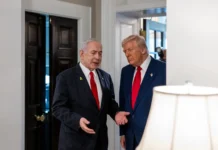


Bill Maher’s White House dinner became a case study in how charm and restraint can disarm even sharp critics and obscure the real dangers
Once, our intellectual feuds shaped the world: Voltaire and Rousseau debated human nature and governance; Sartre and Camus clashed over responsibility and resistance; James Baldwin faced off with William F. Buckley on race and morality; Einstein and Philipp Lenard, the pacifist vs. the Nazi, argued over science and ideology. These were thinkers whose disagreements defined eras.
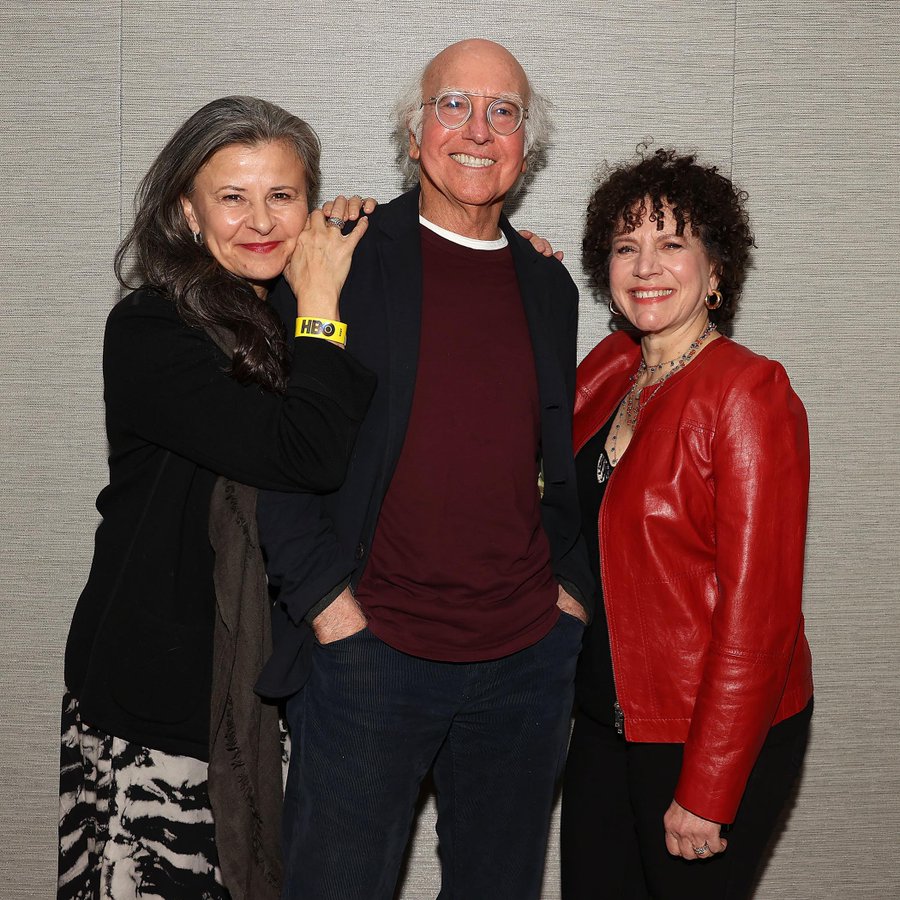
Today, our public discourse is shaped by different kinds of duos — most recently, the comedians Bill Maher and Larry David. Maher, who recently claimed a “maybe” leadership of centrist-minded Americans, and David, who sharpened observational comedy into psychological art, now find themselves not only as cultural commentators but as foils for one another in a revealing exchange about power, persuasion, and political clarity.
Let me just say that I am a huge fan of Maher’s. He’s erudite and funny, he is blazingly articulate and charismatic, and he shares my suspicion of both MAGA and the orthodox progressives. Hell, I wish he’d invite me onto his show. And his impulse, to engage despite the toxically polarized reality, is totally correct. But Maher’s framing of what transpired — his focus on Trump’s tone, his surprise at the president’s civility, and his conclusion that Trump is merely “playing a crazy person on TV” — misses the shocking reality that Trump has needlessly sparked a state of emergency all over the world.
I understand Maher wanted to be fair and open-minded – that’s his brand and normally I’m on board. But what he appears not to see is that he wasn’t witnessing Trump in an unguarded moment. He was witnessing a performance — just not the usual one. Trump’s team clearly understood the opportunity: a televised dinner with one of the most visible anti-Trump voices in America, who reaches an audience not already sold on the MAGA worldview. In that context, Trump was advised — and obviously agreed — not to argue, not to provoke, and not to react. And it obviously worked.
Maher was evidently struck by the fact that Trump didn’t blow up at him when he offered politique critiques like “You’re scaring people” – by, for example, blowing up their retirement savings, risking a global economic depression, suggesting he’d deport citizens to El Salvador, and preferring Putin to our allies. “He didn’t get mad,” Maher repeated. “He laughed. He listened. He took it in.” The absence of anger became the event. Maher interpreted silence as openness, even humility. “A crazy person doesn’t live in the White House,” he concluded. “A person who plays a crazy person on TV a lot lives there.”
This is exactly the impression I’m sure Trump’s advisers hoped he would convey. It gave Trump something his public persona rarely provides: plausible deniability. Maher, despite decades of sharp critiques, became the vessel through which Trump could be seen as reasonable and self-aware, even likable. As opposed to a person who mocks the handicapped, disdains POWs, uses his Easter greeting to call his predecessor a “highly destructive Moron” and casts reporters as “the enemy of the people.”

Nowhere in Maher’s debrief is there any indication that Trump actually engaged with the substance of what was said. He didn’t explain his views, defend his record, or respond in any meaningful way to disagreement. He simply didn’t explode. And for Maher, this non-reaction was so unexpected that it became a revelation.
What Maher fails to grasp is that Trump’s erratic public behavior, tough it is certainly repugnant, has never been the central concern. The main issues that for a rational electorate should be disqualifying are not about theatrical outbursts or outlandish tweets. They are the three structural flaws that Trump consistently exhibits: ignorance, lack of intellect, and malice. These qualities are not hidden. They are embedded in policy, visible in public rhetoric, and reflected in governance. They are demonstrated in actions, not affect.
Judging a president — or anyone in power — should not hinge on how politely they behave in private. It should be based on what they do when the cameras are on, when the decisions matter, and when they are tested by crisis, criticism, or power itself.
“I know — your mind is blown. So was mine,” Maher says. But my mind is not blown, and yours should not be either. That Trump didn’t lose his temper in a closed-door meeting with a celebrity guest means close to nothing.
This is where Larry David’s parody lands with such precision. In “My Dinner with Adolf,” David imagines himself invited to dine with Hitler in 1939. There, he finds a charming host, quick to laugh, who bonds with him over relationship trouble, charmingly suggests he might shoot his dog (since he already kills “Jews, Gypsies and homosexuals”), and makes disarmingly self-deprecating jokes. “Suddenly he seemed so human,” David’s narrator reflects. “Oddly enough, this one seemed more authentic, like this was the real Hitler. The whole thing had my head spinning.” The joke is devastating.
David’s parody isn’t an attempt to equate Trump with Hitler. It’s a warning that reducing our analysis of leaders to their tone or demeanor in a friendly setting opens the door to moral confusion. Charm can be weaponized. Civility, in context, can be strategic. A dictator who laughs is still a dictator.
Maher, for all his normal brilliance, walked away with exactly the conclusion Trump wanted him to have — that the real problem is public perception, and that beneath the surface, there’s nothing to fear. In doing so, he handed Trump a powerful tool: validation from a critic, broadcast in prime time, embedded in a monologue that portrayed him as misunderstood rather than malign.
In the end, Maher tells us: “He gave me nothing. Just hats.” But that’s not true. Trump gave him a hand grenade that Maher set off on his own show. And in return, Maher gave Trump what he was seeking: a version of legitimacy, through the validating words of one of his most prominent detractors.
This wasn’t a spontaneous, revelatory encounter. It was a calculated move that worked. The president’s handlers understood that restraint — just this once — could yield a reward greater than any Twitter tirade. And so, one of the entertainment world’s most brilliant wits, a man whose entire career has been built on spotting hypocrisy and puncturing facades, risks becoming the punchline himself.
A cruel destiny: trained by Putin, left without fangs by Zelensky, chained by Europeans
