












Classic cars and license-plate collecting seem to go hand in hand. But Cristian Luca has taken his two passions a bit further than most—and will soon publish the first book ever to chronicle the history of Romanian license plates.
The book, titled “Numere de Inmatriculare in 100 Ani in România,” runs 400 pages long and contains 12 chapters of history. The project has taken him two years to compile. Only 111 copies will be printed initially, though that could increase if demand is strong.
The book, now in its final production phase, will sell for €40—just enough for Luca to recover his costs.
“In the beginning, I wanted only an album with my plates. But over time, I collected more and more stories and finally decided to write it all down for other people,” he explained over coffee at the modest little Bucharest apartment he shares with his wife, Viorica. “This book will be for plate collectors, for those who enjoy classic cars, and for anybody who likes interesting history.”
Luca, 59, is a parts and services manager at the Țiriac Collection, a sprawling museum of vintage automobiles across from Otopeni International Airport. He’s been employed there for the past 10 years; before that, he worked in sales of cigarettes, coffee, whiskey and other commodities.
Along the way, he’s managed to build up a small car collection of his own that currently includes a 1958 Alfa Romeo Julietta Sprint, a 1969 Dacia 1100, a 1972 Dacia 1300 and a 1990 Audi 80. That doesn’t count the 2001 Renault Megane 1 he uses every day to get to work and back.
Luca also has an impressive collection of 600 or so license plates, all of them Romanian. A few dozen are displayed at home in glass cases—interspersed with more than 1,000 scale-model cars which is he is no longer actively collecting. Luca keeps the rest of his plates in boxes because he simply has no room to display them—a common problem among collectors of such things.
“I tried to count how many plates I had when I began writing the book,” he said. “I started making photos of each plate but then lost count because I bought more plates.”
In general, license plates are usually manufactured from tin or aluminum, but they can also be made out of plastic, fiberglass, wood or even leather. No one really knows how license plates began, though the reference book of all serious hobbyists, the 800-page Registration Plates of the World, says the German state of Baden began issuing plates on a regular basis in 1896, and that Luxembourg was reported to have issued the number “1” to a Benz the year before.
According to RPW, Romania began issuing license plates in 1906 in Transylvania, which was then part of the Austro-Hungarian Empire. But Luca dates Romanian plates from 1913, when the government started assigning numbers to specific vehicles rather than people.
“In fact, the first car, a Peugeot, entered Romania in 1889. It was owned by a well-known baron named Barbo Bello. The state gave him #1 and that number became his property, regardless of how many vehicles that person owned,” he explained. “This system was used until 1913, when they started issuing numbers to specific vehicles.”
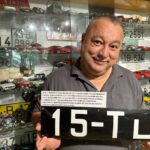
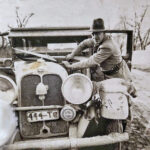
Around 1913, Romania began producing porcelain enamel license plates with white numbers against a black background—about the same time US states started doing the same thing. Only five such plates survive, and Luca has one of them: 15-TL.
“I got mine from a doctor in Bucharest. I had the opportunity to buy others but didn’t have enough money at the time, when they were being offered to an antique shop,” he said, conceding that the one he has is worth thousands of euros. “But it’s difficult; nobody’s selling and nobody’s buying.”
After 1928, Romanian plates reverted to a black-on-white color scheme and have remained that way ever since. Today, plates are manufactured in the standard long European format, with the EU flag and letters “RO” at far left. The registration consists of a letter code—“B” for Bucharest, “CJ” for Cluj and so on—then a series of numbers and letters.
Surprisingly, Romania does not allow vanities. Luca thinks that’s a mistake.
“Here, even if you have a lot of money, you cannot get a plate with special combinations of names and letters, like they do in the UK or Switzerland,” he said. “But in my opinion, they should do it because we need money for infrastructure and healthcare.”
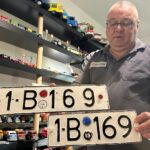
Luca generally finds his plates at flea markets, antique shops, swap meets and online. And while he doesn’t possess any tags that were once affixed to vehicles owned by Romania’s longtime dictator, Nicolae Ceausescu, he is the proud owner of “1-B 169”—which belonged to a very high party official in Ceausescu’s entourage.
Today, roughly 9.45 million vehicles are in use, and the country has perhaps 100 license plate collectors among its 19 million inhabitants. But nearly 4,000 people belong to the closed Facebook page “Numere de Inmatriculare Vechi Romanesti.” Luca administers that invitation-only group, as well as a public one for collectors of foreign plates that has about 1,000 members.
These collectors’ groups meet monthly throughout Romania, and once a year, there’s a national meet in Bucharest. The next one is set for June 21 at the Ministry of Interior; about 100 are expected to attend.
For more information on the book or the meeting, or Romanian license plates in general, please contact Luca at [email protected].