







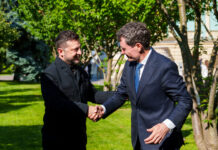





Renowned Cambridge physicist Professor Mark Thomson is running for the post of Director-General of CERN.
So you wouldn’t perhaps expect a description of the Universe as ‘sticky mud’ or to be discussing how GPS needed Einstein’s theory of relativity to function with someone who wants to lead the European laboratory for particle physics, an unrivaled international science hub and home to the Large Hadron Collider.
But explaining almost unintelligible cutting-edge science in a way that most people can understand is a necessary skill for a top international scientist whose role goes beyond the intricacies of particle physics.
When Universul.net sat down for an interview with Professor Thomson late last month, he described the scientific discoveries of the last 20 years in both a fascinating and straightforward way.
We talked about the Higg’s boson which began to be discovered about 60 years ago, that describes the Universe as a sticky field of mud (more on that later); and Einstein’s theory of relativity which is the basis of our GPS navigation systems.
He’s currently the UK’s representative to CERN, the European Organization for Nuclear Research, the place where the worldwide web was created. It started out as a sort of chatroom for scientists to hash out new theories and ideas and has become the virtual thread that keeps our everyday lives from unraveling.
Professor Thomson who’s been shortlisted for the next CERN executive director with two other candidates from Greece and the Netherlands discussed his plans with Universul.net.
CERN held interviews for the role this Friday Sept. 27 with the three finalists. There will be elections on Nov. 6. followed by a formal appointment at CERN Council meeting on Dec. 12.
Incumbent Fabiola Gianotti, an Italian experimental particle physicist appointed in 2016 is standing down after two terms.
“I am running …. because I have the scientific credentials, the experience and the vision to deliver an even brighter future for every one of CERN’s member states, for its world-class staff, and for the fundamental breakthroughs this organization continues to unlock in our understanding of the Universe,” he said.
It’s a crucial time for the organization.
“This is an interesting time for CERN. In the next 5-6 years …members of CERN Council…will take a decision about the large Hadron collider which we’re operating… that won’t start until the middle of the 2040s,” he told Universul.net.
“Plan A is to build the Future Circular Collider which is a new 91-kilometer tunnel. It is an incredibly ambitious project and will require significant resources from the CERN member states and outside.”
“The next Director General of CERN needs to have scientific credibility and understand science and have that credibility with the community.. I believe I have that, particularly with young people,” he told Universul.net
“Making the Hadron Collider more powerful, brighter, is quite a challenging project to deliver in parallel with all the future planning, and the role requires experience and not just science but leadership of a large scientific organization.”
The Large Hadron Collider (LHC) is the world’s largest and highest-energy particle collider, and was built by CERN.
Professor Thomson, 58, was in Romania in late August for a CERN council retreat in the mountain resort of Sinaia, an opportunity for scientists to have an open dialogue in a relaxed setting.
“I really like meeting scientific communities and learning their views about science,” he told us in Bucharest where he met Research and Innovation Minister Bogdan-Gruia Ivan.
“This visit is an opportunity to meet with ministry reps and chance to meet Romanian scientific community and to visit the laser research facility at Magurele,” he said.
In Britain, he has the backing of leading figures from across the scientific community including Michele Dougherty and Sheila Rowan to be CERN’s next executive director.
The British government have rather unusually publicly announced their backing, saying he has the best combination of skills in terms of management and science, and is the right choice, having the double skill set the other candidates don’t have.
The Council that will vote on their next director now has 24 members; Estonia joined at the end of August. As the UK’s representative on the Council, he will recuse himself.
As well as his professorship at Cambridge University, Professor Thomson is the executive chair of the Science and Technology Facilities Council (STFC),a major scientific organization.
STFC has a budget of about one billion pounds a year with 3,000 staff; scientists and engineers, technicians and multiple sites near Oxford, Harwell, near Liverpool.
It focuses on light sources, lasers, neutron sources, large scale infrastructure. “It’s very relevant,” for the position he is running for.
“What CERN will do for the long-term vision is incredibly important for CERN and for science. It is important to set that ambitious direction for the future. That is going to require a lot of discussions with international partners and that is going to requires a lot of experience which I have, I believe .”
“The way forward is very strongly scientifically motivated. We discovered a new type of matter called the Higgs boson in 2012. Completely new matter. Nothing ever seen like it in the Universe.”
It’s named after Peter Higgs, a theoretical physicist who back in the 1960s said there was clearly a problem with scientists’ understanding of particle physics at that time.
“We had this very clever model that unified two of the forces, that basically says two of the forces are the same but they manifest themselves differently and there was a problem with that because the whole problem was the whole theory did not work-you had massive particles of mass and Peter Higgs and a few others came up with this very ingenious theory now known as the Higgs mechanism to find a way of making the theory work and allowing massive particles to have mass,” he said.
It then took us almost 60 years to actually have the technology in hand to really test that theory and discover that particle associated with that theory.
“The matter is everywhere. It is very strange. What makes this particle completely different is in some ways it is present everywhere in the Universe even where there is nothing. It has this very strange property.”
“It is like the Universe is a sticky field of mud….The vacuum has some kind of stickiness to it..and when all the other particles go through the vacuum, they feel the presence of this stickiness and that’s what gives all the mass of the particles we know.”
“If the Higgs field was not there, all our particles would have no mass and zoom off at the speed of light. You would just disintegrate at the speed of light. Don’t worry it’s not going to happen! It’s a very key property of our Universe and what we did at the large Hadron Collider.”
“We smashed protons together, that’s what we do at the large Hadron Collider. It’s a bit like hitting this field of mud very, very hard and that creates ripples and those ripples are waves … and as we know from Quantum mechanics, waves actually materialize as particles so in fact by smashing the field very, very hard we saw the Bosons..these particles associated with the Higgs field so we discovered it looks like it’s the correct model for the Universe.”
“The next project, the.. general consensus is that we’ve found this new kind of matter 12 years ago and we really need to study it, and understand what it really is,” he said.
For that, CERN needs to build a machine that enables scientists to study it and the best machine he and others believe is the Future Circular Collider (FCC)
However, it’s a very expensive machine and CERN will face the challenge of bringing resources from existing members potentially from outside Europe.
Are we on the brink of new discovery, I ask.
“What we are going to do now from now until the early 2040s is we are going to run the large Hadron Collider…we are going to make it more powerful. We are 7% through the data taking so we are really at the start of that journey. We’ve already discovered the Higgs Boson. Some people were hoping you’d switch the machine on and we’d see many other discoveries but that’s not really the way science works,” he said.
The Hadron Collider is in Geneva, Switzerland, about 100 meters underground
“There are multiple reasons they are underground. Some of the machines produce low levels of radiation; you can’t just put them on the surface. No special clothes worn.. You don’t want to be in the tunnel when it’s operating as there is some radiation. It is controlled areas—you don’t go in there but it’s not like a nuclear facility or anything like that.”
“Who knows exactly what’s going to happen but we are really right at the start of the Hadron Collider discovery search and we don’t know. There is a huge opportunity there that we might see something but it’s not guaranteed and that is absolutely right because discoveries by their nature—you are discovering something unknown. “
Are colliders built or do you order them, I wondered.
“They are all one-off, all unique—these very high energy colliders.. You don’t go out and pick up a catalogue like Colliders are Us.”
“Colliders are basically strings of very powerful magnets, although there is a lot more to it than that.”
CERN will come up with the design of the magnets which requires a huge amount of expertise in doing that and then you have to engage with industry to industrialize that process because CERN isn’t a manufacturing site.
“There are many benefits. As soon as you start to push technology beyond what you’ve got today that’s when you start having developments that start changing people’s lives. Ultimately, they will filter down to something practically useful rather than just applied to science.”
“There are many stories and my favorite example of that is that Einstein predicted the general theory of relativity back at the turn of the 20th century.. At the time, nobody thought that had any practical use at all…. but if we didn’t know about the general theory of relativity, we wouldn’t have functioning GPS today. You have to understand these subtle corrections to make GPS work. Something very esoteric, which is basic science changes the way of technology we take for granted nowadays.. If he hadn’t come up with his theory, we wouldn’t have GPS.”
“Pushing this basic science really does bring technological benefits. You don’t know quite how long it’s going to take or where those benefits will be.”
“Typically there will be one major discovery in cosmology, particle physics or astronomy once every 10 years if you’re lucky, maybe once every 20 years, and these two are enormous.”
As a scientist, Professor Thomson “would like to understand what happened at the Big Bang…The first thing you do is you build big telescopes and you look at what the Universe looks like today.”
Looking back in time
“Telescopes that look at Universe today like the James Webb telescope that my organization built one of big cameras for that is looking at the Universe but also looking back in time. As you look out deeper and deeper in the Universe you are looking back in time as well as looking very, very far away because it takes light a long time to get where you are.”
*Gravitational waves are ‘ripples’ in space-time caused by some of the most violent and energetic processes in the Universe. Albert Einstein predicted the existence of gravitational waves in 1916 in his general theory of relativity.
*On 14 September 2015, the universe’s gravitational waves were observed for the very first time. The waves, which were predicted by Albert Einstein a hundred years ago, came from a collision between two black holes. It took 1.3 billion years for the waves to arrive at the LIGO detector in the USA.
*The James Webb Space Telescope (JWST) is a space telespace telescope designed to conduct infrared astronomy. As the largest telescope in space, it is equipped with high-resolution and high-sensitivity instruments, allowing it to view objects too old, distant, or faint for the Hubble Space Telescope. This enables investigations such as observation of the first stars and the formation of the first galaxies. Source: Wikipedia.
Russian Center of Culture and Science has its activity suspended in Romania
