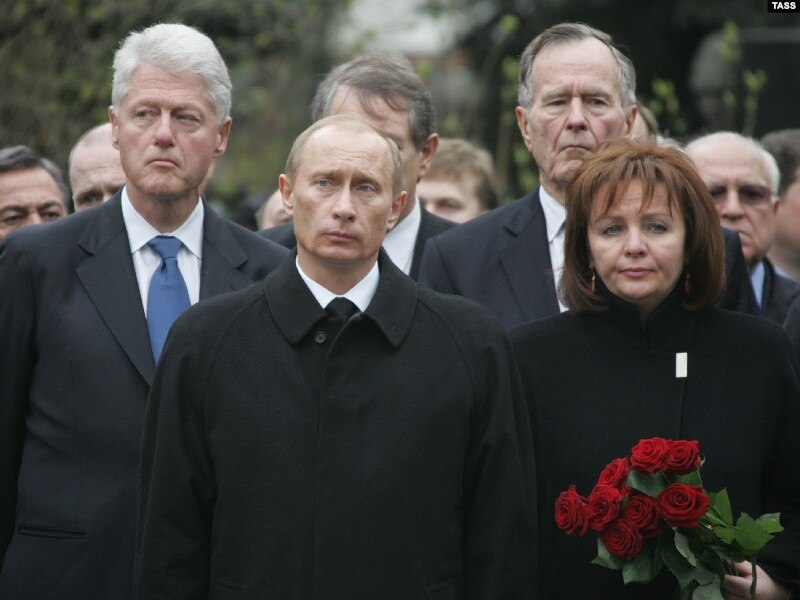
Fostul președinte al SUA, Bill Clinton (stânga), președintele rus, Vladimir Putin, fostul președinte al SUA, George H.W. Bush, și Liudmila Putina participă la înmormântarea fostului președinte rus Boris Elțin la Moscova, în aprilie 2007 / Sursa: TASS
FOURTH OF JULY READ: Nixon saw exactly what would happen in Russia. Crook though he was, he towered over today’s leaders in his understanding of history.
In 1992, Richard Nixon issued a warning about Russia that, in hindsight, may be among the most accurate geopolitical predictions of the post-Cold War era. As we survey the wreckage of the ongoing war in Ukraine, started by an aggressive and imperialist Russia, it is worth remembering Nixon’s words and considering the lessons – not just about Russia but also for the West.
Speaking shortly after the collapse of the Soviet Union, he said that while communism had been defeated, the ideas of freedom were now on trial. If they somehow failed in Russia, what would emerge would not be a return to Marxist orthodoxy, but a new authoritarianism that would menace the world.
I remember the early 1990s well. I was a young reporter for AP running around Eastern Europe and the Soviet Union, witnessing the collapse of communism and sharing in the euphoria and triumphalism. The roar of history seemed to confirmed what had been drummed into me by my education in America: Our system was the best and reigned supreme. The somewhat disgraced former US president knew a little better, but almost no one listened. We ere captivated by shinier things, like Bill Clinton playing the sax and explaining that he did not inhale.
“It is often said that the Cold War is over and that the West has won it. That’s only half true, because what has happened is that the communists have been defeated, but the ideas of freedom now are on trial,” Nixon said. “If they don’t work, there will be a reversion to not communism, which has failed, but what I call a new despotism, which would pose a mortal danger to the rest of the world because it would be infected with the virus of Russian imperialism, which, of course, has been a characteristic of Russian foreign policy for centuries.”
Thirty years later, with Vladimir Putin’s brutal war in Ukraine and ongoing assaults on democracy worldwide, Nixon’s words seem less like commentary and more like prophecy. What he foresaw was what actually came about – with the West’s unwitting help. It was a warning was rooted in a sophisticated understanding of Russian history that few Western leaders at the time shared (and that the current occupant of the White House is surely clueless about).
For Russian imperialism is not a modern invention. It is a throughline that defines the nation’s relationship to its neighbors and to power itself.
defines the nation’s relationship to its neighbors and to power itself.
Beginning with Ivan the Terrible in the 16th century, who crowned himself the first Tsar of all Russia in 1547 and launched campaigns into Kazan and Astrakhan, Moscow began expanding its reach across the Volga River basin. The conquest of Siberia followed, extending Russian rule to the Pacific Ocean by the 17th century. By the early 1700s, Peter the Great had launched the Great Northern War (1700–1721) against Sweden, securing access to the Baltic Sea and founding St. Petersburg as Russia’s “window to Europe.”
Catherine the Great, in the late 18th century, continued this aggressive push. Under her rule, Russia annexed Crimea from the Ottoman Empire in 1783 — a move that Putin would famously reprise – this time stealing land from Ukraine – in 2014.
The Polish-Lithuanian Commonwealth was carved up in three successive partitions between 1772 and 1795, with Russia taking control of vast tracts of Polish territory. By the 19th century, the Russian Empire stretched from Warsaw to Alaska. It swallowed Georgia in 1801, annexed large parts of Armenia and Azerbaijan in wars with Persia, and pressed southward against the Ottoman Empire in repeated Balkan conflicts. The Crimean War of 1853–1856, though a defeat for Russia, was waged with the same imperial rationale: securing dominance over Orthodox Christians in the declining Ottoman territories and gaining access to warm-water ports on the Black Sea.
The imperial impulse did not die with the Romanovs. The Soviet Union, while ostensibly internationalist and anti-imperialist in rhetoric, was in practice an empire of the old style, maintaining control over its periphery through brute force. The Red Army crushed uprisings in Hungary (1956) and Czechoslovakia (1968). Stalin deported entire ethnic groups, including Chechens, Crimean Tatars, and Volga Germans. The USSR’s invasion of Afghanistan in 1979 was yet another example of projection beyond its borders under the guise of ideological necessity. What united Tsarist and Soviet policy was not merely power, but a particular vision of Russian greatness—one inextricably tied to territorial expansion and control.
Not even including all the Eastern European countries of the Warsaw Pact, which it controlled and dominated, the Soviet Union, which was essentially Russia writ large, spanned 11 time zones and a landmass of over 27 million square kilometers – about three times bigger than the United States or China.
The whole thing started to fray under the weight of its own contradictions. The Soviet Union’s ambitions to control much of the world could not be funded by an economy based on the idea that excellence is not rewarded financially. In the mid-1980s came a new Soviet leader, Mikhail Gorbachev, who was committed to change. But when I met him years later (below, in Moscow), he made clear that the part of the equation he wanted to ditch was the crazy imperialism and the ideological extremism; he actually thought communism, or at least a light and friendlier version of it, could be preserved.
When the Soviet Union finally collapsed in 1991, there was a brief window in which it seemed possible that Russia might chart a different course. But the conditions were not ripe, and the West’s approach was deeply flawed.
The intellectual face of that moment was Jeffrey Sachs, the Harvard economist who became the chief architect and advocate for “shock therapy.” The idea was that only a radical, rapid transition from central planning to free-market capitalism would work. Anything else would drag out the pain and invite opposition. Sure, currencies not designed to float freely would collapse in an instant, wiping out savings and pensions and anything held in cash – but you cannot make an omelet without breaking any eggs.
Sachs had earlier advised Bolivia and Poland, and brought that same zeal to post-Soviet Russia. He pushed for immediate price liberalization, an end to subsidies, and rapid privatization. In theory, this would allow the invisible hand of the market to allocate resources efficiently and give birth to a dynamic capitalist democracy. This was the learned view of the IMF.
The results were catastrophic. Without legal safeguards, regulatory infrastructure, or a functioning civil society, Russia’s transition degenerated into a grotesque fire sale. State-owned enterprises were sold for pennies to well-connected insiders, often through rigged “loans-for-shares” schemes that enriched a small class of oligarchs. Ordinary Russians, many of whom lost their life savings overnight due to hyperinflation, looked on as former Communist elites and new mafiosos looted the national economy. GDP contracted by over 40 percent in the early 1990s. Life expectancy plummeted. Pensioners went unpaid. Crime surged. Democracy became associated not with dignity or prosperity but with chaos and humiliation.
Sachs would later express some regret for the harshness of the shock therapy model and blame the Clinton administration and the IMF for failing to provide the level of aid needed to make reform work. But by the time these realizations took root, the damage was done. The West had squandered Russia’s trust, and the Russian people had lost faith in the promise of liberalism. The vacuum was filled by Vladimir Putin, a former KGB officer who understood both the appeal of stability and the uses of nostalgia.
Putin’s rise was enabled by Boris Yeltsin, the man who had once stood triumphantly atop a tank during the August 1991 coup attempt against the aforementioned Gorbachev. Yeltsin, while briefly revered in the West for allowing the Soviet Union to dissolve peacefully, quickly became a cautionary tale. Plagued by alcoholism — which caused an utterly absurd White House visit — and surrounded by corrupt advisors, Yeltsin presided over a decade of institutional collapse.
Ridiculous though Yeltsin was, the West was in a panic in 1996, fearing that he might lose the presidency. His main rival in the election was precisely what the West feared – a return of the communists, led by longtime apparatchik Gennady Zyuganov (who, remarkably, still reigns supreme atop the irrelevant Communist Party of Russia). So the West pulled out all the stops, and Yeltsin was reelected in a vote widely considered locally to have been rigged with the assistance of Western consultants and IMF funding.
The iconic image of that campaign was Yeltsin, pumped up who knows how, dancing erratically at a campaign rally in Rostov-on-Don just days before the presidential election.
idential election.
This cemented the view among Russians that democracy was a shell game. When Yeltsin handed power to Putin on New Year’s Eve 1999, it was framed as a sober choice for continuity. It was in fact the formal burial of Russia’s democratic experiment.
What we feared – myself included – was a reverting to communism. That was never in the cards – the Russians never liked communism. What they liked – just as Nixon understood, was the projection of Russian power.
Once in office, Putin consolidated control with remarkable speed. Independent media were brought to heel. Opponents were exiled, imprisoned, or killed—sometimes abroad, as in the case of Alexander Litvinenko, poisoned with polonium in London in 2006, or Sergei Skripal, targeted with a nerve agent in Salisbury in 2018. Russian bot farms flooded social media with disinformation aimed at destabilizing Western democracies. The 2016 US election was interfered with through hacking and propaganda. Putin’s Russia offered sanctuary to uber-leaker Julian Assange and cooperation to extremist political parties across Europe. It was not just a dictatorship locally — it was an active, aggressive force aimed at weakening the liberal order which lies at the heart of Western power in the world (American readers: don’t be confused by the use of the world “liberal” as this is not about trans bathroom rights – for more about liberalism, read here).
The apotheosis of Nixon’s warning came in 2014, when Putin annexed Crimea. That was followed by the proxy war in eastern Ukraine and, eventually, the full-scale invasion in February 2022. This was no mere border dispute—it was the assertion of a worldview that sees Ukraine not as a sovereign country but as part of a greater Russian destiny. The same mindset threatens Moldova, the Baltics, Georgia, and Kazakhstan. It is rooted in the centuries-old notion that Russian greatness requires expansion and that the West must be perpetually humiliated.
Nixon also understood the wider consequences: “The West has, the United States has .. a great stake in freedom succeeding in Russia. If it succeeds, it will be an example for others to follow. It will be an example for China, for example, to follow, for the other communist states, the few that remain. If it fails, it means that the hardliners in China will get a new life. They will say, it failed there, there’s no reason for us to turn to democracy.”
So how did the Putin meltdown affect China? Was Nixon right?
Well, under Xi Jinping in the past 12 years, China has undergone a dramatic reversion to authoritarianism, marked by a consolidation of power unseen since the Mao era in the 1960s. Term limits have been abolished, dissent has been crushed, surveillance intensified, and the Communist Party reasserted as the central authority over all aspects of Chinese life. Economic liberalization has been rolled back in favor of state control, while ideological conformity and nationalism have surged.
Abroad, China’s increasingly aggressive posture — from militarizing the South China Sea to imposing economic coercion on smaller states — reflects a new imperial assertiveness. Nowhere is this more dangerous than in Taiwan, where Xi has declared reunification inevitable, refused to rule out force, and ramped up military provocations. The threat is not just to Taiwan’s vibrant democracy, but to the global balance of power.
And even in America, given the systemic breakdown we observe, some are moving to the view that authoritarian systems might work better. All of this, too, is evident in the comparison of Nixon to the current leadership. Both are crooks in the eyes of many people, but only one is a true authoritarian.
Nixon was not just prescient about Russia, he was deeply committed to the idea of America as a force for good in the world (despite his mistake in backing the 1973 coup against the leftist President Salvador Allende in Chile). To hear him speak of America’s role in the world, it is hard to imagine a greater contrast to vulgarity, ineloquence and self-dealing the current Republican president. In his “silent majority” speech in 1969, Nixon said: “Let historians not record that when America was the most powerful nation in the world, we passed on the other side of the road and allowed the last hopes for peace and freedom of millions of people to be suffocated by the forces of totalitarianism.” Think of how that’s worded and consider Truth Social. SAD!
Of course, for all the depth of his geopolitical analysis, Nixon was a profoundly flawed man. His petty and spiteful attacks on democracy — culminating in the Watergate scandal — were corrosive and paranoid. His use of federal agencies to target perceived enemies and his obsessive secrecy all point to cynicism. There was also a weird undercurrent of crypto-antisemitism in his private conversations, where he indulged in conspiratorial mutterings about Jews controlling the media and finance. In 1974, under the weight of mounting evidence, Nixon was hounded out of office.
The way that happened, though, is indicative of how far America has sunk. Nixon left office because senior Republicans, including the esteemed Senator Howard Baker, made clear that he no longer had their support and they would vote for his removal because of his lies and coverups over Watergate.
Imagine such a scenario in 2025! Imagine today’s Republican lemmings and toadies confronting a president caught on tape inciting a violent insurrection, stealing classified documents, demanding officials “find the votes” and openly defying court orders. Imagine them standing for values and principles.
Back in 1973, impeachment in the House of Representatives was seen as momentous – I remember how few people even know you also had to be convicted by a supermajority of the Senate. Resignation was understood as the honorable way to prevent national collapse. The system worked—not perfectly, but better than it would today. Today Donald Trump was twice impeached, and reelected.
The party that once nudged Nixon toward the door now genuflects to a vastly more corrupt, utterly ignorant and more dangerous figure. Trump is a vulgarian utterly devoid of historical knowledge, decency, or strategic vision. And yet he is the face of the Republican Party. Worse still, he is effectively aligned with the very Putin that Nixon warned us about. He praises him. He trusts him more than American intelligence. He calls NATO obsolete. The GOP is no longer resisting Russian despotism but echoing it.
That is how far we’ve sunk in half a century. Nixon, for all his sins, came from a more serious time. He believed in institutions, even as he tried to game them. He understood history and he made a little of by going to communist China, which was momentous. Nixon warned that if freedom failed in Russia, it would send a signal to autocrats everywhere—and to the worst instincts within the West itself. He was right.
Russians and Americans, and many others too, all suffer the consequences.
Ask Questions Later is a reader-supported publication. To support our work, consider becoming a paid subscriber.