














He fused the personal and the political, the exhilarating and the everyday, the sordid and the sublime. Who does that anymore? Who even tries?
Let’s take a moment to salute Mario Vargas Llosa, whose death at 89 this weekend puts paid to one of life’s dependable delights: the knowledge that every few years he would issue a novel to both enlighten and entertain. His passing makes my own existence, by a small yet discernible measure, that much less fantastic. Any reader unfamiliar with his work might want to check it out — for Vargas Llosa, in my book, was one of the last titans of global literature — an art form that I fear is in grave danger of extinction.
Yet how he made it seem so smooth! The Peruvian’s stories of Latin America felt at once specific and universal, rooted in place yet infinitely relatable. He was that rare kind of novelist who wrote seriously and passionately without being ponderous. He had a gift for turning history into narrative, for animating political and social realities through flesh-and-blood characters whose true landscape was the absurdity of human comedy itself.
Unlike his onetime friend and later rival Gabriel García Márquez (who, infamously, he once punched in the face), Vargas Llosa largely resisted the siren song of magical realism, which I always found to be a crutch. His imagination was immense, but he was, at heart, a journalist. His stories were not built on myth or miracle, but on the hard, strange facts of life itself.
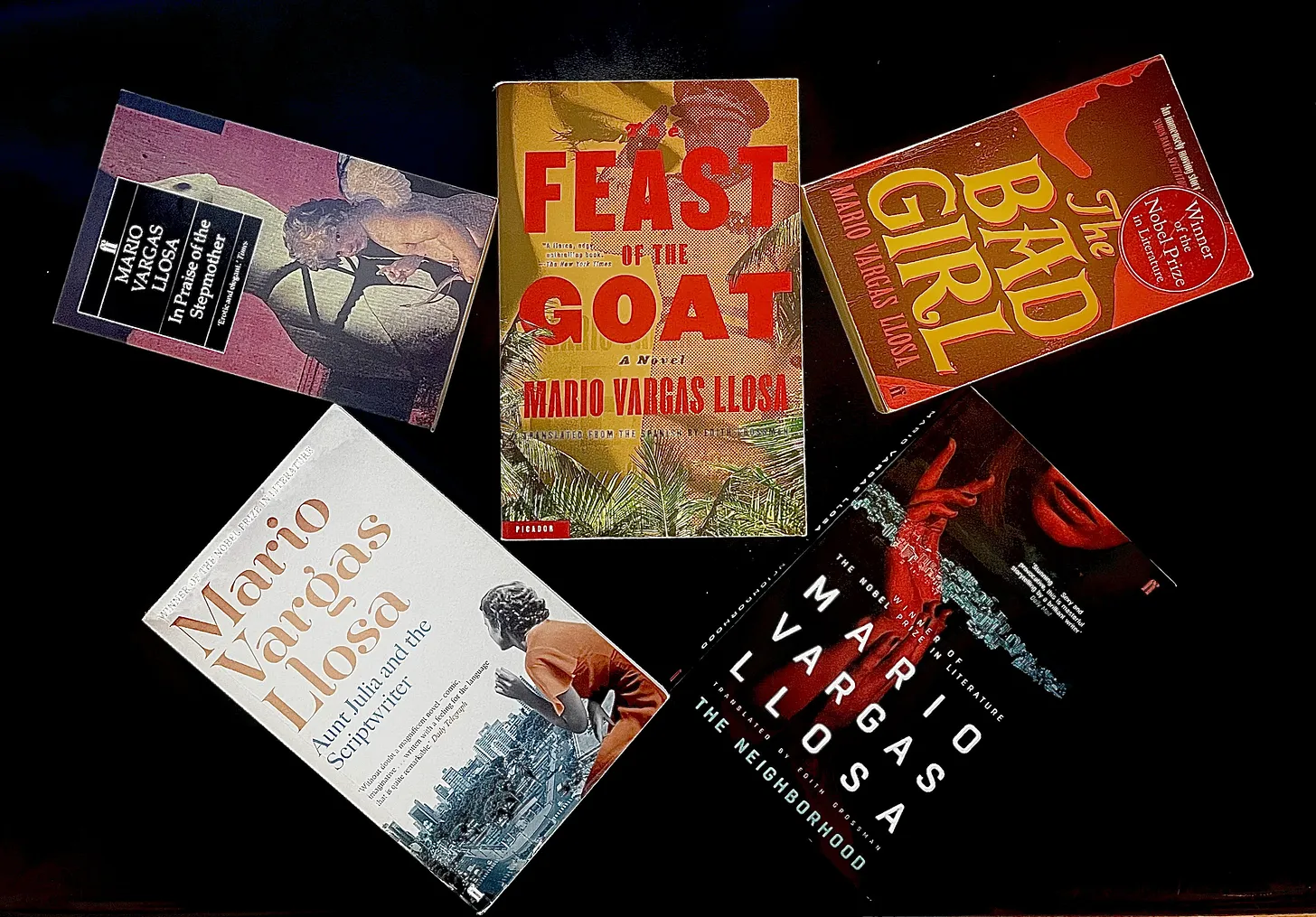
The Feast of the Goat — a tour de force about the Dominican dictator Rafael Trujillo — manages to be both a taut political thriller and a profound meditation on trauma, memory, and complicity. It is brutal and vivid, with a narrative architecture as tight as any modern novel. His last book to be translated from Spanish, 2019’s Harsh Times, was another in that vein, about a coup in Guatemala. Don’t care about Guatemala or the nationalization of the fruit industry? Matters not — you will not put it down.
Even when he turned toward modern life and personal entanglements, his work never felt slight. The Neighborhood (2016), set in the elite circles of Lima, tackled blackmail, gossip, and power with sly humor and sharp insight. Its world of upper-class scandal and tabloid politics feels startlingly prescient. That book, like many of his others, explored sex with a frankness that could easily have tipped into the crude or gratuitous — but never did.
In Praise of the Stepmother remains one of the most daring novels of its time: erotic, transgressive, and yet oddly tender. Only a writer of deep psychological insight and aesthetic control could have made something so provocative seem so sincere. Aunt Julia and the Scriptwriter walks the edge between reality and invention, blending Vargas Llosa’s own youthful love affair with a witty, semi-autobiographical portrait of artistic ambition, romantic chaos, and the blurred boundaries between life and fiction. The Bad Girl explored youthful obsession from the vantage of age and disillusionment, weaving a love story that unfolds across Europe; I read it at the pool in Greece — unputdownable, again.
Crucially, Vargas Llosa wrote fiction that never dated itself by leaning on technology or trends. There’s no embarrassing tether to the gadgets or slang of the moment. His stories remain timeless not because they avoid modernity, but because they approach it through character and theme rather than novelty. In a literary era plagued by instant obsolescence, that’s big.
How impactful was all this? My friend Mihai Răzvan Ungureanu recalls first reading Vargas Llosa in 1987, while in the Romanian army. The communist regime had allowed one book — The War of the End of the World — to be translated, because it was theoretically about a different political and economic system: Brazil. “It was unbelievable — everyone was reading it,” recalls Mihai, who went on to become democratic Romania’s prime minister and to know Vargas Llosa personally. “It was perceived as a parable of Ceaușescu’s regime. But the authorities thought the book was based on fantasy and weren’t interested. That’s the kind of power he had.”
A few years after that, Vargas Llosa became a political figure — controversial, to put it mildly. His 1990 presidential bid in Peru ended in defeat to Alberto Fujimori, and in later years he embraced a form of classical liberalism (which means right wing in some places) that alienated much of the literary left. But to understand Vargas Llosa’s politics, one must situate them in the broader context of Latin American history — a region where ideological extremism, whether from the right or the left, has often trampled individual liberty. His defense of free speech, democracy, and pluralism may have earned him scorn in some quarters, but it was principled and consistent with his literary ethos: the dignity of the individual against the machinery of power.
When the global right began to mutate — when it lurched into nationalism, demagoguery, and anti-democratic populism — Vargas Llosa didn’t follow. He denounced Donald Trump as a dangerous populist, warning that his rise echoed the authoritarian strongmen of Latin America, left and right alike. He rejected the xenophobia and conspiracism infecting conservative politics and doubled down on his faith in liberal democracy, even as it became an increasingly lonely stance.
In the end, Vargas Llosa defended reason — as this publication tries to do. He critiqued left when it veered into tyranny, and had the clarity to reject the right when it lost its moorings. Far from selling out, he stood firm on principle — one of the few to do so in a world of collapsing nuance.
In the space of two years, we’ve lost both Vargas Llosa and Milan Kundera —two writers who, in very different ways, showed us how the novel could grapple with the political and the personal, the erotic and the existential, without losing its coherence or soul. Kundera, the philosopher-novelist, brought wit and skepticism to bear on the absurdities of ideology. Vargas Llosa, a classic storyteller, gave us urgency, momentum, and narrative force. Neither bowed to fashion. Both believed that fiction was a means of understanding the world — not escaping it.
Vargas Llosa and Kundera were far from perfect — but they were committed to the idea that literature matters, and that the novel, at its best, is a space where history, politics, psychology, and pleasure collide.
