












Interviews on Arab and Israeli TV reveal an astounding gulf in perceptions
I’ve appeared regularly on both Israeli and Arab media throughout the current war, but rarely have I experienced such complete whiplash as I did from recent appearances on Qatar’s Al Jazeera and Israel’s I24 in Hebrew. The degree to which perspectives clash beggars belief, even in our polarized and radicalized times. It makes you wonder where all this goes from here — and unless we learn to see things from the other’s point of view, I’m sure the answer is “nowhere good.”
On one side, I was painted as a villain and apologist for mass Palestinian suffering; in the other, as an unrealistic and misguided defender of those same Palestinians against righteous Israeli tactics. How I came, strangely, to embody two diametrically opposite opinions — neither of which actually represent me — is a story of how impossible it is to escape the constant narrative-twisting that has come to define this war.
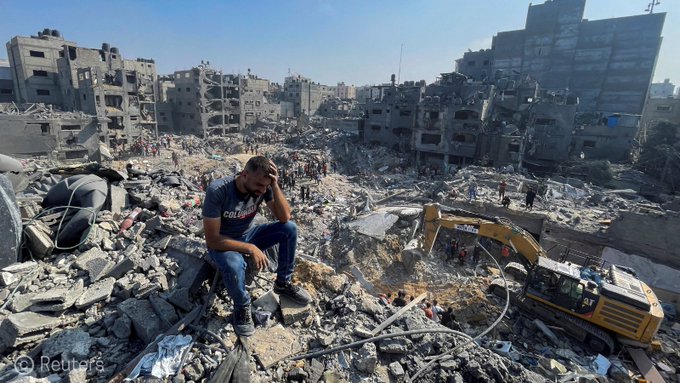
Our story begins on Jan. 2, when I was interviewed twice on Al Jazeera, the Qatar-based news channel that has now been banned not only by Israel, but also by the Palestinian Authority in the West Bank. Host Sami Zeidan opened by citing an array of global organizations, including Save the Children and the Norwegian Refugee Council, that have accused Israel of obstructing aid to Gaza. “Are they right to be concerned about the siege and disruption of aid at a time when people are facing a cold, wet winter?”
“I think they’re absolutely right to be concerned,” I replied. “We are clearly witnessing a major humanitarian drama — probably a catastrophe.” However, I noted that much of the aid sent into Gaza is hijacked by Hamas and sold on the black market, a claim supported by numerous reports. Plus, drivers of trucks have been attacked, leading some to be unwilling to enter the strip.
“The UN Special Committee to Investigate Israeli Practices stated on Nov. 14 that Israel’s obstruction of humanitarian aid through its siege on Gaza is intentionally causing death, starvation, and serious injury, and is using starvation as a method of war,” Zeidan persisted. “Are they wrong?”
“I can’t read minds, and neither can the UN Special Committee,” I said. “I strongly doubt Israel’s intent is to cause starvation or death. Their intent is to get back the hostages and remove Hamas.” While agreeing that there is hunger and epic suffering in Gaza, I added that I had no evidence of starvation as such. What I meant, as I clarified numerous times, was starvation deaths – but it was too late for nuance.
On a second appearance a few hours later, Zeidan once more grilled me about my claim, even advising viewers at exactly what time GMT the outrage had been logged. “You made it very clear that you don’t think there is starvation in Gaza. We’ve now heard from an Oxfam official who said, very clearly, that there is. Having heard that, are you willing to concede that maybe you didn’t present the right reality of what’s happening in Gaza?”
“What I said was that, as far as I knew, there was no widespread death by starvation. There is great hunger, great suffering, and a completely inhuman situation that any of us should bemoan,” I said. “Rather than getting stuck on semantics about the definition of starvation, let’s agree that the Palestinians in Gaza are suffering monumentally. We should all hope that 2025 brings an end to the war as quickly as possible.”
But my attempt to shift the conversation toward how the crisis might be resolved was drowned out.
I maintain that appearances on Al Jazeera are important for creating understanding across a cultural divide — and, indeed, I sincerely applaud the channel, which is no admirer of Israel, for inviting me on; that’s more consideration than you’d get from some partisan Western channels. Indeed, the comments about my experience on its YouTube channel (a sample below) were interesting: Quite a few were on my side, some quite extremely and gleefully so. But yes, the vast majority expressed incredulity at what they viewed as my shameless evil. One argued that my “white face, yellow hair, blue eyes and perfect English” proved I don’t belong in the Middle East (I am, as some readers will know, currently based in Tel Aviv).

That evening, I was copied on an email from an individual in Australia identifying as a “Gay Christian for Palestine.” It was addressed to the United Nations but included a host of potentially interested parties, from U.S. Secretary of State Antony Blinken to media personalities like Piers Morgan, and read: “Dan Perry as an American Zionist hitler (sic) like person is a racist fascist prick and I pray to god someone wipes his family off just like the Jews are ripping out families in Gaza.” The cost of doing business, I suppose.

The very next day, I appeared on the weekend news panel on Israel’s I24, this time in Hebrew. (The multilingual broadcaster has recently expanded to the local market). The channel purports to take no explicit political position in the Israeli context — but let’s just say that the tone and content couldn’t have been more different from on Al Jazeera.
During my appearance, Israeli reserve Lt. Colonel Shosh Raban, who is a leader of a lobby defending strong military action, advocated for halting humanitarian aid into Gaza altogether.
“Under every version of international law, it is illegal to knowingly starve a civilian population,” I responded. “The whole world would be against you. Even Trump would have to be against you. You cannot harm the innocent on purpose.”
The panel positively exploded, with Raban and others accusing me of dangerous naivety. Eli Stivi, the normally sympathetic and soft-spoken father of a hostage held in Gaza, argued that “on October 7, everyone there was involved.” “What about a two-year-old?” I countered. “Women and children!” he insisted, referencing videos of Gaza mobs attacking hostages in the streets. “Babies?” I asked . “Maybe not babies,” Stivi conceded grudgingly.
I tried to argue that denying aid to civilians was “not moral, not Jewish, and not smart. Israelis should not be dragged down to Hamas’s level and become inhuman.” But even I could barely hear what I was saying, because of the vitriolic shouting I met as a response. Raban called me “delusional” and “detached” and said she could “hardly believe what I’m hearing, even as a joke.”
Only one panelist supported me fully: Lt. Col. Doron Avital, a former centrist Knesset member and ex-commander of the elite Sayeret Matkal unit. “I want to back up what Dan said,” Avital offered. “We cannot play games with humanitarian aid.”
