









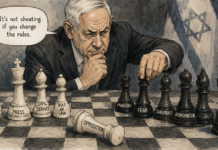




Israelis are losing patience with Netanyahu’s delay tactics in his bizarre negotiations with the butchers of Hamas

The murder of six young Israelis held by Hamas has brought Israelis’ rage against Benjamin Netanyahu’s government to a boil. With a national protest strike planned for Monday, there is mounting exasperation and impatience with what critics see as a cynical abandonment of the hostages aimed at enabling Netanyahu to cling to power amid epic calamity and failure.
So great is the anguish at the government’s handling of the situation that the coverage of the protests that erupted over the weekend, after the murders were reported, quite remarkably hardly focused at all on the actual murderer: the Palestinian jihadist group Hamas, which on Oct. 7 last year spawned a war that has to date killed perhaps 40,000 of its own people.
At the heart of recent events is Netanyahu’s insistence that Israel must retain at all costs a slice of Gaza known as the Philadelphi Corridor, along the strip’s border with Egypt. That runs counter to Hamas’ demand that Israel quit all of Gaza – which Israel seemed to accept several months ago, as part of the proposal announced by President Biden on May 31.
The accusation now achieving widespread currency is that Netanyahu has reneged in order to scuttle the anticipated cease-fire and hostage deal. He would be doing this for two reasons: first, his self-serving (but effective) argument that political recriminations over the Oct. 7 debacle must be put aside during the fighting; second, because the extreme-right parties that are key to his coalition have threatened to bring it down should he stop the war (they want, instead, to resettle Gaza with Jews).
Commentator Haim Levinson crossed his own Rubicon when dealing with all this, writing in Haaretz: “We refuse to believe our prime minister is an evil person, the leader of a sick cult — (but) we must realize that this is the case.”
Events of recent days could hardly have been scripted to more perfectly – and harrowingly – bring matters to a head and cause such a message to resonate.
On Thursday morning, Netanyahu insisted on holding a surprise Cabinet vote declaring that Israel will not abandon Philadelphi. It was well understood that such a decision – if implemented – would indefinitely delay any hope of a deal. And it was opposed by Defense Minister Yoav Gallant in what degenerated into a shouting match in which Gallant represented the view of the security establishment that the corridor was not important enough to scuttle the talks. Netanyahu plowed ahead anyway.
On Saturday night reports began to circulate that the military had found six bodies of hostages in a tunnel in southern Gaza. By Sunday morning the military identified the six – all young people, including the American-Israeli Hirsch Goldberg-Polin, whose parents had addressed the Democratic Convention some weeks ago. According to reports the hostages had been shot, in the head and in the neck, between 48 and 72 hours prior – meaning, quite possibly, that it happened around the time of the Cabinet decision.
The shocking imagery – and the unprovable but compelling possible connection between the events – unleashed a torrent of outrage which has been building up ever since the return to Israel about a week earlier of the bodies of six other hostages, including several elderly and venerable figures, including an artist, a historian and the founder of a kibbutz in southern Israel.
“You were sacrificed on the altar of .. the Philadelphi corridor!” wailed Nira, the mother of the murdered Almog Sarusi, who was 27. “You and so many other beautiful and pure souls. Enough! No more!” Danny Elgert, brother of a hostage believed to still be alive, accused Netanyahu of “having decided to kill the hostages” and caused a fuss by comparing on TV the Thursday decision to the 1942 Wannsee conference in which the Nazis decided to exterminate the Jewish people.
Arnon Bar-David, the head of the national labor federation Histadrut, announced a general strike, initially just for Monday, which would include shutting down Ben Gurion International Airport. “A deal is more important than anything else,” he said. “Jews are being murdered in the tunnels of Gaza. It is impossible to grasp and has to stop.”
Maj. Gen. (res.) Noam Tibon argued that Netanyahu’s position was undermining a foundational principle of trust between the state and its people, “and that’s why it is so unforgivable, and it will not stand…. The government of Israel is insisting on something that has no military logic to impede the hostage deal, and one understands that it’s political.”
On Sunday, Gallant tweeted that Thursday’s decision must be reversed. The Cabinet reconvened and refused to do so, and heard from hostage negotiator, retired general Nitzan Alon, that the hostages were in ever greater danger. Netanyahu blocked the move, arguing that this would reward the murderers of the hostages.
In addition to the deaths of hostages, Israel is of course also paying in other currency for the continuation of the war. If the war were to end, the Lebanese militia Hezbollah has committed to ending its attacks in Israel’s north, which have caused the evacuation of almost 100,000 for almost a year. The war’s end would also probably trigger renewed discussion about a US-led regional alliance, with the moderate Sunni Arab nations led by Saudi Arabia, as a counterweight to Iran. It would end the constant bleeding of Israel’s economy, or its international standing, of social cohesion – and of course it save the lives of countless Palestinians used by Hamas as human shields.
Is all this a reasonable price for retaining the Philadelphi corridor? In weighing the question, consider a few facts.
Yes, there is some value in remaining there: It is the dividing line between Gaza and Egypt, from where Hamas smuggled most of its weapons. But it is not a panacea. Most of the smuggling was below ground in tunnels that neither originate nor culminate in the corridor itself.
Capturing the corridor was not mentioned as a goal of the war until the spring – and keeping it has only recently surfaced as a demand. Moreover, the corridor was not mentioned as a goal of the war in October, after Hamas invaded Israel and massacred 1,200 people: Returning the hostages (then numbering 250) and removing Hamas from power in Gaza were the goals.
Military officials have also noted that any soldiers posted along the corridor would be very vulnerable, almost sitting ducks.
Moreover, if Hamas had indeed been removed, there would be a lesser need to worry about smuggling. And why is Hamas still in a position to return to power once Israel withdraws, even though it has been much weakened? Because the government does not allow discussion of an alternative, despite tremendous pressure from the Americans, the Arabs, and almost every non-governmental player in Israel. That’s because no possible replacement is palatable to the far right.
What’s left? The theory that Hamas can be pressured into giving up the hostages by heaping more destruction upon Gaza has been tested for almost a year. It probably won’t start working now in the little time that the remaining hostages probably have left.
Veteran hostage negotiator Yaron Blum, who has been working with hostage families, perhaps put it best: “What are these stupidities about the Philadelphi corridor? This is to me the Rubicon, and we must stop everything in its tracks.”
