















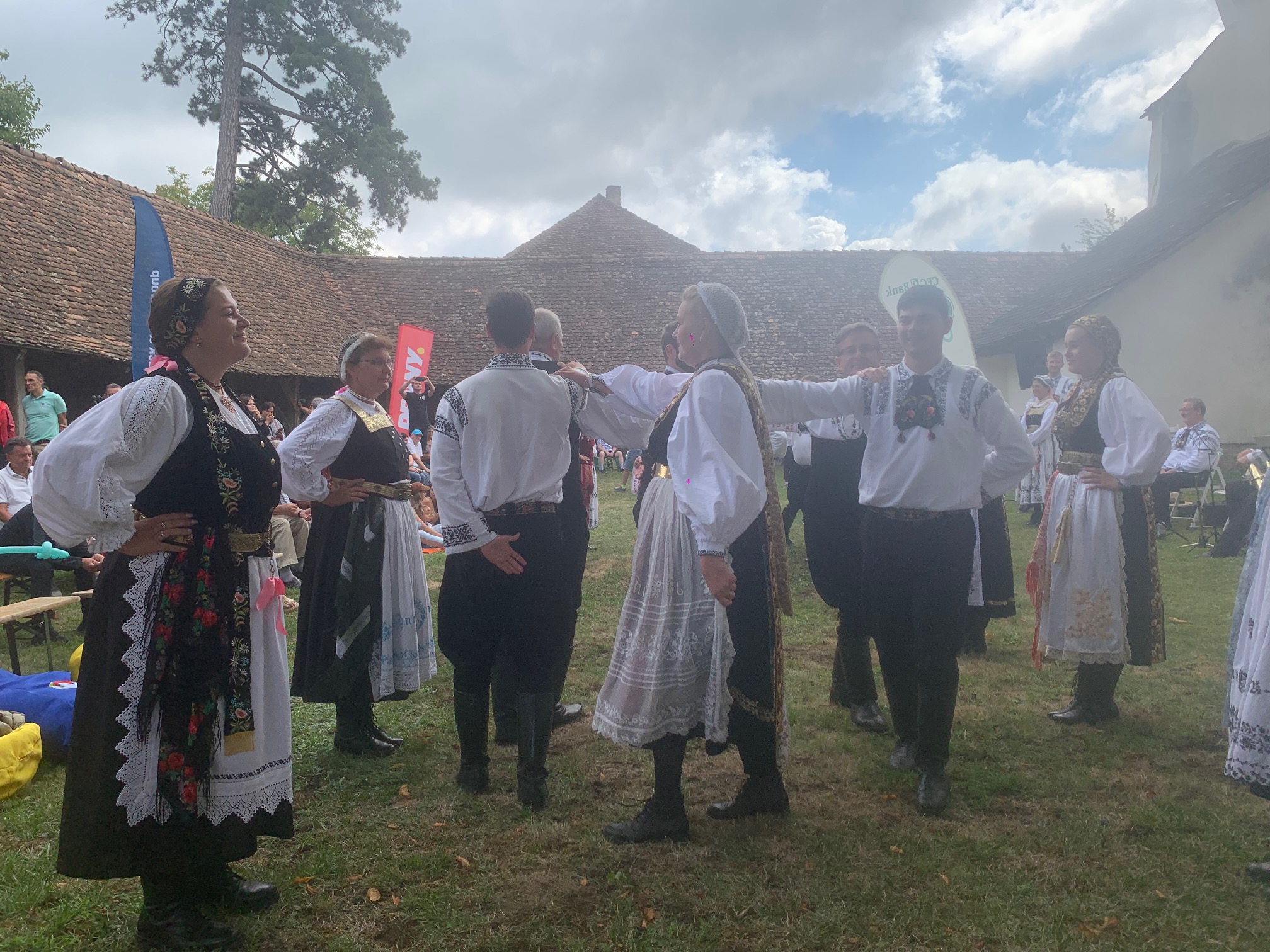
The sun came out of the clouds on Saturday morning in time for a Saxon band to strike up outside a Transylvanian Fortified Church on the second day of the Haferland festival that celebrates the traditions of the community in the area.
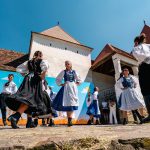
Local residents dressed in traditional black and white embroidered costumes with white lace bonnets (married women) gold cummerbunds performed Saxon dances. A couple of hundred people came to the event held in the courtyard of the 14th-century church.
The church still has some some original artwork from the 14th and 15th centuries at a time when Saxons were Catholics, not members of the Evangelical Church, a Protestant denomination.
“Last year there was more sun and less people,” said former British Ambassador, Andrew Noble, now an ambassador for the Haferland Festival. “Saxons are proud of their past and present,” he said in Romanian.
“This festival is important for us, if those who left 35 years ago (Eds: when communism collapsed) are still proud of their roots, we should be too,”he told a crowd of Romanians, Saxons and foreign tourists.
“It’s good we can tap into the past for the benefit of those who live here now and in the future,” he said to applause.
Haferland founder Michael Schmidt and Bernd Fabritius, a lawmaker of the Christian Social Union of Bavaria and former of the Bundestag, the German Parliament, who both come from the Saxon villages were at the event.
The festival, which runs from Aug. 8-11 in ten Saxon villages, offers visits to fortified churches, concerts, a ball and guided tours. This year it features a medieval wrestling exhibition as well as the usual traditional dancing shows.
Some 10,000 visitors are expected for the duration of the festival, a highlight of the Transylvanian summer.
This year’s Haferland runs on from a celebration of Saxons’ 800 years of residence rights in Transylvania in Sibiu last weekend.
The Golden Charter of the Transylvanian Saxons was issued by Hungary’s King Andrew II in 1224 and granted provisional autonomy to the Saxons or Germans living in Transylvania which was then part of the Kingdom of Hungary.
Historically, the Saxons or ethnic Germans acted as a buffer between the Romanians and Hungarians whose relations were often fractious. Although a minority, the Hungarians ruled Transylvania until the Austro-Hungarian Empire collapsed in 1918, and Transylvania was reintegrated into modern-day Romania.
Today, the Transylvanian Saxon community numbers just 12,000.
The popular festival ends Sunday with a ceremony for the 700th anniversary of Rupea fortress, a towering medieval monument of major historical importance that looms high over the landscape.
The 2024 edition of Haferland Week takes place under the high patronage of His Serene Highness Prince Philipp von und zu Liechtenstein, of the Princely House of Liechtenstein, and – for the first time ever- under the auspices of the Royal Family of Romania.



Transylvanian bishop praises patron of Haferland festival that celebrates Saxon traditions
