








Is Trump really mad at Putin? Don’t bet the farm, because the president does love a dictator
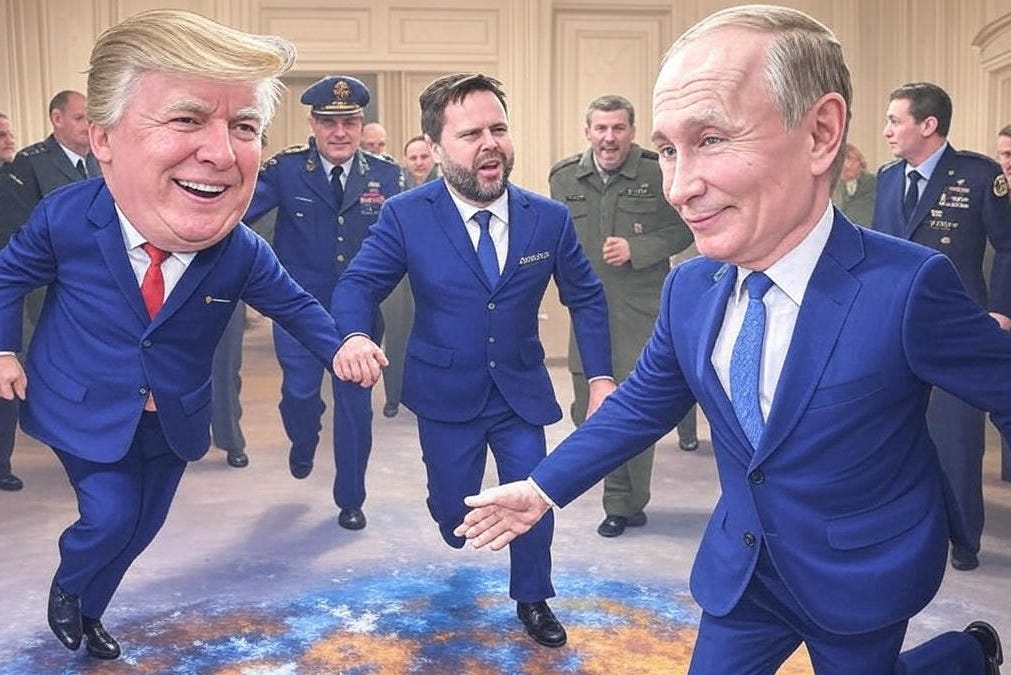
One of the strangest features of Donald Trump’s extremely strange public persona is the widespread impression, backed by solid circumstantial evidence, that he’s somehow in the pocket of Russian dictator and international outlaw Vladimir Putin. For a guy so obsessed with dominance, image, and the projection of strength, Trump has seemed oddly willing to look weak by defending Putin’s international meddling and military atrocities.
So a lotta people are wondering what to make of Trump’s comments this week. Standing in a New Jersey airfield, Trump broke with tradition in lambasting Putin (albeit in his traditional third-grade level of speaking): “I’m not happy with what Putin’s doing. He’s killing a lot of people and I don’t know what the hell happened to Putin. I’ve known him a long time. Always gotten along with him, but he’s sending rockets into cities and killing people and I don’t like it at all. Okay? We’re in the middle of talking and he’s shooting rockets into Kyiv and other cities. I don’t like it at all. Surprised. I’m very surprised. We’ll see what we’re gonna do.”
Well, Putin’s been “sending rockets into cities” for a while now, while Trump has recently been accusing Ukraine of starting the war. So what gives? What really has changed? And “what we’re gonna do”?
It could be all the options in our poll — true anger, just negotiation, a burst of ego or absolute political theater. But there is no doubt that Trump has reason to be angry. Especially since throughout his campaign, he boasted that he’d finagle an end to the three-year-old war “on day one.”
Trump appeared to have a simple plan: freeze the front lines, twist Ukraine’s arm to accept Russian occupation of seized territories, and claim peace. He did his part with the determination of a true lickspittle: Accusing Volodymyr Zelensky unfairly of being a dictator (while never using the word about the actual one in Moscow); insisting, absurdly yet repeatedly, that Ukraine started the war in which Putin attacked it; and for a time halting aid and intel after kicking the Ukrainian leader out of the While House (while JD Vance hectored him for allegedly not saying “thank you,” which he had done countless times).
Yet Putin, seemingly confident of his hold over Trump, is not playing ball. His demands have expanded beyond what Trump might have expected, and his brazen disregard for the most basic of decorum has shot through the roof.
The background is that in September 2022, seven months after invading Ukraine, Russia held “referendums” in four Ukrainian regions in the east of the country — Donetsk, Luhansk, Zaporizhzhia, and Kherson — declaring them part of Russia just days later. These votes, conducted under occupation and in wartime conditions by a country that falsifies elections that way AQL readers breathe air, were condemned as illegitimate by the international community. Russia didn’t even fully control the territories at the time and still doesn’t — but it has indeed captured most of them (as per the map below).

According to the Kremlin, the status of these regions is now “non-negotiable.” That means Trump’s envisioned shortcut to peace — forcing Ukraine to accept the status quo — won’t work unless Kyiv agrees not only to cede what has been lost but to fork over yet more. Moreover, Putin didn’t show up to the Turkey-hosted peace summit two weeks ago that he himself initiated, despite Zelensky’s attendance and Trump’s own hints that he might participate. B and C teams treaded Turkish water.
All of this makes Trump look ridiculous. And, like the unforgettable line in Godfather Part II, a man in Trump’s position cannot afford to be made to look ridiculous (I suppose I should amend it to say: quite this ridiculous).
So what’s more likely than Trump suddenly discovering a moral opposition to war crimes is that he doesn’t appreciate looking like a chump. Certainly not at the same time that his tariff mania, and the astoundingly illiterate justifications of it, make him look like an idiot as well (while his acceptance of Qatari gifts in the form of planes raises the suspicion of corruption on top).
Still, the bigger question isn’t whether Trump is mad — it’s whether he would actually cut off US support to Ukraine. The odds are high that he eventually would — despite his minerals deal with Zelensky. His base, increasingly isolationist, is receptive to the idea.
And that raises a pressing dilemma for Europe. If Trump pulls the plug, what should the continent do?
The answer is not obvious. European leaders will face a fateful choice: either continue supporting Ukraine militarily and economically on their own — at great cost and risk — or pressure Kyiv to accept a ceasefire along current front lines, effectively freezing the conflict and locking in Russian gains. And thus basically doing the same thing Trump had intended to do.
Supporters of continued resistance argue that Ukraine has every right to reclaim the 20% of its territory lost since 2014, including Crimea. And that appeasing a dictator and rewarding aggression and terrible ideas that historically backfire. But others in Europe may be tempted by realpolitik: that a frozen conflict with a road to EU membership for Ukraine is preferable to an endless war without US backing.
NATO membership for Ukraine — the other prize some had considered, and which in 2008 indeed was offered — is all but dead. It cannot happen without US backing, and even some NATO supporters privately acknowledge that the offer of future membership was a red line for Russia — one that, while not justifying Putin’s aggression, may have exacerbated the conflict. Ironically, NATO has already proven it can functionally support Ukraine without formal membership. It may have to do so indefinitely.
Sanctions are another battleground where Trump’s intentions are unclear. The West’s economic pressure on Russia has produced real effects — but not a collapse. According to recent assessments by the Economics Observatory, Russia’s economy is roughly 5% smaller than pre-war forecasts. Western companies have exited en masse, imports of high-tech goods have slowed, and military production has become costlier. But Russia has also adapted: reorienting trade toward China, India, and others, and substituting foreign goods with domestic ones.
Budget deficits have widened, inflation has surged, and the ruble remains unstable — but none of this has altered Putin’s course. Why? Because the sanctions, though vast in number (over 13,000 imposed), are full of loopholes, inconsistently enforced, and undermined by global divisions. For example, Russian oil is still flowing — often sold at a discount to Asian markets — and much of the revenue continues funding the war.
So what’s Trump “gonna do”?
Well, if he were serious about pressuring Putin, which does sound like science fiction, he’d push for a crackdown on sanction evasion, close enforcement gaps, and target key sectors like energy and defense manufacturing more aggressively. Instead, he talks about “considering” sanctions while praising Putin’s toughness in the next breath.
Is Trump really mad at Putin? Maybe, but not in the way it matters. Not because of massacres or geopolitical crimes — but because Putin isn’t sticking to the script where Trump plays global kingmaker and everyone else bows.
That’s the saddest part, in a way. Because whether Trump’s anger is real or feigned, his instinct is not to stand up to dictators — it’s to be one. Trump recently backed the pro-Putin presidential candidate who threatened to arrest rivals and drag Romania out of the EU. The supposed leader of the West backs the enemies of the West. That’s the absurd, contradictory and infuriating reality that we face.
So Europe must deal with it. If Ukraine’s fight for sovereignty is to continue, it may have to do so with Europe — not America — as its primary sponsor. That means bigger defense budgets, longer-term commitments, and difficult decisions about how far to push Putin — and how to deter him without lighting the whole continent on fire.
