











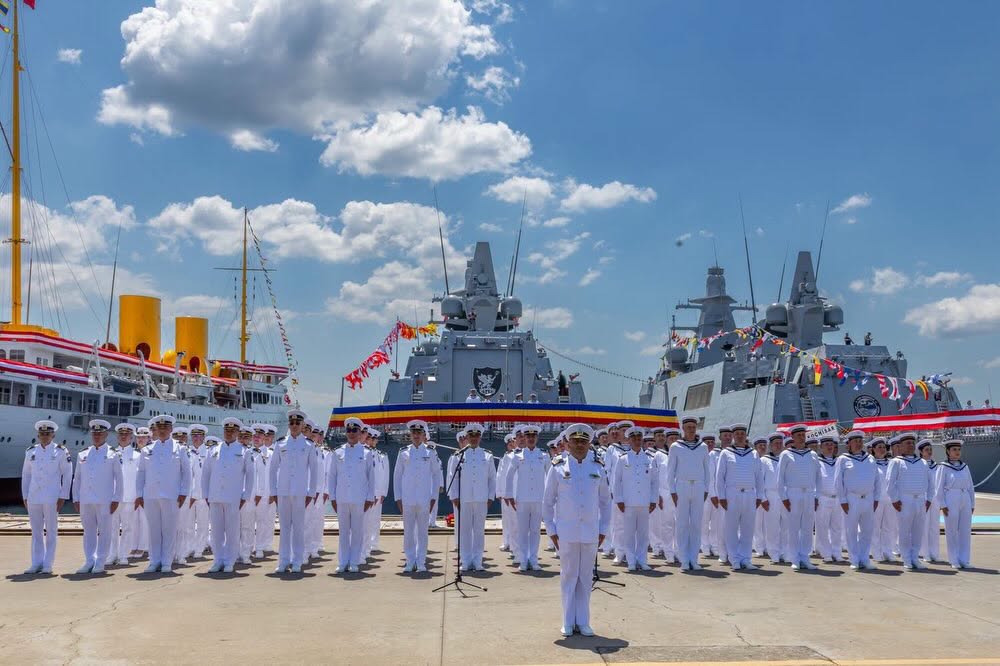
Romania has taken an important step in strengthening its defense capabilities with the acquisition of a new multi-role corvette from Türkiye—the first new naval combat vessel to enter the fleet in three decades.
The investment is part of a broader vision for the modernization of Romania’s Armed Forces. Four additional vessels are expected to follow through the SAFE program, contributing to the renewal of critical military capabilities across all services.
The new corvette will significantly enhance Romania’s deterrence and defense posture in the Black Sea, combining advanced sensors, modern weapon systems, and NATO-interoperable capabilities designed to address today’s evolving security challenges.
The acquisition also reflects the strong and growing strategic partnership between Romania and Türkiye, built over the past 15 years on shared interests and regional security cooperation.
The corvette Contraamiral August Roman (261) was commissioned in June 2026 and originally built for the Turkish Naval Forces by Turkish company Asfat at the Istanbul Naval Shipyard as offshore patrol vessel Akhisar, the ship was sold to Romania before entering Turkish service.
The Akhisar’s sister ship, TCG Koçhisar (P-1221), has been commissioned into the Turkish navy as the first of its Hisar-class offshore patrol vessels (OPVs).
Procured by Romania in December 2025 in a contract worth EUR223 millionContraamiral August Roman represents the first delivery of a Turkish-built warship to a European Union and NATO member state.
The primary missions of the ships include intelligence, surveillance and reconnaissance (ISR) and maritime special operations.The final weapon and sensor configuration of the ship is subject to change as it is being built ‘for but not with’ various systems.
The partnership is expected to expand further to include the protection of critical underwater infrastructure in the Black Sea—an area of increasing strategic importance. This is essential not only for regional security, but also for safeguarding the infrastructure that supports Romania’s energy future, including the development and exploitation of Black Sea natural gas resources.
