






Romanians on May 18 choose between the path of the West or the darkness of Putin-style illiberalism
My parents were born in Romania. I speak the language (see video above), lived in the country for four years, and have visited countless times. I feel deeply connected to the place — to its people, its culture, and its history. Yet I am not a Romanian citizen, and in essential ways I am not Romanian. That distance may mean I miss certain nuances. But it can also bring clarity.
In decades of leading journalistic coverage across over 100 countries in Europe, Africa, and the Middle East for the Associated Press, I’ve seen what makes societies different – but also what is similar. And I can say this: in almost every society, 30 to 40 percent of the population feels alienated from the system and frustrated with their lives.
Some are frustrated with corruption or stagnation. Others feel alienated by modernity, multiculturalism, or just the erosion of traditional hierarchies. Many simply feel powerless in their own lives. They are angry — sometimes with convincing cause, sometimes without — and they seek refuge in ultranationalism, conspiracies, and tribal belonging. It’s a chaos of grievances and misanthropy, united not by a coherent ideology but by shared bitterness.
When a single political force manages to consolidate that vote — as George Simion’s far-right juggernaut seems to be doing with Romanians — it can win a plurality in an open field. In the May 4 first round of the country’s rerun presidential election, Simion maxed out the disaffected. But what matters now is not that he won the first round. That is noise. The only thing that matters is whether everyone else — who should, in any version of a logical world, be the majority — can unite against him in the second round on May 18. Because if they do not, Romania will follow a path trodden by some other countries in recent years — into illiberalism, isolation, and the kind of national disgrace that brings horrifying divisions of the kind being experienced by Americans right now.
This is not just about one candidate. It is a referendum on Romania’s direction. Will it continue along the difficult but rewarding path toward liberal democracy and integration with the West — or choose the darkness of Putin-style authoritarianism masquerading as national pride?
Romanians must decide whether they remain in the family of liberal democracies (which they only joined three decades ago after the nightmare of communism), or do they cast their lot with a loose but growing coalition of autocrats, saboteurs, and strongmen — from Vladimir Putin to Viktor Orban, from Donald Trump to Recep Tayyip Erdogan to Benjamin Netanyahu?
A Simion victory would be celebrated in the Kremlin, and not only there. It would be another crack in the democratic alliance that underpins the postwar international order. It would embolden Russia’s aggression in Ukraine, undermine Europe’s unity, and send a signal to aspiring autocrats — including those in the MAGA movement — that illiberalism is winning. It would be a victory not just against Romanian democracy, but against Western civilization itself.
There are three reasons why everyone who is not pro-Putin might not come together — and all are dangerous.
- Fatalism. After a strong first-round performance, the media often anoints the frontrunner as inevitable. But this is psychological, not mathematical. People, even sophisticated ones, can fall into the trap of thinking “he’s going to win anyway” — and then, by withdrawing, they help him do just that. Some even jump on the bandwagon to support the “winner.” This is how democracy collapses: not in a bang, but in a sigh of resignation.
- Petty Politics. Some will refuse to endorse Simion’s second-round opponent, independent Nicușor Dan. That decision — driven perhaps by ego, perhaps by miscalculation — is not just petty. It is reckless. This is a moment that demands maturity, even sacrifice.
- Personality. Simion is somewhat charismatic, in a thuggish way. He speaks with clarity. He offers easy answers to hard problems, as is the right-wing populist mode. None of them hold up under scrutiny, but in a circus-like age, where social media can dominate the discourse, simplicity can be seductive. Even people outside his ideological tribe — educated people, urban professionals, fence-sitters — can be drawn in by his “alpha” demeanor. That could be enough to move another 5–10% of the vote.
- This is critical, because Simion is part and parcel of the global attack on democracy by the illiberal right – carried out, paradoxically, in the name of democracy itself.How can this be? Because there are two versions of democracy in circulation. One is liberal democracy, constrained by checks and balances, civil liberties, and rule of law. The other, which to humanity’s misfortune is represented by Trump in the United States, is a kind of electoral authoritarianism — an autocracy legitimized by winning elections.Whether or not he declares it openly, Simion is aligned with that camp. Its members – from Hungary’s Viktor Orban to France’s Marine Le Pen – draw strength from anger at globalization, identity anxieties, and collapsing trust in institutions. They claim to represent “the people,” and thus feel entitled to rewrite laws, silence dissent, vilify minorities, and reshape reality. Leaders like Putin and Erdogan have used this logic to crush civil society and unleash waves of division and fear.
- Simion speaks in that same register. He talks of “Romanian values,” of purity, of taking back control. But a Romania under Simion would find itself adrift — tolerated, perhaps, by a Trump-led Washington, but marginalized in Brussels and Berlin. Putin and Trumpworld are not Romania’s friends. Its economic lifeline and strategic alignment lies with Europe, not Moscow.Simion claims to support NATO, but he opposes military aid to Ukraine, has been banned from entering Ukraine for pro-Russian activities, and echoes Kremlin talking points. He bashes the EU and would likely govern in alignment with the global far-right — Putin’s useful fools.There are indications that he may try to elevate as premier Calin Georgescu, who came in first in the cancelled round from November and was thereafter barred from running – and there are reports that such a government would try to pull Romania out of NATO and the EU. In retrospect it was not only dubious but practically unwise to bar Georgescu, who was just replaced by another more clever and charismatic hooligan with their base now fired up.
It would be a huge gist to Putin and a blow to the West, as Romania is mid-sized country of almost 20 million people and a frontline state in the effort to aid Ukraine. There is no national signal dignity. It would be an act of national self-sabotage.
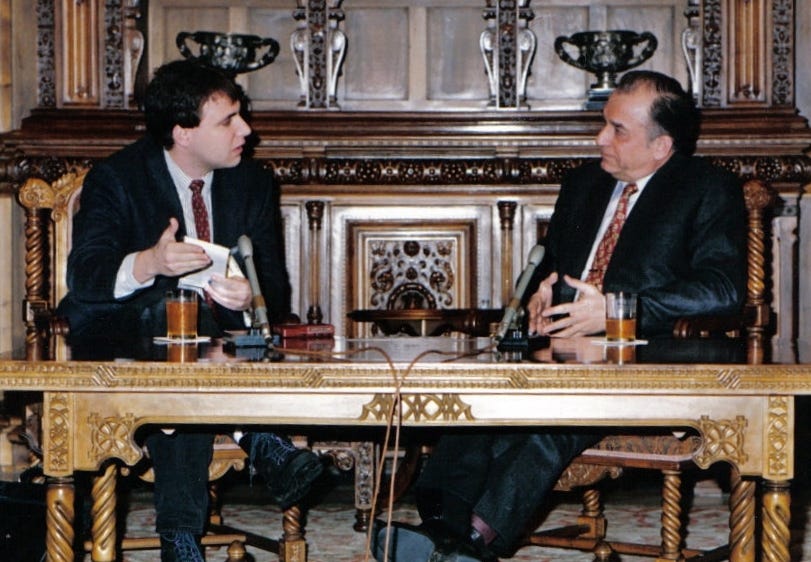
I understand the anger many Romanians feel. Corruption persists. Inequality is real. Many traditional politicians are uninspiring or worse. That began with Romania’s first post-communist leader Ion Iliescu, who was among the oiliest of ex-communist apparatchiks (below being interviewed by me in 1991).

Some may hope that Simion, if elected, would be constrained by Romania’s political structure. But that is a dangerous bet. The presidency’s hybrid role — operating by norms, not just laws — makes it especially vulnerable to someone who ignores norms and pushes limits. Simion could paralyze government, attack institutions, and create crisis after crisis to justify the centralization of power. That’s what Erdogan did. It worked.
And the social costs would be grave. Simion’s ethno-nationalist rhetoric poses a threat to the country’s minorities — especially Hungarians and Roma — and could inflame tensions that Romania has worked hard to contain. Once the state scapegoats entire communities, the damage can be lasting.
There is still time to avoid this path. Precedents abound: in France, in Israel, even in the U.S. The far right can be defeated if the center and left cooperate. Romania, more than most, knows where the road to authoritarianism leads — and how long it takes to climb out.
I arrived in Romania a few weeks after the 1989 revolution. The stores were empty. Not metaphorically — literally. The regime had broken the spirit of the people. It built a country on lies and fear. Children were taught to betray their parents. Romania was cut off from the world, not for years but for decades.
And the result was not “national dignity.” It was despair, disconnection, and darkness.
Over the past 30 years, Romania has made extraordinary strides. Mistakes have been many, and Balkan-style politics have bred cynicism and anger. But the country is freer, richer, more open, and more respected than at any time in its modern history. To deny that is not patriotism. It is ignorance at best — and stupidity at worst.
So Romanians tomorrow are choosing between the path of the West, which with all its frustrations is the road to prosperity and freedom, or the darkness of Putin-Style illiberalism. That the US leader is undoubtedly rooting for the latter is the defining insanity of our moment. If Romanians are seduced in that direction, the country is headed for years of misery and regret.
