











Romanians on Tuesday celebrated Epiphany, one of the most important religious holidays in the Orthodox calendar.
The January 6 feast features a variety of Christian and folk traditions, involving holy water, basil and horses.
In the Orthodox Church, Epiphany marks the baptism of Jesus in the River Jordan, while Catholics and Protestants celebrate Epiphany as the arrival of the Magi or three wise men.
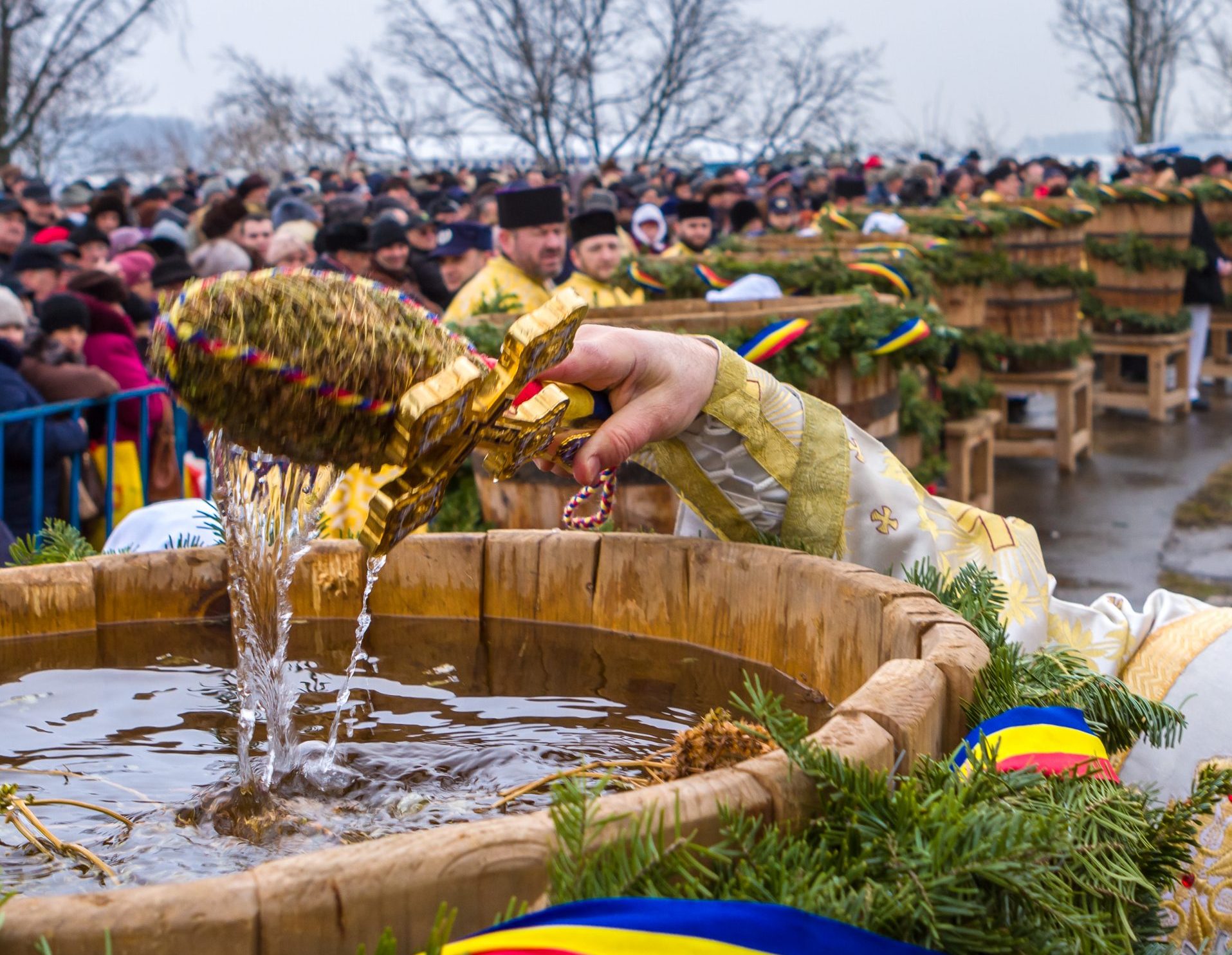
In Romania, Orthodox priests typically go from house to house with a cross and splash children, wells, and trees with holy water to chase away evil spirits.
Holy water known as “agheasma”’is said to have miraculous properties and to be able protect people from diseases and misfortune.
‘At Epiphany, … the Baptism of the Lord, a great miracle is performed every year. The Holy Spirit, descends above the water (and) changes its natural attributes. It becomes incorruptible, that is, it is not subject to corruption, it remains clear and fresh for many years, it receives the grace of curing diseases, casts out demons and any opposing powers; it guards people and their homes from any danger,” according to ‘Sermons and Spiritual Guidance’, by St. John Maximovitch, a Russian-American Orthodox bishop.
One custom in Romania and neighboring Bulgaria, which is also a Christian Orthodox nation, involves a priest throwing a cross into a river or a lake as men then leap into the icy waters to retrieve it.
The person who successfully brings it ashore receive the priest’s blessing. It is said they will be blessed with good fortune all year long.
The day also includes al folk traditions, such as carol singing or predictions for the coming year.
Unmarried girls put basil under their pillows and custom has it that they will dream about their future husband.
Folk tradition says that if the weather is good on Epiphany, the year will be rich in bread and fish. It was a mild 5C in the Romanian capital but much colder in other parts of the country.
Epiphany is followed by Saint John the Baptist Day on Jan. 7, another major saint day.
Epiphany marks the end of the 12 days of Christmas, but not all Orthodox Christian churches celebrate it on the same day.
While the Orthodox Christian churches in Greece, Bulgaria and Romania celebrate the feast on Jan. 6, Orthodox Churches in Russia, Ukraine and Serbia follow the Julian calendar, according to which Epiphany is celebrated on Jan. 19, as their Christmas falls on Jan. 7.
More of the sermon by St. John Maximovitch, the Russian-born bishop known for his holiness, healing miracles, clairvoyance, and care for the poor and orphans, especially among Russian exiles in China and America.
“And since water is found everywhere, sanctifying the waters, Christ prepared nature to enjoy the consequences of the sacrifice He came to offer us. But it is not only that. He gave the waters the power to wash away human sins. John’s baptism was only a sign of repentance. Christian baptism is the new birth, the forgiveness of all sins,” he says.
Through water God punished the sins of the first world and lost it in the flood. It is also through water that God now saves people, in the mystery of baptism.
Christ the Savior grew up in Galilee, in the city of Nazareth. He remained there, hiding from men the power and wisdom of His divinity, until he was thirty years of age, obeying the Law, which said that no man should preach or prophesy before he was thirty years old.
‘For this reason the Lord Christ did not begin His preaching until these years, nor did He show Himself to be the Son of God and the great High Priest, Who went through the heavens until the number of His years was fulfilled.’
‘Then, when the thirty years were fulfilled, and the time of His divine appearance came, as the Gospel says, to appear to Israel: It was the word of God to John the son of Zechariah in the wilderness, sending him to baptize Him with water. So he put a sign for him by which he could know the Messiah, the One who came into the world, as the Baptist alone in his good news says, saying, “He who sent me to baptize with water, he said to me, ‘Upon whom you will see the Spirit descending and remaining on Him, He is the one who baptizes with the Holy Spirit.’ (Lives of the Saints)
St. John said: ‘I baptize with water; but in the midst of you is He whom you do not know, Who comes after me, Who was before me, and Whom I am not worthy to untie the strap of my shoes.’ (John 1:26-27).
St. John Maximovitch (1866-1966), known as the Archbishop of Shanghai and San Francisco, was canonized by the Orthodox Church in America (OCA) in 1994 and is an important saint for Orthodox Christians.
