








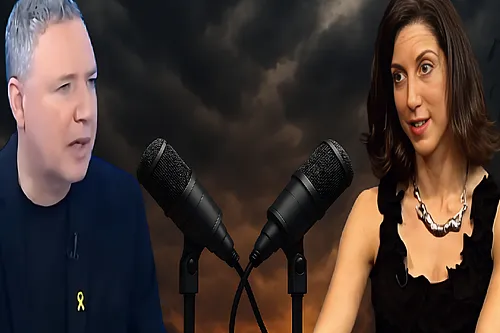
Prediction is always a dicey, hubristic business. But in today’s episode of Critical Conditions, Claire Berlinski and I took the plunge anyway. Our preview of 2026 suggests a year in which deferred truths become politically unavoidable — a year of decisions and reckonings. We are reaching a breaking point.
In trying to divine what the near future might hold, we addressed an array of issues from the ridiculous to the sublime. Topics included Iran on the brink of possible rupture, China testing Taiwan with ever-normalized coercion, Europe facing its moment of strategic adulthood over Ukraine (and more), AI reshaping politics, geopolitics, and even truth itself, and elections — from Sweden to Israel to the US — that will decide whether democracies can repair themselves or collapse under the weight of collective foolishness. Wild cards, from Putin’s potential overthrow to a catastrophic AI accident, remind us that fragility breeds surprise. In 2026, the pressures long deferred will demand decisions, and the world will find out whether institutions bend — or finally break.
Above we offer the highlight reel — and the full episode (and writeup) is just below, after the paywall. It’s worth it, especially at the crazy and fleeting discount!
Here’s the embedded podcast:
We ranked our respective predictions from number five to one.
Claire’s number five was China and Taiwan. The likelihood of a direct invasion in 2026 is modest, she said, but increasingly possible. Coercive gray-zone operations, maritime and airspace harassment, economic pressure, and routine provocations are increasingly normalized. Beijing is rehearsing escalation, and nationalist politics narrow the room for de-escalation if something finally goes wrong. Even without war, these routines erode restraint and set the stage for a future conflict. Timing is everything, and 2026 may accelerate a trajectory Beijing has long plotted.
My number five was immigration politics and the era of mass migration. Europe and other Western countries are reaching the limits of what their societies can absorb. The far-right has already exploited this, but the real change will be mainstream liberal parties adopting some of its messaging—not out of conviction, but out of political necessity. Fortress Europe is becoming more visible, and debates over identity versus labor needs will dominate political discourse. While politically fraught, this evolution reflects a reality Western societies cannot indefinitely defer.
Shared number four: Iran. The Islamic Republic is structurally exhausted. Economic dysfunction, water insecurity, generational alienation, and widespread protests signal a regime under pressure. Both of us agreed that authoritarian systems often collapse suddenly when fear ceases to function at scale. Military factions, ethnic minorities, and frustrated clerical institutions add further instability. 2026 could witness a rapid rupture — a coup, rebellion, or regime shakeup — accelerated in part by Israeli actions that have undermined the regime’s capacity to repress effectively. The likelihood of major change this year is far from certain, but the preconditions are unmistakable.
My number three was Europe and Ukraine. 2026 will be Europe’s forced moment of adulthood. With Trumpy American walking (running!) away from leadership of the free world, and teh US commitment to Ukraine wobbly at best, European powers must decide whether to sustain Ukraine and build a serious defense infrastructure for themselves as well. This year could mark decisive steps in EU strategic autonomy, with Europe supplementing U.S. shortcomings, doubling down on defense, and stepping into global regulatory leadership, particularly in digital and social media governance. Claire ephasized the operational risks. Russia’s hybrid campaign will intensify without credible US deterrence, creating a denser, more dangerous environment. Near misses —misattributed strikes, drone incidents, or border collisions — could escalate unpredictably. Europe’s response will determine whether it stabilizes Ukraine and asserts strategic relevance, or watches crises proliferate.
My number two was Artificial intelligence (it was Claire’s Number One). Both of us place AI at the heart of systemic risk. AI has been treated as an amazing tech curiosity or a business opportunity. In 2026, its impact becomes political, economic, and existential. Job markets will be disrupted, search engines will converge with generative AI, and algorithms will shape the narratives people inhabit. There could be civilizational counter-narratives emerging, turning the question of training models into one at the center of geopolitics. Claire emphasizes AI-driven micro-targeted persuasion, synthetic citizens, and localized influence campaigns, which could erode shared reality and democratic epistemic ground. The consequences are profound: legitimacy, governance, and social cohesion will all become entangled with invisible, opaque systems. Expect this to enter the very center of global politics.
My number one was a series of key elections. Sweden’s vote will signal Europe’s political trajectory on immigration. Israel’s election may determine whether the country stabilizes as a liberal democracy or slides toward ethnocratic authoritarianism under Netanyahu, with consequences for the region and nuclear risk (I assess that a few more right-wing victories and Israel will collapse). In the United States, the midterm elections will show whether voters punish the Republican Party for enabling Trump-era abuses, tariffs, and institutional destruction — and whether Congress will be able to limit the damage for the remainder of Trump’s term. By the way, Claire predicts Trump may not finish out his term, ousted by the Administration on grounds of incompetence and dementia. She thinks there is a not-small chance of a President JD Vance.
We ended by highlighting high-impact, low-probability scenarios. I suggested Vladimir Putin’s overthrow — a personalist autocracy can fracture suddenly. Claire envisions a catastrophic AI accident, revealing society’s surrender of control to systems it cannot predict or regulate. Both underscore the fragility of complex systems and the potential for abrupt shocks.
Across these domains — authoritarian politics, great-power rivalry, European strategic autonomy, artificial intelligence, and democratic self-correction — the unifying theme is that denial is running out of road. So yes, indeed: We expect a year of decisions and truth.
