










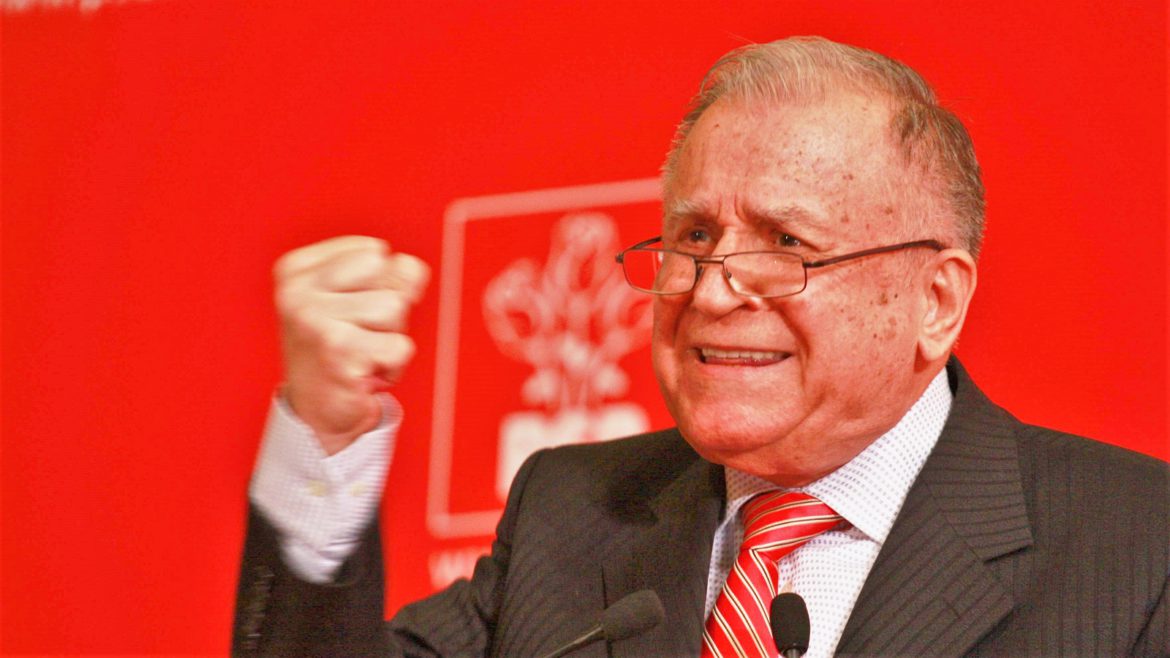
Ion Iliescu, who came to power during Romania’s bloody revolution, steered the post-communist country toward NATO and the European Union, but died while facing charges of crimes against humanity for his role the country’s bloody revolution has died, the government said Tuesday. He was 95.
“With deep regret, the Government announces the death of the former President of Romania, Mr. Ion Iliescu” a statement said. Despite the charges against him, the government will give him a state funeral.
He died Tuesday at the Prof. Dr. Agrippa Ionescu’ Emergency Clinical Hospital where he was admitted in June suffering from complications from lung cancer.
Considered a reformed communist by some, and a shameless opportunist who was simply more wily and younger than Nicolae Ceausescu by others, he came to power during the revolt that overthrew Ceausescu in December 1989 and oversaw his execution on Christmas Day 1989. He served three terms as head of state – from December 22, 1989 to 1992, then from 1992 to 1996. and between 2000 and 2004, considered his most successful term in office.
He presided over the 1995 Snagov treaty that set Romania on a pro-Western path, but never fully explained his role in the revolution where more than 1,100 people died, many after the execution of Ceausescu when he had taken over as the country’s informal leader.
He was charged with crimes against humanity in 2019 after a long-running investigation but there was no trial partly because of his age and mainly because the case was considered too politically sensitive for Romania’s establishment which has never properly investigated the revolution. Like Iliescu, many second-level communists came to power after 1989 and did not want their pasts scrutinized.
Upon his death, reformist President Nicusor Dan said in a post on Facebook: “History will judge Ion Iliescu, a key personality of the transition of the 1990s . It is our obligation to clarify the major unsolved files of that time so we can move forward. May God forgive him,” the president said.
Mr Iliescu and two other officials were accused of spreading disinformation in their TV appearances and statements, increasing the risk of “chaotic shooting”. He denied wrongdoing.
The son of a railway worker from the southern town of Oltenita, Iliescu joined the Communist Party in the 1940s and rose rapidly through its ranks, studying in Moscow which sealed his Communist pedigree. He served under Ceaușescu as a government minister and propaganda chief and was seen as a possible successor to Ceausescu, before being sidelined as Ceausescu feared his popularity in the party. In the mid-80s, he was viewed by insiders and diplomats as the successor to Ceausescu.
His last political gesture before being taken to hospital was to congratulate Dan for winning the presidency.
He is survived by his wife, Nina, whom he met in Moscow. The couple had no children.
