

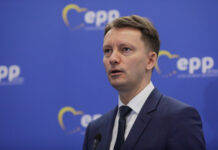


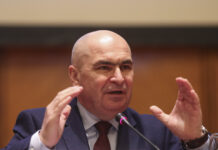




Russia’s hybrid attack against Romania began eight years ago, long before Kremlin-friendly Calin Georgescu ran for president, a leading Romanian audiovisual official said Monday.
Mircea Toma, who is a member of the National Audiovisual Council said the Kremlin began its campaign in Romania before the pandemic, promoting pseudo medical products on online platforms.
The products, which included fake cancer treatments, were used to create a database of vulnerable people who are easy to manipulate, he said. This same audience was later targeted by conspiracy messages and campaign messages which supported Călin Georgescu.
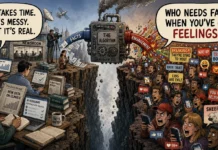
The Russians used “The fisherman’s tactics“, meaning that before throwing the rod, the fisherman places a bait to attract the fish, said Toma, a psychologist and founder of the Cațavencu Academy publication.
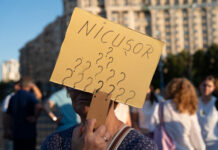
The purpose of these campaigns was to identify people who would be susceptible to manipulation. These- “suckers“, were more likely to accept any conspiracy theory and support Călin Georgescu, he said.
“They got lucky with the pandemic as it perfectly fitted their goals. They wanted to identify suckers, as well as erode trust in authentic sources of information,” Toma added.
This strategy was used to recruit an audience that not only accepts false information, but is also angry with the authorities. “And all of a sudden you had a target, not only ready to accept “crap”, but also angry at those (they think) are trying to fool them.”
Georgescu’s speech
Toma analyzed the meteoric rise of Călin Georgescu, calling him an”artificially constructed phenomenon“. Behind this phenomenon there is a well-organized network, which used online manipulation tactics to quickly increase his popularity.
The strategy of influencing the electorate included the use of micro-influencers, who, without being aware of the whole scheme, were paid to promote certain messages. “Micro-influencers… received some money to post a message!,” Toma explained.
Neighboring Moldova has a clear picture of the mechanism through which such campaigns are financed. “The evidence is in Moldova, they have identified the physical route of the money,” he said.
But Romania isn’t alone. The information attack is part of a global phenomenon observable in other democracies. “We are not the only target. I think we are one of the multiple, global targets of this type of war. I think it’s a war waged against democratic culture and that the people who initiate it would like global partners who work in the same political paradigm, autocrats for example,” he said.
“Unlike what happened in England with Brexit, where there were online tools that allowed them to identify audiences, and these audiences with their own particularities had messages tailored to their expectations, here it was the opposite!
In Romania, the audiences are uniform and they receive the same message. They no longer tailored the message according to expectations, but brought a message with the name ‘Georgescu,'” Toma explained. He also noted that this tactic was also used to promote conspiracy theories and anti-vaccination messages during the pandemic.
In this context, Toma also brought up the amplification of populist messages through public figures that adopt conspiracy narratives. He mentioned Anamaria Gavrilă “who tries to copy from Georgescu’s speech as much as she remembers.”
He drew a parallel to the strategy used in Hungary, where George Soros was turned into a public enemy similar to the character Goldstein in Orwell’s novel “1984.” “The path to power was to demonize Soros, who became a political actor without actually being there! With posters on the streets showing Soros’ face… It is a classic propaganda mechanism,” Toma explained.
The role of the National Audiovisual Council (ANC) in combating disinformation
The NAC has started to monitor and intervene in the online environment, and now has direct communication channels with social media platforms. “We have organized ourselves internally to cope with this pre-electoral and electoral period, so that we can take down things that can produce effects in hours, not in days,” Toma said.
In recent weeks, the council has imposed substantial fines, of 100,000-200,000 lei, for violations of audiovisual legislation. An important development is the council’s collaboration with platforms such as TikTok and Meta to remove illegal content in a few hours.
The ANC operates based on rules inspired by the European model and tries to limit media abuses . But major challenges remain for combating disinformation and the aggressive messages promoted by some television stations. „We have a lot of fake news, incitement to violence, aggressiveness, unfounded accusations, threats. ANC members have been threatened several times“, he said.
Toma concluded that increased vigilance and greater involvement of media institutions are needed to combat manipulation of information: “This interface is one that led in Romania to promote the campaign started eight years ago through voices that, sometimes have revealed themselves. A collective effort is needed to combat this type of influence.”
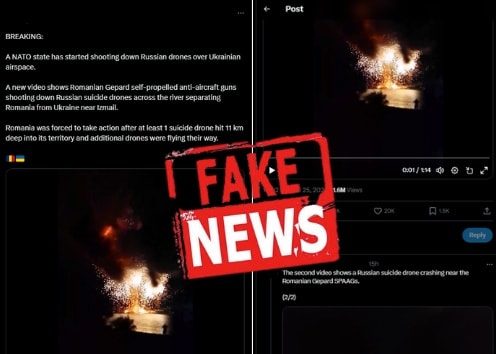
Disinformation as a weapon of war. Russia’s amplified its propaganda war against Ukraine in 2024
