










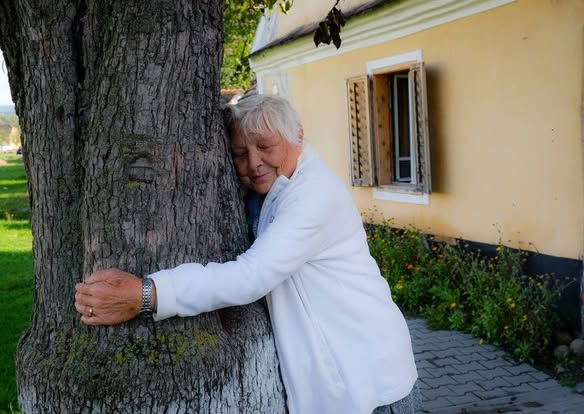
Sofia Folberth was born and lived her life in the Transylvanian village of Criț, even when she no longer lived there. Because, as she says today, ‘Heimat’ (Eds: the German word for home) is the place where you feel at home, what is inside you, what you have here, inside you, she says pointing to her heart.
She remained in Romania for a long time, before reuniting with her family in Germany at a late age. She carried her roots with her, for a while, far from home. But she didn’t stay there, returning year after year to her home in Crit before she began to look through the archives of the local Saxon church, to sweep the church, to get rid of the cobwebs. She discovered old documents which were written from 1615 to 1991.
Her community had fallen apart, but the written words remained. She took everything she found after the Saxons left to the sacristy of the Church and began to write. She had no pencils, no paper. She asked the police for a sheet of paper and wrote on the back of calendars.
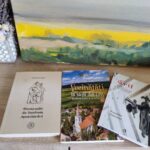
All alone, Sofia and her conscience were recovering the history of the place; writing it down and memorizing. Sofia practiced forgetting. Thus, she became the source and protagonist of some literature about her small village, a symbol of Saxon culture and history in Transylvania: “Criț.The history, stories and life of a Saxon village” and “Neighborhoods of the Saxons of Criț. Written ordinances from 1615 to 1991”.
Any traveler that cared to visit the Fortified Church of Criț over the years
has listened to her telling tourists from all over the world about the village history and its church. Sofia did everything she could so that time would not bury the village’s past. So that past lives were remembered. Since the Haferland Festival began in 2013, she has been the soul of this Saxon celebration that brings back all those who have not forgotten to their ‘Heimat.’
The joy of living
Sofia Folberth was born in the first quarter of the last century, on June 29, 1922, on St. Peter and Paul’s day when the Saxons used to place a wreath of flowers at the entrance to the village. After the celebrations on that day, all the villagers went to the theater – improvised in a shop, where a troupe of amateur actors from the village acted out ‘The White Horseman. ‘Towards the end of the play, just when it got more exciting, Sofia’s mother was in labor. On the way home, the woman said to her unborn child: “Couldn’t you have waited a little longer so I could see how it ends?” Sofia, was the first born in her family and would go on to live everything that more than a century of history can throw in the way of a human being. She remembers every detail from her early years: what the car to ever passed through Criț looked like, what the colors decorated Queen Marie’s coffin (Eds: she died in 1938), the funeral procession she watched at Bucharest’s Triumphal Arch. She remembers the exact address where she worked for an industrialist family in
Bucharest. When she was 16, she was sent, like most young Saxons, to experience
life in the big city. Sofia went to the opera twice. The first show I saw was
The Marriage of Figaro. “I was dressed in my Tyrolean costume, but I didn’t fit in, because all the ladies were wearing elegant dresses. But that didn’t stop me going to another opera
because I liked the music.”
She was 20 when the war came to her doorstep. She was taken to a camp in Germany with a baby in her arms. She was recruited by the Americans to be parachuted into Transylvania to deliver messages to the partisans in the Făgăraș Mountains but couldn’t leave to leave her child with strangers. She helped as much as she could. She liked learning, was curious, and passionate about the stars – she found out that her passion was called astrology. She liked the liked the land, agriculture, listening to grown-ups speak, books. Everything!
She read the books she picked up from the school library on Saturdays, both for herself and for her father. The library of the school in Criț had 817 books. Sofia is a gifted orator. She’s a public speaker at meetings, various anniversaries and she captivates her audience. She speaks Saxon – an old Flemish version – and German, the language the Saxons wrote in, she knows Latin proverbs, and in the fourth grade, she began to learn Romanian at school, which was also the language that Romanian history was taught in. She learned about Petru Rareș (Petru Rareș was a 16th century Moldavian voivode or ruler) which was her exam subject. Criț has one of oldest school traditions in Romania dating back to 1593. In one article, the school principal says: “if our students
leave the village and do not know Latin and Greek, whose fault will it be? Theirs or ours?”” My father didn’t go to bed at night until he read something. Even a few pages from an agricultural calendar or a newspaper, anything, but he had to read something!”, says Sofia. From him she learned to work the land, to plant trees, to discuss the wider world. Sofia
absorbed everything.
We are like trees
“In our region, only men planted crops in the fields because it was grueling work. But one autumn my father took me with him and said: Sofia, let’s teach you how to sow wheat, because I am going to war, all the men are leaving, and you women must know how to sow wheat. He gave me a bag of wheat and I set off on the field. I was very proud of myself. He showed me how to throw the seeds by hand, taking them back and forth in rows, not an easy job know. You had to reserve ten centimeters at the end of every row and when you’d finished you have fewer grains in your hand. But I am so glad I sowed crops! I’ve loved working on the land all my life!
Seeing plants grow is like watching young children grow!” To make sure plants grow, you must not plant them in dead soil.” When you plant a seed, or anything in the ground, my father told me to be careful, the way the root is planted, as it needs sun, which gives it life and there are bugs and greenery around. Because if you plant it too deep, the earth is dead and nothing bears fruit from dead earth.”
In recent years, Sofia Folberth has listened to news about migration, conflicts, wars on the radio. She’s decided to tell her story of living with others, of the comings and goings
that enrich the world, in a future book.
‘We want to build bridges, not walls’ Haferland Festival showcases Saxon traditions
