












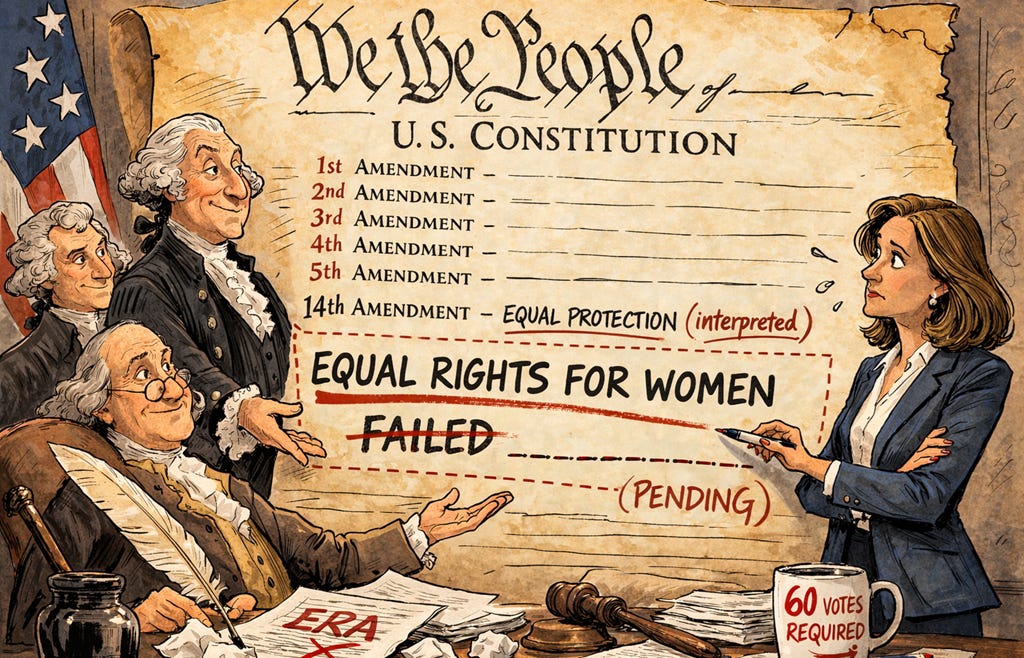
International Women’s Day should remind us that the US still has not managed to write a simple sentence into its founding document: that women are equal before the law
Many of the international “days” calling attention to various groups are, let’s face it, just a little bit lame. But we should make an exception for International Women’s Day, which was marked this weekend. A more righteous cause is difficult to envision.
For starters. this is a strange time to promote the cause of women, because the political demographic that in the past could be reliably assumed to favor feminism – basically the left – has been coopted by progressives who seem more interested in cancelling JK Rowling for claiming women and men even exist. Odd.
Moreover, what remains of feminists these day can look back with some satisfaction. Women, of course, vote (an amazingly new achievement, barely a century old). Women run companies. Women command soldiers, sit on supreme courts, and occasionally fly spacecraft. In many Western universities they now outnumber men. The pipeline of future doctors, lawyers, and professors increasingly tilts female. Compared with the world of even half a century ago, the transformation is remarkable. In fact, some men sense women are favored over them now in the job market, which — while not exactly true – needs examination.
But any fair examination would also conclude that the inequalities remain quite striking, and the work of feminism is not finished. And the most striking fact about women’s rights, at least in the United States, is how incomplete the legal foundation remains: the American Constitution, the oldest such document still standing, still does not explicitly guarantee equal rights between men and women.
This fact sounds improbable enough that many Americans assume it cannot quite be true. Surely somewhere in the founding document of the world’s most self-consciously constitutional democracy there must be a simple sentence stating that women are equal by law. But – unlike in most democracies – there is not.
Instead, gender equality in the United States rests largely on judicial interpretation of the Fourteenth Amendment, a clause written in 1868 to define citizenship after the Civil War. Beginning in the 1970s, the Supreme Court interpreted its “equal protection” language to prohibit many forms of sex discrimination. Those decisions created an important body of law protecting women in employment, education, and public life.
But interpretation is not the same thing as text. Most modern democracies do not leave such things to implication. Germany’s constitution dispatches the matter in a single line: men and women have equal rights. South Africa’s constitution spells it out with admirable clarity. Canada’s charter explicitly bars discrimination on the basis of sex. The United States — the country that likes to describe itself as the pioneer of modern constitutional liberty — has never quite managed to say it.
The Equal Rights Amendment was supposed to fix that omission. Its language is almost comically straightforward: “Equality of rights under the law shall not be denied or abridged by the United States or by any State on account of sex.” Congress approved it in 1972. For a moment it seemed inevitable that the amendment would become part of the Constitution. Then American politics intervened.
The country’s amendment process is designed to be brutally difficult. Constitutional changes require two-thirds support in Congress and ratification by three-quarters of the states. Indeed, it is aggressively and egregiously countermajoritarian, in ways that are devastating to democracy itself. The document is fatally flawed. So the Equal Rights Amendment came close but stalled just short of the finish line. A ratification deadline expired in 1982.
For decades the issue lingered in legal limbo — until a recent attempt in the United States Senate to revive it arose, and then collapsed. What was remarkable about that vote was how unremarkable it seemed. Almost every Republican senator opposed even allowing the amendment to move forward — as everyone knew they would. Republicans are insulated from the wrath of the people by the anti-majoritarian system than gives then a huge advantage electorally (more on that another time). The measure required a supermajority of 60 votes, there was no way to get enough GOP votes, and the effort died with a procedural shrug.
More curious still was the reaction — or rather the lack of one. Few senators felt the need to justify their votes in much detail. Even fewer observers seemed inclined to press them for an explanation. That is striking because the Equal Rights Amendment does not propose some elaborate social engineering scheme. It simply states that equality under the law should not be denied because of sex. One might imagine that opposing such a principle would inspire a bit of shame.
Yet in modern American politics there is a certain pattern. Positions that appear difficult to defend —opposing gun restrictions despite record firearm deaths, attempting to repeal health insurance for millions, or refusing to convict a president after an attempted election subversion — often proceed with surprisingly little explanation. It’s actually pretty simple. Politicians behave this way because they can. Republican politicians, mostly. The Dems have other issues.
Still, the story of women’s equality is not quite as simple as slogans suggest.
One fact is difficult to dispute: women remain underrepresented at the very top of economic power. Roughly half the American workforce is female, yet only about one in ten Fortune 500 companies is run by a woman, and women hold less than a third of senior executive roles. That gap is real.

But the interpretation is less straightforward than activists on either side sometimes claim. Running a global corporation is a peculiar career choice requiring decades of extreme work patterns —relentless hours, constant mobility, and a willingness to subordinate much of one’s private life to the job. It is entirely plausible that many talented women simply decide they would prefer not to live that way. Economists increasingly emphasize this demand-side explanation, particularly the way careers diverge after children arrive, when men’s earnings often accelerate while women’s flatten.
It used to be that generalizing about groups – men, woman, ethnic groups, whatever – was seen as somehow bigoted. Now the identity-addled far left seems if anything to revel in and insist on it. You cannot have it, then, both ways.
At the same time, a growing number of men believe the pendulum has swung too far in the other direction — that employers now prefer women. Diversity initiatives and a louder public conversation about discrimination have helped fuel that perception. Yet the empirical evidence offers little support for the idea that the labor market broadly favors female candidates. Hiring experiments in which identical résumés are sent out under male and female names usually show either no difference or a slight advantage for men. What the research does reveal is something subtler: bias tends to operate in both directions depending on the occupation. Women face obstacles in traditionally male fields; men face them in jobs stereotypically associated with women. The labor market still carries the imprint of old expectations.
All of which makes the current debate about gender occasionally feel detached from historical perspective.
Whatever the balance of forces today, one fact is beyond dispute: across most of human history women were not merely disadvantaged but systematically subordinated — legally, economically, and often physically. In many societies they were treated quite literally as property. For that, a massive correction was and is needed.
And the bad traditions have not entirely disappeared. In parts of the world they remain explicit policy. The Taliban’s restrictions on women and girls in Afghanistan — banning education, work, and basic public presence — amount to one of the starkest systems of gender repression on earth. The international response has been strangely muted, as if the systematic confinement of half a population were merely another regrettable cultural variation. That is a disgrace.
Against that backdrop, the United States’ constitutional omission takes on an almost surreal quality. A country that prides itself on the clarity of its founding principles has never quite managed to include the obvious one. So the debate about pay gaps, hiring practices, and corporate leadership will continue, as it should. But stepping back from the statistical trench warfare, there is at least one point on which agreement ought to be easy.
So if any cause deserves universal recognition, it is the simple proposition that half the human race should be free, educated, and equal before the law. Perhaps it will one day make it into the Constitution Americans so revere.
