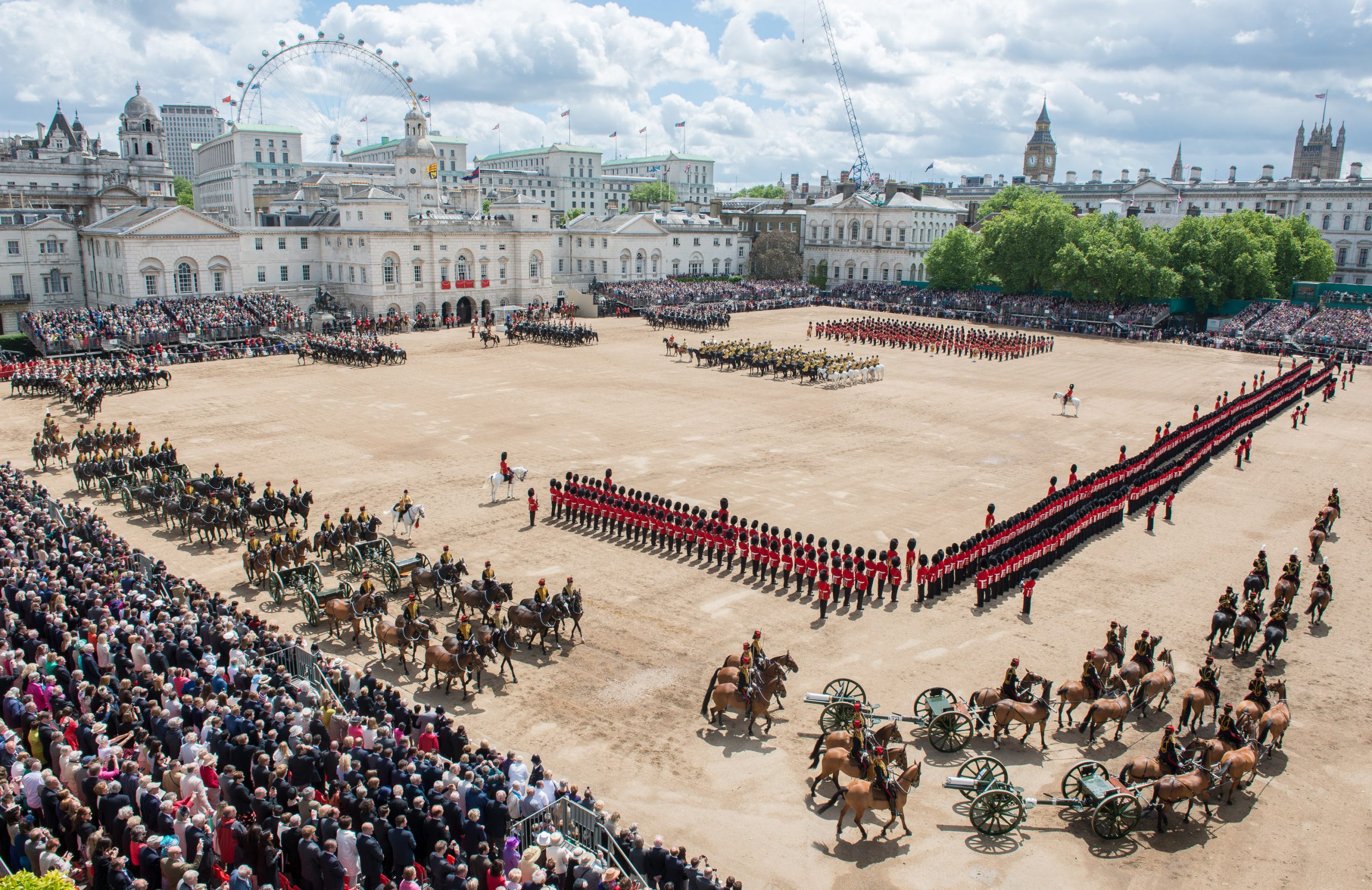
The Queen's Birthday Parade also known as Trooping the Colour, Horse Guards Parade, London, June 2013.
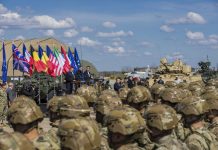
More than a thousand soldiers and horses from the Household Division paraded in front of their Colonel in Chief, Her Majesty The Queen, 15th June 2013, with the immaculate precision, colour and pageantry that marks them as truly World Class.
Later as the last shot of a 41 gun Royal Salute was fired from The Green Park to mark The Queen's Official Birthday, the skies roared with an impressive fly past from the RAF featuring 32 aircraft of 13 different types.
The centuries old tradition of Trooping The Colour has been held on Horse Guards Parade to honour the Sovereign's Birthday almost annually since 1805. Each year the Five Foot Guards Regiments take it in turns to Troop their Colour in front of the Sovereign. Colour is the name given to regimental flags of the British Army, and were used as rallying points as long ago as the Kings of Babylon.
In the Middle Ages, each Lord or Baron flew his banner as a sign by which his followers could distinguish him in battle. Colours were last carried into action by the 58th Foot in South Africa in 1881. Up to that time they participated in all the varying fortunes of their Regiment; were often torn by enemy fire and acquired an almost religious significance.
Even today, uncased Colours are invariably carried by an officer and accompanied by an armed escort.
This year, the Colour being trooped in the presence of Her Majesty The Queen, was that of the 1st Battalion Welsh Guards. The Welsh Guards have recently returned from operational service in Afghanistan where they worked as part of the Afghan Police Advisory Team assisting the country to achieve self governance. The Field Officer in Brigade Waiting, Lieutenant Colonel Dino Bossi, Welsh Guards, commanded the Parade.
Commonwealth leaders intend to defy the UK in a plan to examine reparations for the transatlantic slave trade, reports the BBC.
This open discord comes as a result of Downing Street refusing to address the matter of reparations at Commonwealth Heads of Government meeting (CHOGM), which is to begin tomorrow in Samoa.
Reparations would mean billions of pounds on behalf of the United Kingdom.
On his way to the Summit, the prime minister doubled down on the UK’s position, insisting calls for reparations for slavery were not on his agenda, preferring to focus on what he calls more temporal problems, such as those of climate.
The prime minister said there was “no question” that slavery was “abhorrent”, adding: “But I think from my point of view and taking the approach I’ve just taken, I’d rather roll up my sleeves and work with them on the current future-facing challenges than spend a lot of time on the past. That’s my focus.”
Labour MP Bell Ribeiro-Addy has warned the “Commonwealth will crumble” if the government does not reopen talks.
She said “an apology is absolutely free”, dismissing attempts to focus on the “here and now” rather than unpick wrongs of the past — just days after Aboriginal protestors demanded an apology from King Charles on his Australia tour.
The United Kingdom’s Prime Minister already has an important meeting set for the next year with a delegation of Caribbean nations over the issue. The 15 member states of the Caribbean Community (Caricom), who have previously set out formal demands for reparations in a 10-point plan, are planning a delegation to the UK in 2025 with an updated list of demands.
Sir Keir is the UK’s first Prime Minister to have visited a Pacific island nation, and will be in the company of King Charles, the head of the Commonwealth, during the gathering.