













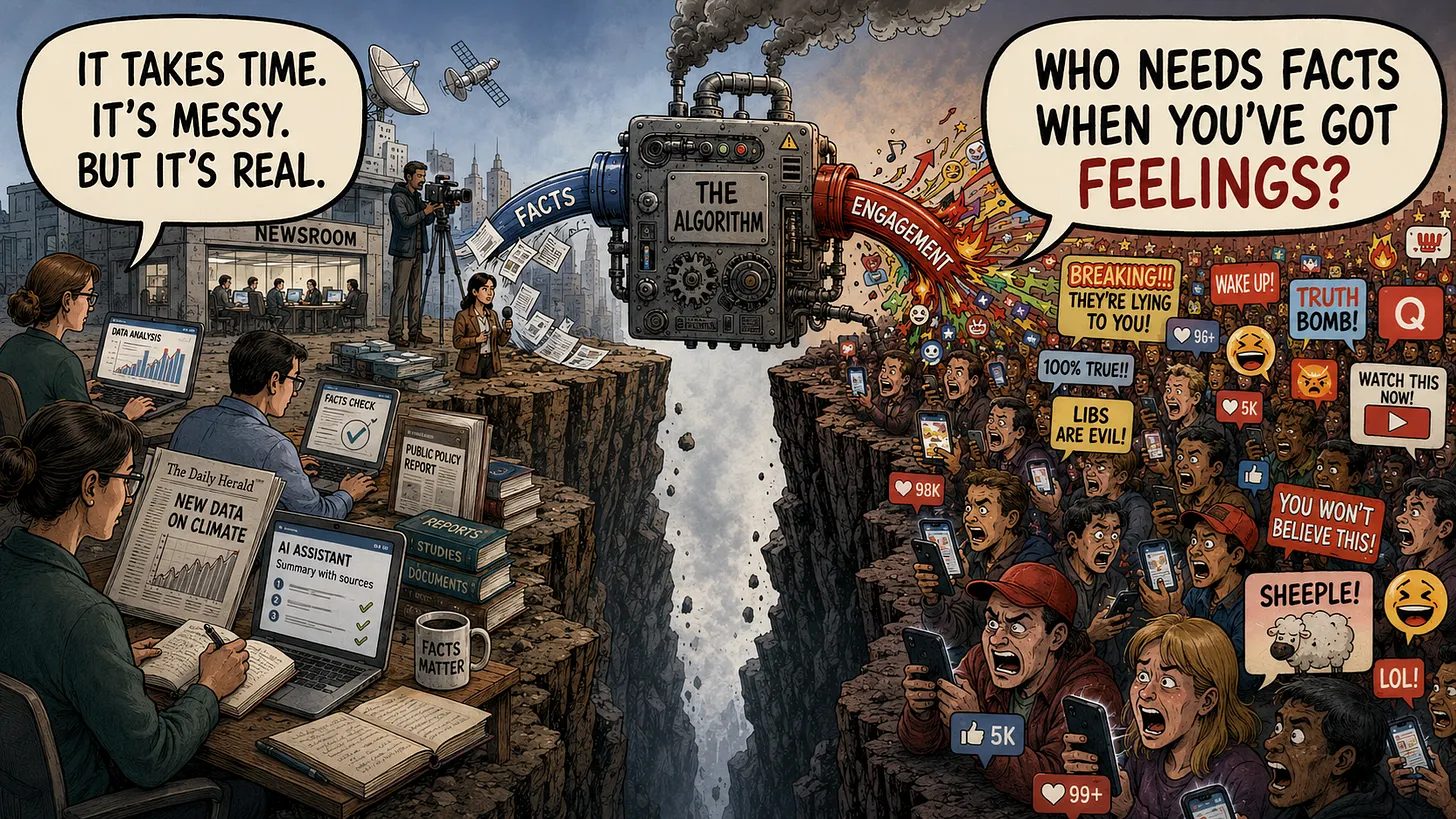
WEEKEND READ: The dangerous chasm between world of the informed and everyone else
The headline finding from the 2026 Reuters Digital News Report, released in recent days, was that for the first time, social and video platforms have overtaken both television and news websites as a source of news.
Fifty-four percent of respondents across dozens of countries said they had used social or video networks for news in the previous week, compared with 52 percent for television and 51 percent for news websites and apps. These numbers will deepen fears that journalism is dying. I see something even worse: What we’re witnessing is not exactly the replacement of one information system by another but the emergence of two increasingly separate information worlds.
The first world remains connected, however imperfectly, to the production of facts. It consists of business people, policymakers, investors, academics, professionals, and engaged citizens who seek real information and analysis – because they need it to make decisions. They may consume it differently than in the past, reading newsletters instead of newspapers, following individual journalists instead of media institutions, listening to podcasts instead of television broadcasts, and sometimes using artificial intelligence to summarize events. But the foundation still originates with reporters, analysts, researchers, and institutions attempting to establish what is true.
The second world is driven not by information but by engagement. It revolves around identity, outrage, tribal loyalty, entertainment, and emotional stimulation. News-related information exists there too, but in competition with propaganda, conspiracy theories, disguised advertising, influencer content, foreign influence campaigns, and malicious fabrication. The consumers of this world will not make great decisions on who to vote for or what to invest in.
Residents of the first world will pay top dollar for excellent platforms offering real journalism. They will probably be wealthier, and the advantage of being informed will make them wealthier still. Residents of the second will wallow in anger and jealousy, manipulated by shadowy interests and increasingly hating “the elites.”
And that is really the crux of the matter — because many will claim to find “elitism” is the very idea that real journalism matters, or even exists. This is the type of thing that sounds vaguely reasonable, but is not, and residents of the first world know it. It lives in the area code of denying there is truth and urging people to do their own research. It is bad faith, bad science and bad for society. Yet residents of the first world might benefit from it in a way: the more people run into a wall because they won’t believe the wall is there, the richer the elites will be.
And to the matter at hand: the shift in the consumption of “news” has been building for several years as social and video platforms gained ground while television and news websites lost it; what the study discovered is that we have finally crossed a tipping point. And while some people may not understand this, many are actually indifferent. The Reuters report shows that the proportion of people who describe themselves as even interested in news has declined sharply in recent years. That suggests many are migrating from news to “content.”

Some might argue that this is not really new. Every generation imagines its media environment is degraded. There were sensationalist newspapers in the nineteenth century. There were tabloids in the twentieth. There was talk radio, partisan television, celebrity gossip, and supermarket journalism. Serious consumers of information have always been a minority. Newspapers of record have always coexisted with popular media. There is truth there, but it understates how much has changed. The popular press was still press. Even the most sensationalist newspaper employed reporters who gathered facts and reported for editors, and they faced legal liability. Its standards may have been poor and politics objectionable, it may have exaggerated and sensationalized, but it remained connected to the production of news. It nodded in the direction of shared truth.
An influencer does not need to report anything. An anonymous account does not need to verify anything. A political operative does not need to investigate anything. A propaganda account or one representing a business interest is not beholden in any way to any semblance of the truth. And the algorithms do not distinguish between them and news – only between content that captures attention and content that does not. So journalism is no longer merely competing with inferior journalism. It is competing with content whose purpose is totally different, indeed opposed.
This directly leads to a critical consequence.
The old two-track system still revolved around a shared reality. A reader of a tabloid newspaper and a reader of The New York Times might disagree about politics or draw radically different conclusions from the same events – but they generally agreed on the existence of those events. They inhabited a common factual universe.
Today’s information environment is creating competing perceived realities. And only in one world does the truth matter very much. That development has profound implications for democratic societies, which depend on some degree of shared factual foundation.
Artificial intelligence adds another layer of complexity. According to the Reuters study, roughly one in ten people already uses AI chatbots as a source of news, and among younger people the number is significantly higher. That figure will almost certainly continue to rise.
Yet there is something fundamentally misleading about the notion that people are getting their news from AI. AI, unlike social media, sounds serious, but it does not gather news. It does not attend press conferences, investigate anything, interview anyone or travel anywhere. It does not discover facts – it reads, synthesizing information produced by others.
Reuters found that a majority of people who receive information through AI do not consistently click through to the original reporting – meaning they consume the summary while bypassing the source. That eliminates revenue for the people and organizations that hit the pavement and found something out.
The chatbot may become the interface through which users consume information, but the underlying knowledge still originates with journalists, researchers, experts, and observers who did the actual work of discovering it. It is another medium – not another source. If AI ends up killing the thing it is the medium for – real journalism – it will quickly become dumber, and outdated.
The implications of this disaster extend beyond journalism.
For much of modern democratic history, it was assumed that mass participation and mass information would reinforce one another. Better-informed citizens would make better democratic choices. Newspapers, broadcasters, and other journalistic institutions were imperfect, often biased, sometimes sensationalist, but they were part of a broader democratic project of creating a sufficiently shared understanding of reality for self-government to function. It was a business with a social mission. This can sound like a contradiction, and it wasn’t perfect, but it worked well enough, just barely.
If a relatively small segment of society remains connected to rigorous reporting, expertise, fact-based analysis, and direct engagement with reality while a much larger segment increasingly consumes information through algorithms, influencers, tribal communities, and emotionally optimized content, the gap between the elites and the broader public may widen dramatically. The more reality becomes the province of a minority, the more tempting it will become for some to conclude that democracy itself is an outdated mechanism.
We are already hearing versions of that from parts of the technology sector, which is experiencing a moment of hubris. Venture capitalist Peter Thiel famously argued that he no longer believed freedom and democracy were compatible. Others have not gone that far, but there is certainly growing skepticism about the capacity of mass publics to function intelligently in a bewilderingly complex world while zombified by non-information.
I remember what this looks like when I was based in Cairo as the Middle East Editor of the Associated Press. The military staged a coup in July 2013, ousting an Islamist government that had based its electoral support in large part on people who were illiterate and undereducated. Many friends and associates – professionals who’d certainly harbor democratic sentiment in developed societies – favored the coup because they had no faith in a majority of the people to avoid causing disasters at the ballot box.
The emergence of two information worlds is likely to bring some version of this paradox to Western societies as well. Citizens do not need to agree on policy. They do need to agree, at least broadly, on what is happening in the world around them. If a majority of the citizens think two plus two is five, we will have a problem. And we must prepare.
