













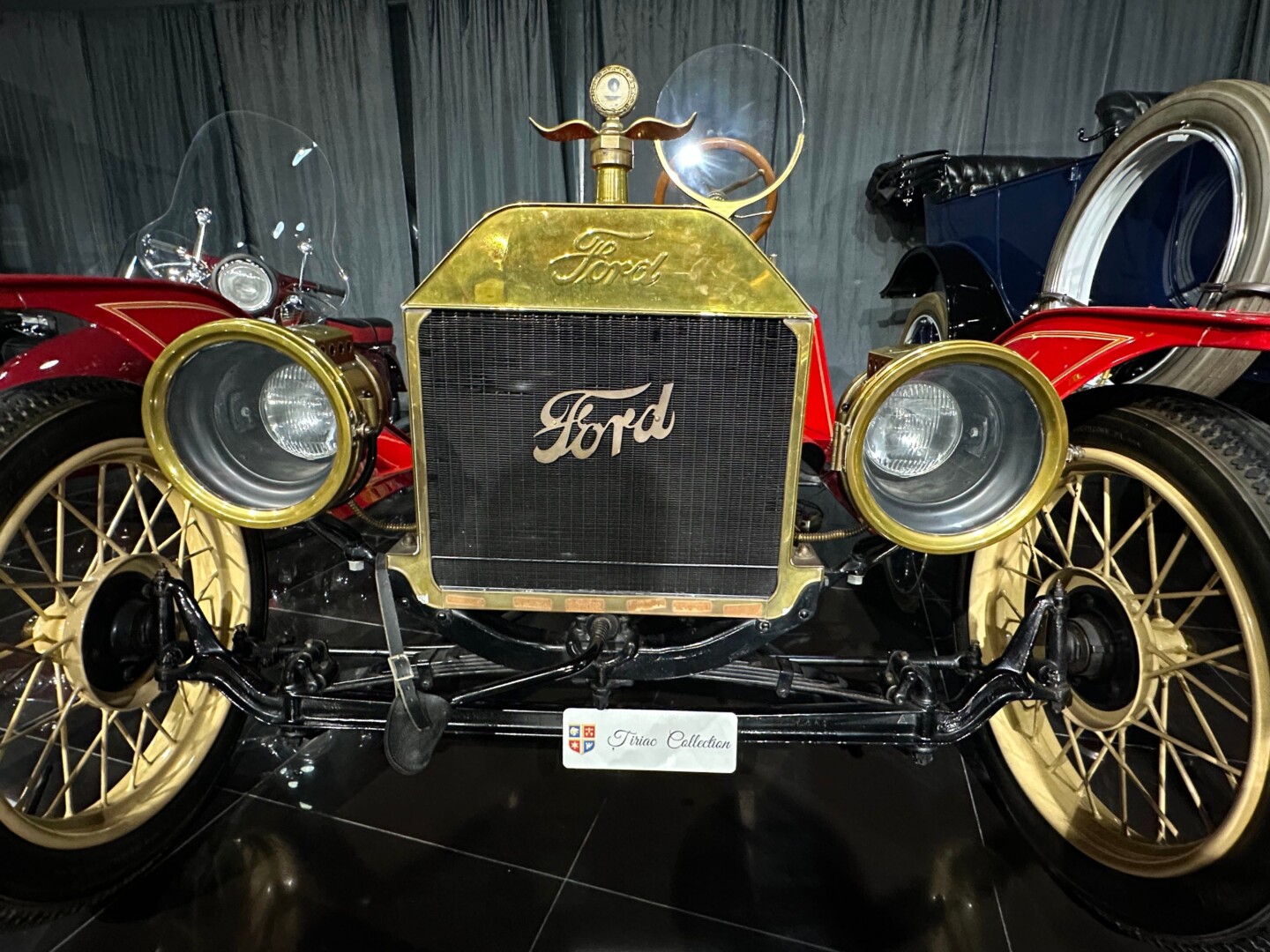
A museum that is a must-see for classic car enthusiasts, among the top five in the world, and weirdly unheralded
British rocker Sir Elton John, Sultan Mohammed Shah (known as the Aga Khan III), Hollywood entertainer Sammy Davis Jr. and Argentine power couple Juan and Eva Perón had precious little in common— except that all of them once owned luxury cars now displayed at a little-known museum in this Balkan capital.
The Țiriac Collection — one of the most underrated tourist attractions I’ve ever encountered — sits directly across a busy highway from Bucharest’s Otopeni International Airport. I discovered it totally by accident during a six-hour layover this past weekend, thanks to a fellow car enthusiast and license-plate collector who works there and introduced me to his boss, Andrei Dumitrescu.
“I was born in a garage, and I’ll die in a garage,” Andrei declared proudly upon meeting me. The Romanian-born auto mechanic came to Israel with his family at the age of 3, finished his army service and returned to Europe at 19. He’s worked here for 13 years, the last three as a manager.
“I’m not doing this for money. When I came here, I didn’t ask what the salary was; I asked what cars they had,” said Andrei, who speaks fluent English and Hebrew in addition to his native Romanian. But that kind of thinking went against conventional wisdom—and the wishes of his father. “He had his own shop in Haifa, and he was completely against it. There was so much money in repairing normal cars, he just couldn’t see a future in this, until recently.”
Despite the official “after sales manager” on his business card, Andrei said “we don’t sell anything, we only buy. This is not a business. It’s a personal collection that’s open to the public.”
That collection belongs to Romanian billionaire Ion Țiriac (pronounced tsee-ree-AHK), a former tennis and hockey champion who later went into business and earned a fortune in banking, insurance, airlines and retail sales. Țiriac, 86, is Romania’s top importer of Mercedes-Benz, Hyundai, Land Rover, Jaguar and Mitsubishi. As of May 2025, Forbes magazine put his net worth at $2.2 billion.
Indeed, money appears to be no obstacle; this Romanian is so rich, he even forgot that he owned a Ferrari F40, one of the most expensive vehicles ever made—and the first Ferrari capable of exceeding 200 mph.
Notably, while other car museums exist elsewhere, this is the world’s only gallery with a complete collection of all seven Phantom models in the I-VII series produced by Rolls Royce. Experts place the Tiriac facility as in the world’s top 5 by number and quality of cars on hand.
Among them is a green 1952 Rolls Royce Phantom IV—one of only 18 ever made—that once belonged to Aga Khan III, the 48th Imam of the Nizari Ismaili community. There’s also a pink-and-white 1962 Rolls Royce Phantom V bought by Elton John, as well as a yellow 1968 Maserati Ghibli Berlinetta owned by black Jewish entertainer Sammy Davis Jr.

In all, the Țiriac Collection covers 4,300 square meters of showroom space and has about 200 vehicles on display, including 45 Mercedes-Benzes, 20 Rolls Royces and 23 Ferraris. Another 100 are in storage or in various stages of restoration. They range in age from an 1899 Hurtu 3 1/2 Quadricycle to a 2025 Ferrari Daytona SP3 that was delivered only two weeks ago.
Notably, all models displayed at the Țiriac Collection gallery are fully functional, and are taken out for a drive once or twice per year. The majority of cars here are European, though plenty of large gas-guzzling American beauties can be enjoyed as well.
One of the 10 Caddys featured is the shiny black 1951 Cadillac 75 limousine that belonged to Argentine President Juan Perón and his famous wife, María Eva Duarte de Perón. Before arriving in Romania, this vehicle had been displayed at the Museo Evita in Buenos Aires.

About a dozen people work there, including tour guides, drivers and shop mechanics. This month, the museum will close for renovations and reopen in October with about 7,000 square meters of exhibit space. Admission is cheap even by Romanian standards: only 20 lei ($4.50) for adults, 10 lei ($2.25) for seniors and 5 lei ($1.13) for students; kids get in for free.
“My passion for cars started as a child,” Țiriac said in a May 29 press release announcing the expansion. “I wanted this collection to be shared with the general public, because when it comes to fascination for cars and speed, age is not a factor. Since we opened this gallery in 2013, thousands of children have stepped for the first time into the universe we have created here. It’s a huge joy for me.”
It’s difficult, of course, to put monetary values on such cars, but Andrei said probably the most valuable of the lot are a 1935 Hispano-Suiza M70, a bright-red 1937 Mercedes 540K worth roughly $5 million—only 83 were built—and possibly the 2014 F150 “La Ferrari,” said to be worth upwards of $7 million.
Despite its long years under communism, the museum has only a few cars manufactured in Eastern Europe. This includes a 1958 Trabant 601L —the most common vehicle in former East Germany—as well as a 1964 Volga GAZ M21 built in the USSR. There’s also a 1939 Ford Deluxe manufactured locally, when a Ford factory flourished in Bucharest before World War II.
Andrei said the museum attracts visitors from throughout Europe and all over the world, though “for some reason, people outside Romania know more about this collection than inside Romania.” Some 1,500 people visit per weekend in high season; the day I stopped by, there was a big noisy group of Bulgarian high-school students touring the showroom.
The Țiriac Collection seems particularly popular with Israelis, hundreds of thousands of whom have family ties to the once-large Romanian Jewish community. The countries are a two-hour flight apart and business, academic and cultural ties have thrived since Romania opened up to the world again after its 1989 anti-communist revolution.
“Some come just to visit the museum and go right back to Israel,” he said, recalling the recent visit of an extended ultra-Orthodox family of 15 to 20 people, as well as a young couple. “It was his 24th birthday, and she had brought him on a surprise visit here. He was very excited about the F150 LaFerrari 2014 so I started it up for him.”

Surprisingly, the collection does not include a single automobile owned by Romania’s ironfisted dictator, Nicolae Ceauçescu, who ruled Romania from 1965 to 1989 yet did not drive.
“We don’t own anything that belonged to Ceauçescu because we couldn’t find any,” Andrei said. “The few that remained in Romania after he was overthrown sold for stupid amounts of money, and most of them were smuggled out of the country before we started collecting.”
Larry Luxner is a veteran American journalist whose career spans Puerto Rico, the Balkans, the Middle East and the South Caucasus.
Romanian police officer denied right to a fair trial, European court finds
