














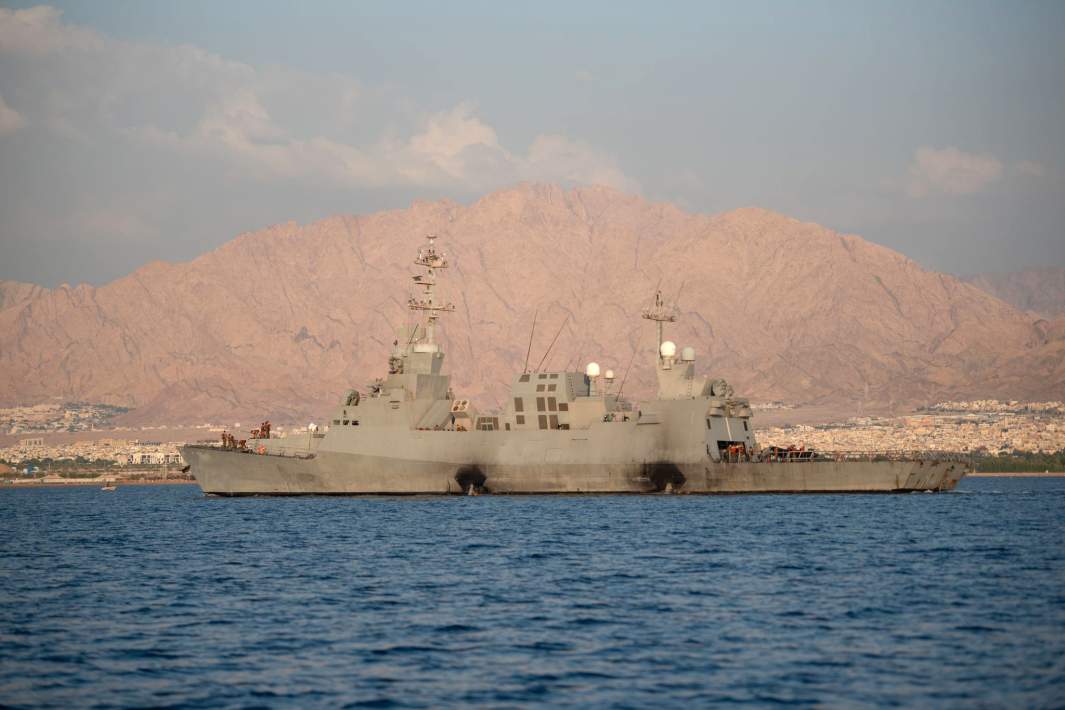
When dealing with thugs, carry a big stick
It’s rare for governments to not give a damn if their population gets crushed in stupid conflicts they start. Even the Nazi monsters can be assumed to have been saddened by the destruction in Dresden and Hamburg — but Islamist militias that take over countries seem to lack that functionality. The most recent entrant into this rogues’ gallery is the collective now known as “the Houthis” — featured in our weekend roundup a few days ago. They are making a big noise, so let’s take a deeper dive.
In recent years the Houthis have taken over much of Yemen, an impoverished place known for Frankincense, Myrrh, tribal warfare and a strategic location in the southern tip of the Arabian Peninsula. Their name makes them sound like an interesting ethnic group — but in fact they are an angry army of thugs named after their original leader from two decades back who hailed from the Houthi tribe.
The AP reports today that the Biden Administration is about to re-designate the Houthis as terrorists in the wake of the mayhem they have sown with maritime trade.. That’s a great start. It probably won’t be enough.
The group, which emerged as a factor from the 2011 wreckage of the Arab Spring, is backed by Iran. That may make sense because they are fellow Shiites, as is the case with another Iranian proxy that has stolen part of an unfortunate country, the Hezbollah militia in Lebanon. But it’s hardly a precondition: Iran also backs Hamas, Sunnis who have gleefully brought much misery to Gaza.
Mainly Iran backs fellow troublemakers. The clerics who run its benighted theocracy want to spread chaos around the Middle East, poke Israel in the eye, and undermine the West. Supporting the Houthis allows Iran to do all three, as we shall see.
In recent months, the Houthis have decided—or Iran decided for them—that they needed to show support for the Palestinians in Gaza.
Those Palestinians, as we know, have been pummeled by Israel ever since Hamas invaded the Jewish State on Oct. 7 and massacred 1,200 in an operation that featured gang rape, torture, dismemberment, burning to death babies, mowing down entire families, and kidnapping about 240 people ranging from infants to peace activists in their late 80s to field hands from Thailand.
A reported 14,000 civilians (and 9,000 Hamas fighters) have been killed in Israel’s resulting effort to remove Hamas from power in Gaza. Hamas clearly doesn’t care about the damage, collateral and otherwise, which is why it won’t surrender as its leaders hide in miles of tunnels surrounded by Israeli hostages and protected by their human shields, the poor Gazans, above.
Indeed, Hamas is almost certainly pleased at the carnage. The group made it inevitable by placing operations in every kind of civilian facility. Yet these deaths are a reputational calamity for Israel, which has been hauled before the International Court of Justice at the Hague on genocide charges.Hezbollah’s strategy and tactics are quite similar. Brave Lebanese have been petitioning Hezbollah to stop shelling Israel (a 79-year-old Israeli woman and her son were killed this week), for fear of all-out war. US officials this week warned them of the same. Hezbollah doesn’t care. If Israel were provoked into battering Beirut, Iran would be delighted. No one who knows the mullahs would deny it.
And what about the Houthis? Well, they might not actually revel in drawing deadly fire upon Yemen, a country that according to the World Bank at this point has a per capita income of about $50/month — close to the bottom of the world’s barrel. But their actions show that, in precise accordance with the script, they do not mind it.
When I was the Middle East editor of The Associated Press our staff won the Pulitzer Prize for an expose on the misery in Yemen. We found horrific torture in prisons run by the Houthis, theft of food aid, rampant use of child soldiers, and much more. As a result of the Houthis’ stubborn war with the internationally-recognized (but inept and corrupt) government as well as the Saudis (backed by the UAE), some 400,000 Yemenis — over 1% of the population — have died from war, starvation, torture, and cholera.
Even since October, the Houthis have risked yet more Yemeni lives in provoking Israel by firing missiles in its direction. Israel’s world-class air force can reach Yemen in an hour, and so can the country’s nuclear weapons.
Mainly, though, the Houthis have shelled and sent attack drones against scores of ships headed to the Suez Canal through the 25 kilometer (15 mile) wide Bab-el-Mandeb, which controls access to the canal for shipping on its way from the Indian Ocean and Persian Gulf to Europe. As I wrote on Sunday, while Yemen in no way owns the passageway, anyone controlling its port of Aden — as the Houthis do — can disrupt the flow of ships. If they are reckless and stupid enough.
The stakes are huge: the Suez Canal accounts for almost a third of global container traffic, about an eighth of the world’s maritime trade, and a tenth of the crude oil.
Already, this outrage has spooked major shipping companies, many of which have started to circumnavigate Africa instead. This could upend supply chains and drive global inflation and leave industries that are reliant on just-in-time manufacturing without components and raw materials. That means consumer goods—the automotive, electronics and consumer goods sectors among many—become scarcer and thereby more expensive. The Houthis are thumbing their noses at the United States (the world’s most powerful military) and—with the exception of Iran—essentially the entire world. Already traffic through the canal has dropped by a third or more. That’s very bad for Egypt, an important country that depends on fees paid by ships for passage through the canal for a quarter of its foreign currency revenue.
Allowing this is madness.
On Dec. 18, the United States announced a new task force to patrol the area, with both Western and Arab countries involved. The U.S. has an aircraft carrier and destroyers there. And last Thursday the U.S. and Britain finally counterattacked.
Houthi targets were struck with precision-guided munitions, including command and control nodes, munitions, depots, and launching systems.
At least five people were killed, but the Houthis promptly announced that their capabilities were not degraded. A spokesman defiantly warned of “a bigger” response (see below). Defiance is the mode for these militias-cum-governments, no less than the use of defenseless “human shields.” (Question to campus “progressives’“: Who here is “the oppressor”?)
It would appear that more strikes are needed to defend global maritime trade from international outlaws. Or, just maybe, more than strikes.
It’s possible that part of the reluctance comes from Saudi Arabia because of a truce signed with the Houthis that has prevented attacks on the kingdom since 2022. The long war with Yemen included the targeting of facilities of Saudi Aramco, which itself handles a tenth of global oil output.
Indeed, some will say that the Houthis cannot be subdued, pointing to the failure of the same Saudis—with U.S. support—to dislodge them. But the naysayers would be wrong. It is one thing to try to remove militants from their strongholds, as Israel is discovering in its prolonged and messy invasion of Gaza. It is something else to get them to back off attacks. Israel learned that, too, in previous rounds of fighting, when the goal—achieved each time—was to get Hamas to stop firing rockets.
It is not assured, but enough firepower should be able to get the Houthis to back down. It would also be a useful signal to Iran that its mischief is not without consequences. That is better than risking an attack on Iran itself, especially since former President Donald Trump’s idiotic pullout from the nuclear deal has left Tehran on the nuclear threshold.
Projecting weakness and indecision with the Houthis — and therefore with Iran — is positively Chamberlainesque. It will only whet Iran’s appetite while handing it a massive victory in the form of global economic mayhem. I am by no means a warmonger, as readers of this publication might have noticed, but this much is clear: If the Houthis don’t back off immediately and completely, they should feel the full might of Western power.
