










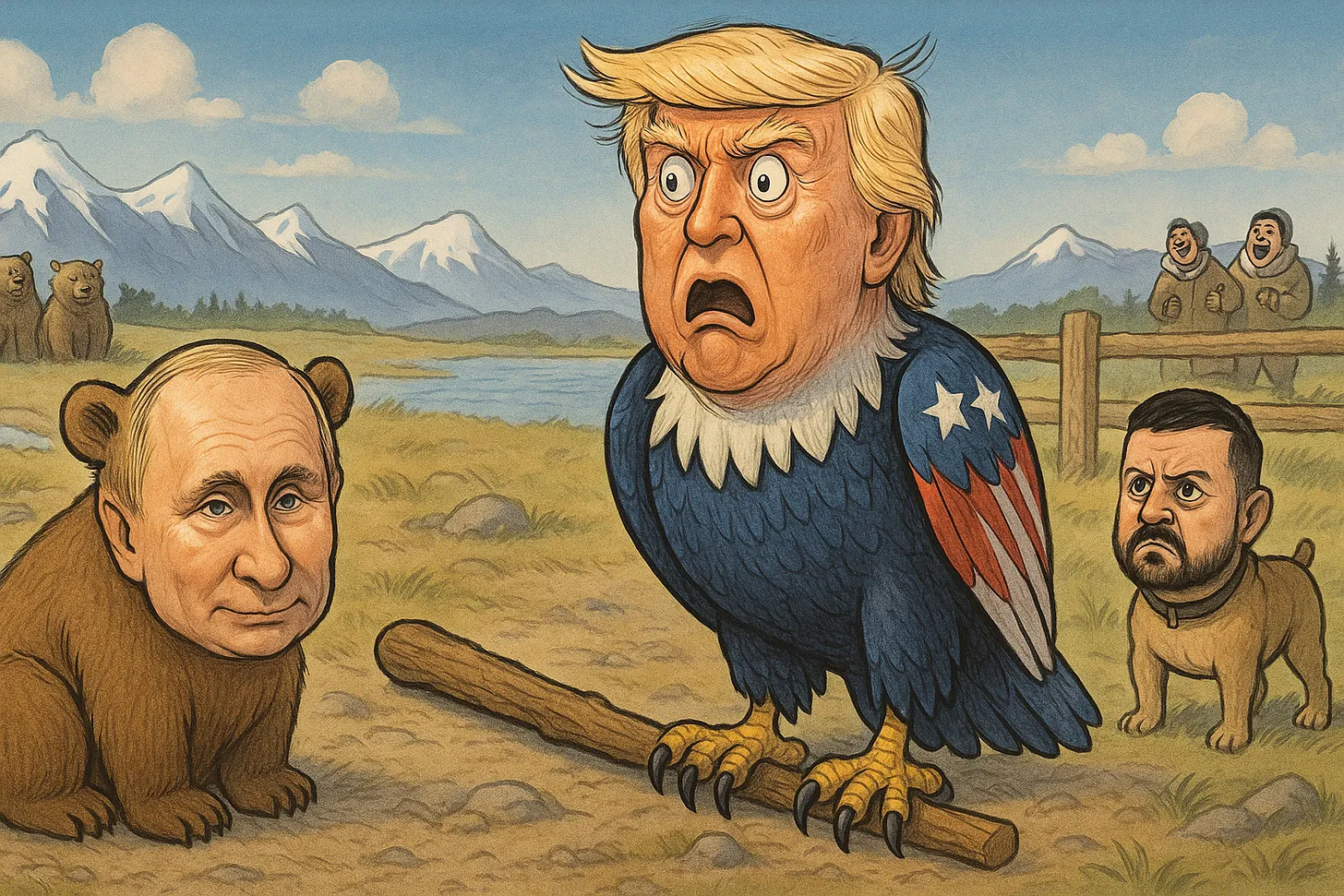
He’s trying to sell out Ukraine on Aug. 15, but even that might not work without massive pressure on Putin.
Trump evidently believes that Vladimir Putin has finally been persuaded to settle for less than the total conquest of Ukraine — specifically, for control over the Donbas region in the east. That’s why Friday’s meeting with Putin in Alaska — one of the few places the dictator can go to without fear of arrest — was set up.
It’s clear that this is a sellout of Ukraine and appeasement of a dangerous aggressor. What’s not clear is whether Trump is being played by the wily, obsessive and unscrupulous Putin. For Trump to avoid again looking like a chump, he will need to carry a very big stick. With it, he needs to organize some serious compensation for Ukraine and leverage against Russia.
The outlines of what the likes of Trump consider a reasonable “deal” are familiar: Russia retains roughly a fifth of Ukrainian territory in exchange for a ceasefire and some form of security arrangement that halts the war. Essentially Russia is paid off — but given its losses in the war, it also has good reason for regrets.
We don’t know whether Putin would actually agree, and if agreement might not be a trick; all we know is that something encouraging was passed off through the inexpert offices of envoy Steve Witkoff. And no less an obstacle may be Volodymyr Zelensky. Over the weekend, the Ukrainian president reiterated that “we will not give our land to the occupier” but also left the door open to “real decisions” for peace. Zelensky emphasized that this means Ukraine must be at the table, yet Trump and Putin plan to meet without him. Theirs is a game of great powers with spheres of influences and vassal states that can be bullied.
Despite his inartful ways, Trump does not lack bargaining chips on both sides to end the war.
The most immediate is the secondary sanctions package scheduled to take effect this month. These would impose tariffs and other penalties on countries buying Russian oil, effectively forcing governments to choose between discounted energy and access to the American market (it sets up a major conflict with India, which has made a hefty profit off buying, and trading, discount Russian crude). The threat has been enough to rattle Russia’s trading partners — and, if maintained, could pressure Moscow toward compromise.
Ukraine also has a fresh offer of military support from NATO countries, one that Trump himself endorsed with Dutch Prime Minister Mark Rutte last month. It allows NATO states to supply Ukraine with U.S. and other weapons and ammunition for the foreseeable future. That guarantee of ongoing Western backing makes it less likely that Kyiv can be coerced.
If Zelensky is to contemplate a deal that cedes territory, which would probably involve the areas currently occupied by Russia, he would be wise to demand compensations that go beyond words.
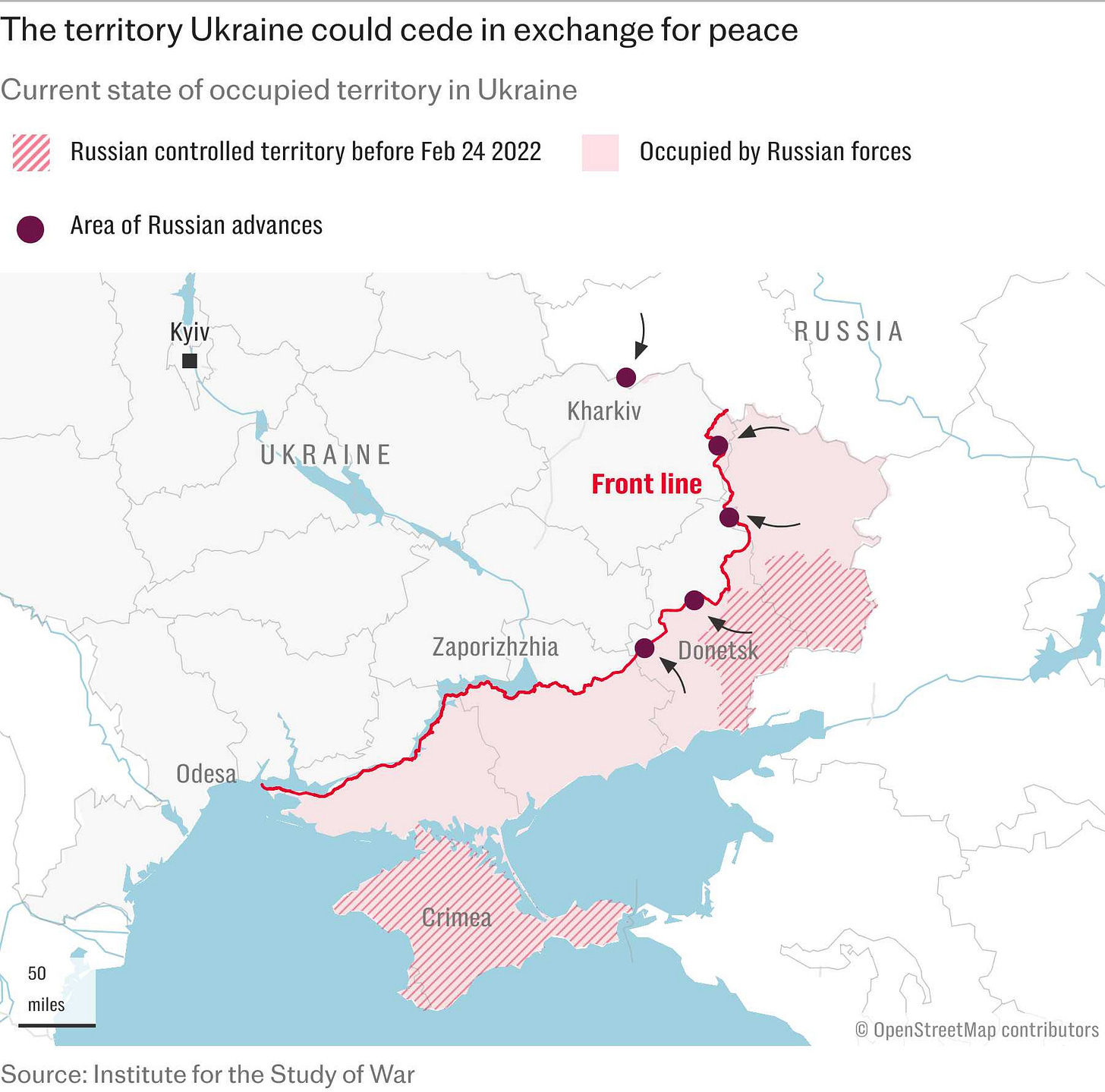
They will need to be concrete, enforceable, and immediate. Given the nature of things, he will need Trump to represent him at the table, beginning with the Alaska meeting. The core elements of a deal acceptable to Ukraine might include:
1. EU Membership – Ukraine’s fast-track admission to the European Union would give it a secure economic and political anchor in the West, even without NATO membership. Brussels will inevitably invoke its process and the need for reforms — especially on corruption — but events have overtaken bureaucracy. Ukraine has earned the right to be integrated fully into Europe. Trump can strong-arm Europe.
2. Reparations for destruction – Russia should be required to pay, directly or indirectly, for the rebuilding of Ukraine’s cities, roads, and energy infrastructure. This is a moral and practical necessity given the estimated half-trillion dollar reconstruction cost over the next decade. Frozen Russian funds – estimated at over $300 billion – can be applied toward this.
3. Return of abducted civilians and prisoners – Thousands of Ukrainians, including children and political detainees, are believed to have been taken into Russian custody since the war began. Their safe return must be non-negotiable.
4. A binding non-aggression agreement – Russia’s invasion shattered trust across the region. Any settlement must include a formal pledge, with verification mechanisms, that Moscow will not attack Ukraine again or undermine its sovereignty through covert means. Given Russia’s interference in recent decades in Moldova, Georgia, and other former Soviet republics in addition to Ukraine, this guarantee must be broad and backed by enforceable consequences.
These provisions would not make the loss of territory painless, but they could give Ukraine a secure future within the European sphere and the breathing room to rebuild. They will be hard to extract form Putin – but that’s what negotiations are all about. Trump – and, more to the point, Trump’s team – need to come armed with carrots and a very big stick.
The stakes are high enough for some chances to be taken, since the war’s toll is staggering.
Ukraine’s economy has contracted by roughly 20 percent. Daily military expenditures are estimated at $140 million, totaling about $51 billion a year. Western nations have poured more than $100 billion in aid into the fight, but the damage is overwhelming: millions displaced, tens of thousands killed, and over 10,000 civilian deaths documented.
Russia has paid heavily as well. By mid-2024, its war bill had reached $250 billion, with defense spending consuming 40 percent of the government budget this year. Falling oil and gas revenues have deepened the strain. Many tens of thousands of Russian soldiers have been killed — a human cost that would be politically unsustainable in a more open society.
That Putin has been willing to bear such losses to enlarge the world’s biggest country by a marginal amount is a testament to the pathological nature of his rule. That pathology is unlikely to vanish – which is why any deal must not simply stop the shooting, but guard against the next war.
If Trump can do that, he may indeed bring the war to a close. If he can also force Netanyahu to end the Gaza war, a Nobel Peace Prize ceases to be absurd. History works in strange ways, through the most bizarre of agents.
