









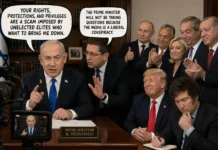

The secret Trump-Putin campaign, aimed at forcing Ukraine’s surrender, has been met with reservations, regrets and stupor all over the world – from the US to Canada, from Europe to Asia.
This states who view it negatively are concerned about both the form and the substance of the plan, because in the Trump era everything was perverted: even Washington’s way of doing diplomacy underwent a genetic mutation that turned it into Frankenstein.
In the first 24 hours since President Donald Trump publicly assumed the plan, the international press has swiftly and clearly exposed the primitive and unprofessional framework in which a document of such importance was conceived: in the family, with a few real estate business companions and in perverse partnership with the aggressor state.
Procedures, mechanisms, key institutions in the American diplomatic and governmental universe have been excluded or, in a few cases, rendered irrelevant by the president-mogul, who returned to the White House a year ago.
Not to mention that a prestigious publication, The Guardian, even raised the suspicion that the American text could have been written in Russian, given some of the clumsy expressions in English, following a clumsy translation from the Cyrillic original.
This type of approach, at the level of the United States of America, is a shock in itself, a shock no less comparable to that caused at the global level by the actual content of the 28-point document.
It’s no wonder that the U.S. G20 partners rejected it outright and almost instantly. It is not surprising that for Donald Trump, the only way out of this new trap into which he has let himself be led by the hand of his counterpart Putin is either to deny him suddenly or to deny him in slow motion.
Don’t worry, the American leader is good at burying his own aborted projects – he has been through this so many times, including related to peace in Ukraine. And he went through this, in no year of mandate, as his predecessors did in four or even eight years.
Returning for a moment to the content of the secret Trump-Putin plan, it is worth noting that, corroborating it with the other Trumpist peace initiatives concerning all of Ukraine, but also Gaza, a stinking inclination towards commonness persists in the mentality of the US leader.
In the previous episodes, his way of conducting business manifested itself as follows:
- By modifying US aid to Ukraine so that it becomes a pure act of sale and purchase: in which Europeans put in the money, the US collects, and Ukraine receives.
- Through Trump’s famous plan for access to Ukrainian minerals, the blackmail is directly applied to the country that has been attacked.
- Through the odious idea of banishing the Palestinians from Gaza and turning the strip into a real estate paradise by the sea.
And now, we have the 28-point plan, and right in the middle of it – point 14 – has the following provision:
- << The frozen funds will be used as follows: $100 billion of frozen Russian assets will be invested in US-led reconstruction efforts and investments in Ukraine. The US will receive 50% of the profits obtained from this operation. Europe will add $100 billion to increase the amount of investment available for the reconstruction of Ukraine. The rest of the frozen Russian funds will be invested in a separate US-Russia investment vehicle, which will implement joint projects in specific areas. This fund will aim to strengthen relations and increase common interests in order to create a strong incentive not to return to conflict. >> (the emphasis is mine)
So, from Trump’s point of view, the war only makes sense if it also produces dividends of billions or rather tens of billions of dollars – for Trump’s America and for Putin’s Russia, of course, not just for Zelensky’s demolished Ukraine or for Europe. Moreover, Europe is called upon to allocate the sum of 100 billion.
The Trumpist appetite for “strategic” behavior is somewhat understandable in terms of his purely transactional philosophy of life. It must also be understood in terms of the gaps that Trump has to cover in the economy due to the inequalities caused to his country’s tariff dynamics, just as Putin is also interested in the situation due to the misfortunes caused to his country’s economy by this unfortunate war.
It remained for the architects of this peace plan to introduce a point that would oblige Ukraine to pay war reparations on Russia’s behalf.
It’s hard to say why they didn’t; after all, it doesn’t seem like something much more out of the ordinary than most of the other provisions.
The red lines violated by the White House through the secret Trump-Putin plan are numerous, odious and cross the entire spectrum – from international law, to the treatment of the victim to the functionality and prospects of the US’s strategic partnerships and alliances.
For a long time, Donald Trump’s fans and detractors, both domestically and internationally clung to the hope that:
- Behind the peeled façade, there is a solid plan.
- The “madman’s theory”, associated with Nixon, is the exceptional instrument with which Trump (himself a fan and “practitioner” of Nixon; for a while the two also corresponded).
- Behind some apparently foolish statements and tactics, they are waiting for the optimal opportunity to manifest plans and strategies of unprecedented intelligence.
But what do we see? The king of Washington is naked! He is so bare that the peak of what he has produced so far in the Russian-Ukrainian file has been the Frankenstein plan in 28 points. And before that, some slightly more timid watered down variations of it.
Punishing the victim, rewarding the aggressor and undermining allies – that’s what the new Trumpist peace plan for Ukraine can be reduced to, that’s how much the first year of Trump’s second term as president is reduced to.
What will happen after this plan appears? It’s somewhat simple:
- One option is that Trump will change his mind about his position on Russia and Ukraine.
- Either – even if Trump does so – something undesirable to Putin will happen, somewhere in Russia or somewhere in the corridors of the Kremlin.
- Or something will happen to Putin himself.
- Or, in the meantime, a crisis breaks out elsewhere.
Each of the elements listed above is perfectly possible; each can trigger broad and deep resets; one of them will also take place before the others; and the one that will happen will influence the current state of the others.
Until then, the war in Ukraine will continue.
Time for Europe and Ukraine to push Trump into the corner of the ring
