













A world order that leaves out the US may be unlikely — but given what Trumpism represents, it would not be undeserved for a while
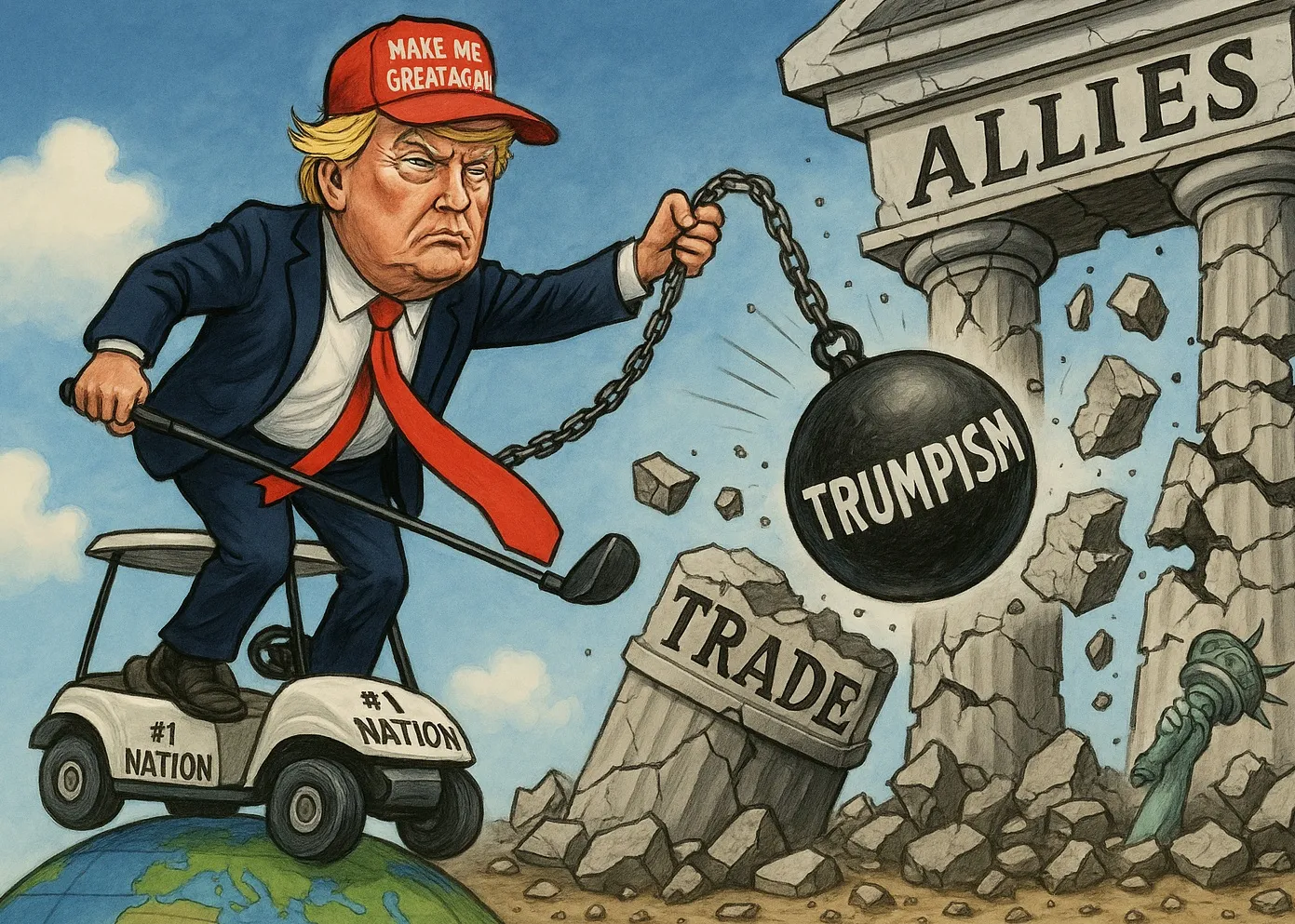
As Donald Trump and his allies dismantle the global system America once championed, the rest of the world faces a choice: brace for chaos and kiss the ring — or forge, at least temporarily, a new order that promotes democratic principles but largely excludes the US while leaving the door open for a future less bullying America to return.
This would have been unthinkable not long ago. But Trumpism’s assault on two essential pillars of the postwar global consensus — multilateralism and liberal democracy — is making it seem necessary to many around the globe.
These two pillars helped expand prosperity, reduce war, and uplift billions. They were indispensable in facing challenges like pandemics, cyberterrorism, and climate change. Trump and his imitators seek to replace them with something cruder: economic nationalism and elected autocracy, with each country fending for itself and each person on their own. Their logic is that America is the strongest, so why the hell not.
Here’s what I’m talking about:
The First Pillar: Multilateralism
Multilateralism means sovereign nations working together, within rules-based institutions, to address problems. Trump rejected this outright. His administration undermined the World Trade Organization, the United Nations, the Paris Climate Agreement — and NATO, the very embodiment of the alliance. And the World Health Organization, which he pulled out of without any logic.
Though the US dominates NATO militarily, it contributes just 16% of the common budget — about the same per capita as Germany — and does not unilaterally control the alliance. This has irked Trump, who has declared NATO “obsolete,” lied about the US share, and shown disdain for its collective commitments.
Next, his tariff war rests on the notion that imports are inherently harmful. The Peterson Institute for International Economics estimated his tariffs on China, Canada, and Mexico cost the average US household over $1,200 per year. Historically, tariffs have caused major damage. The Smoot-Hawley Tariff Act of 1930 worsened the Great Depression by triggering retaliation.
Only after World War II, with the GATT and later the WTO, did global trade recover. Today, trade exceeds $25 trillion annually and average tariffs are down to 2.5%. Trump’s unilateralism threatened all this. These global institutions are part of a bulwark against a return to nationalist chaos. They were created after World War II to prevent World War III. One should recall the maxim about forgetting the lessons of history.
The Second Pillar: Liberal Democracy
Trumpism also redefines democracy as a contest of popularity: win an election, and rule without constraint. It dismisses civil liberties, judicial independence, and press freedom. This mirrors the ideologies of Viktor Orban in Hungary, Erdogan in Turkey, Modi in India, the Law and Justice Party in Poland, and increasingly, Netanyahu in Israel. According to Freedom House — which Trump undercut by slashing foreign aid — 2024 marked the 19th consecutive year of democratic decline, with rights worsening in 60 countries.
This worldview sees rules as weakness and ideals as naïveté. Trump’s America doesn’t want to lead the world — it wants to dominate or isolate from it. That’s a dereliction of the American role in promoting liberty and truth.
The appeal of illiberalism is no mystery. Across the world, fascist forces have weaponized wedge issues amplified by social media and simplistic populism. Immigration, for instance, is both an economic necessity and a cultural flashpoint. Progressive overreach, inequality, and instability have fed public anger. But liberal democrats have failed to explain how autocrats actually harm the very people they rally.
I tried to explain it recently in a discussion with Mitch Albom (of Tuesdays with Morrie), the bestselling author-turned-radio host. I called it “the global tussle between democracy and authoritarianism” and claimed that “Trump is obviously an authoritarian, which is weird.” Give it a listen:
If Trump’s America walks away from its postwar responsibilities, the world has a number of options. One is to grovel and play along, which is what he bragged about after his tariff assault, when he claimed that foreign leaders were lining and “kissing my ass” and saying “please, Mr. President.” I guess there are some people who think this is cool.
Another option, which I think would be my own inclination, would be to wait it out. National dignity, like personal dignity, has no price.
A third would be to call his bluff. Done wisely, this could help Americans recognize the strategic failures of the populist right. Trump’s global strategy involves supporting anti-democratic takeovers around the world. Now, core NATO countries are boosting defense spending and cooperation, anticipating that US leadership can no longer be counted on.
If Trump pulls out, a new alliance may emerge. But other possibilities — economic and political — are interesting to contemplate.
- A Global Economic Alliance: One idea is a broad, low-tariff economic bloc of countries committed to not weaponizing trade. They could cap tariffs at 10%, resolve disputes through arbitration, and signal that interdependence still matters. This bloc wouldn’t need to exclude non-democracies. It might include the EU, UK, Japan, Canada, Mexico, Chile — and even China or India, if they play by the rules. When Trump abandoned the Trans-Pacific Partnership, the remaining members formed the CPTPP, now covering 15% of global GDP. While the US accounts for about 10% of global exports and 13% of imports, it is not irreplaceable. A united bloc would render bilateral extortion tactics ineffective. The message: we will not be divided and conquered.
- A Values-Based Democratic Bloc: Another option is more symbolic but also practical: an alliance of liberal democracies committed not just to trade, but to civil liberties, press freedom, and minority rights. Think of it as an expanded EU — or what America used to represent. This would exclude countries like Hungary, Turkey, India, and Israel under its current coalition — and possibly the US under Trump. The alliance could support election security, regulate social media, encourage academic exchanges, and promote joint infrastructure and cybersecurity. It would be a sanctuary for truth in an age of disinformation. It would affirm that democracy is about values, not just elections — and that those values lead to prosperity and legitimacy.
This is the fight we are in. Trump’s approach is based on a great deal of ignorance about, well, everything — but also an intuitive brilliance about how to manipulate people. What is indisputable is that it runs counter to what the United States has stood for over the past century. Which is to say, more than just another big country throwing weight around in Alpha Male fashion. Such countries can be empires for a while — but every single empire in history eventually collapsed. America was supposed to be immune to collapse.
That’s the fight we’re in. And you know what? If clarity requires sidelining the United States for now, so be it. I’m not predicting this or calling for it. I am saying moves and thoughts in this direction would be a justified comeuppance for the country that I left as a young man, intending to travel the world with the reassuring conviction that I represented a force for good.
As a shining city upon a hill.
